The Business Case for Sustainable Travel : Why Responsible Tourism Is a Strategic Advantage for Travel Professionals
The Business Case for Sustainable Travel in India | A B2B Guide for Tour Operators & DMCs
B2B Strategy Brief · India
Responsible tourism has stopped being a niche and started being the model.
For international partners selling India, sustainability now sits alongside price and product as a core reason travelers — and the operators who serve them — choose one itinerary over another.
The Foundation
Four commitments define sustainable travel
Every credible sustainability claim in tourism traces back to one of these four pillars — the same four in the diagram above.
Environmental care
Minimizing footprint through efficient operations and low-impact routing.
Community support
Directing spend toward local economies rather than external intermediaries.
Cultural preservation
Protecting heritage sites and traditions from the pressures of mass tourism.
Ethical practice
Building operations that hold up to scrutiny from clients and regulators alike.
The Business Case
Five reasons sustainability pays for itself
Beyond the ethics, these are the commercial mechanics that make responsible tourism a growth strategy rather than a cost center.
Travelers from Europe, North America, and Australia are actively seeking eco-friendly stays, community-based experiences, and lower-impact travel — and choosing the operators who can already deliver them.
Sustainable and eco-luxury experiences tend to command stronger margins, better retention, and higher perceived value — sustainability now reads as quality and exclusivity, not compromise.
Responsible practices build credibility and differentiate a brand in a crowded global travel market where most itineraries look interchangeable on paper.
Protecting natural resources and cultural heritage keeps a destination sellable for decades, not just for the next booking cycle.
Responsible operations align with global sustainability standards, reducing regulatory exposure and protecting the brand from reputational damage.
Directional only — the trajectory sustainability-forward operators are positioning themselves on.
Where To Apply It
Four key areas of sustainable travel in India
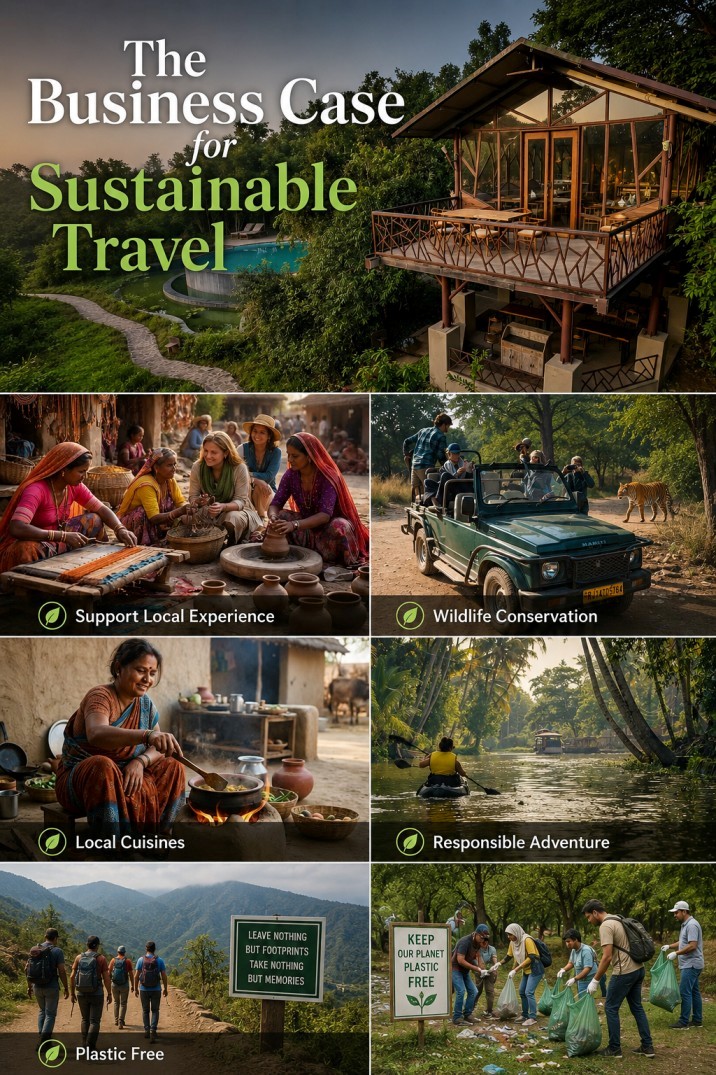
Eco-friendly stays
- Green hotels and eco-lodges
- Energy-efficient operations
- Waste management systems
Community-based tourism
- Direct engagement with local communities
- Support for artisans and rural economies
- Cultural preservation
Responsible wildlife tourism
- Ethical safari practices
- Conservation-focused travel
- Protection of biodiversity
Sustainable transportation
- Optimized routing to cut carbon footprint
- Efficient transport modes
- Slow travel experiences
Putting It Into Practice
How travel businesses implement sustainability
01 Build responsible supply chains
- Eco-certified hotels
- Ethical tour providers
- Community-based organizations
02 Design thoughtful itineraries
- Reduce unnecessary travel
- Favor quality over quantity
- Integrate immersive experiences
03 Educate clients
- Responsible travel practices
- Cultural sensitivity
- Environmental awareness
04 Measure and communicate impact
- Track sustainability initiatives
- Share impact stories
- Build transparency with partners
Setting The Record Straight
Common misconceptions about sustainable travel
Misconception
"It's more expensive."
Reality
It often delivers higher perceived and actual value, supporting premium pricing rather than eroding it.
Misconception
"It limits luxury."
Reality
Eco-luxury is one of the fastest-growing segments in global travel, not a compromise on comfort.
Misconception
"It's difficult to implement."
Reality
With the right DMC handling supplier vetting and logistics, it becomes a seamless part of itinerary design.
The Strategic Partner
What a DMC brings to sustainable travel
A Destination Management Company turns sustainability from a set of good intentions into an operational reality, built into every stage of the itinerary.
- Curating genuinely responsible travel products
- Vetting suppliers and on-ground partners
- Ensuring ethical operations at every touchpoint
- Managing logistics efficiently, end to end
- Embedding sustainability into the itinerary from the start
Looking Ahead
Where sustainable travel is heading
Rise of eco-luxury and regenerative tourism.
Increased demand for genuinely authentic experiences.
Stronger sustainability regulations, globally.
Technology built in for impact tracking.
Growth of conscious, purpose-driven travel.
Build The Case Into Your Products
Sustainability isn't the constraint — it's the advantage
With the right DMC as a strategic partner, sustainable travel in India becomes a high-value, commercially successful part of the product line, not a side offering.
Recent Posts