Bee Falls
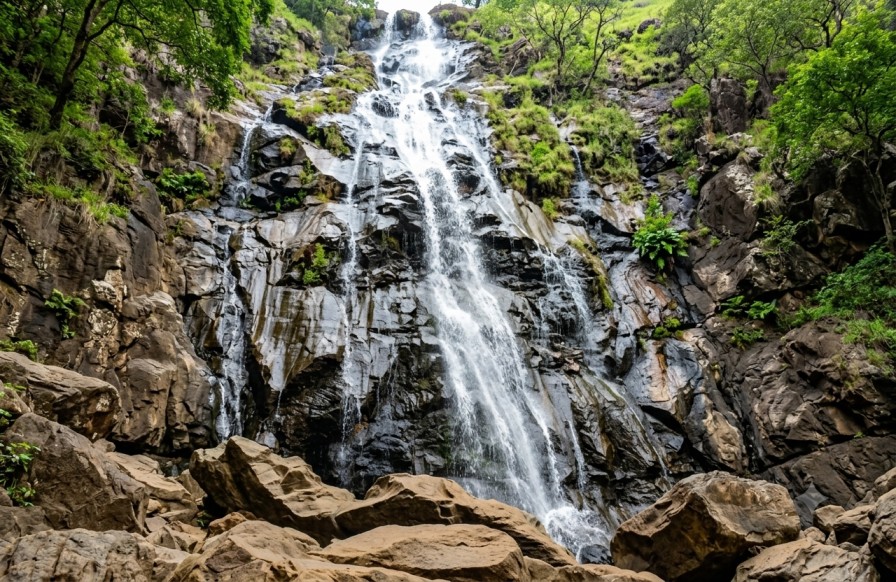
locally known as Jamuna PrapatA perennial cascade dropping roughly 35 metres into a rocky gorge on the edge of Pachmarhi town, reached by a stone-step descent through dense Satpura forest. This reference outlines the site layout, seasonality, and access relevant to Central India circuit planning.
Site character
Bee Falls sits within the hill station of Pachmarhi, in Madhya Pradesh's Narmadapuram district, and is known locally as Jamuna Prapat. The waterfall drops approximately 35 metres over rugged rock faces into a natural gorge, fed by a perennial stream that also serves as the town's principal water source — a functional role that distinguishes it from purely scenic falls elsewhere in the region.
The site is reached by a descent of stone steps through shaded woodland, with upper and lower plunge pools positioned along the route. The trail connects onward to nearby viewpoints, including Apsara Vihar, placing Bee Falls within a broader forest circuit rather than as an isolated stop — a relevant detail for sequencing a Pachmarhi itinerary.
Descent profile
Upper pool
TRAILHEADThe starting point of the descent, with the first of the natural plunge pools and initial views over the gorge.
Main cascade
~35 M DROPThe principal waterfall, at its most forceful during and immediately after the monsoon, viewed from several points along the stepped path.
Lower pool
GORGE FLOORA second bathing and picnic spot at the base of the falls, framed by rock formations and dense tree cover.
Apsara Vihar trail
CONNECTING PATHA forest path linking Bee Falls to the nearby Apsara Vihar viewpoint, extending the site into a wider walking circuit.
On-ground activity
Swimming & bathing
The upper and lower pools are used for bathing, particularly in summer; currents strengthen and water clarity drops during monsoon, when swimming is inadvisable.
Trekking & forest walking
The descent and return climb cover several hundred stone steps through dense woodland, forming a core part of the on-site experience.
Photography
Cascading water, mist, and surrounding greenery offer strong visual material, particularly in the post-monsoon months when the forest is at its lushest.
Picnicking
Shaded, level ground near the pools supports relaxed group stops as part of a broader Pachmarhi day itinerary.
Seasonality
| Period | Conditions | Notes |
|---|---|---|
| OCT — FEB | Peak season | Comfortable temperatures, safer footing on the descent; coincides with Pachmarhi's busiest period. |
| MAR — JUN | Good for bathing | Warmer weather with cool water at the falls, favoured for swimming despite the summer heat. |
| JUL — SEP | Monsoon caution | Heaviest and most dramatic flow, but stronger current, slippery steps, and swimming not advised. |
Access & connectivity
Broader regional and national air connectivity via Bhopal, Jabalpur, or Nagpur.
On the main line to Bhopal, Jabalpur, and Itarsi; onward travel by bus, shared jeep, or taxi.
Vehicle access to a parking point, followed by a walking trail and stone steps not accessible by vehicle.