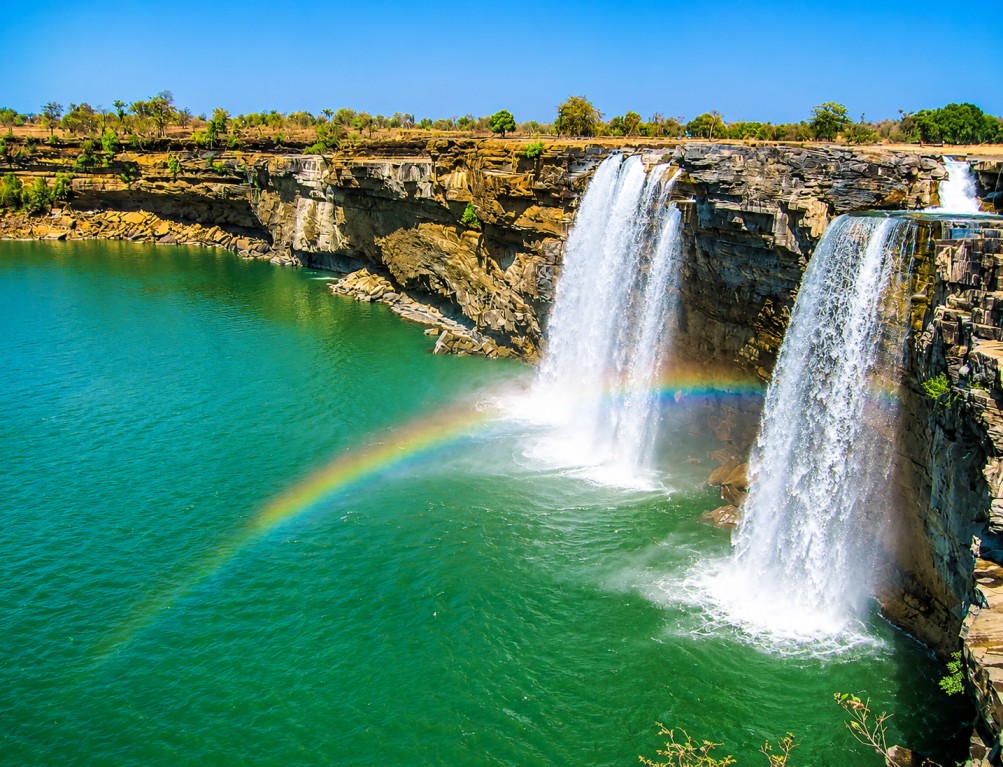
🌊 Chitrakote Falls (Chhattisgarh)
🌿 Overview
Chitrakote Falls stands as one of the most spectacular and visually commanding natural landmarks in central India, a waterfall of extraordinary breadth and drama that has earned widespread recognition as the Niagara of India for the sheer width of its curtain of falling water and the thunderous energy it projects across the surrounding forest landscape. Located in the Bastar district of Chhattisgarh, approximately thirty-eight kilometres west of Jagdalpur on the Indravati river, the falls plunge from a horseshoe-shaped sandstone cliff of approximately twenty-nine metres in height across a width that expands dramatically during the monsoon months to reach nearly three hundred metres, creating a wall of white water of breathtaking scale that is unmatched by any other waterfall in the Indian subcontinent in terms of breadth. The destination draws nature enthusiasts, photographers, adventure seekers, and travelers drawn to the wild and culturally distinctive landscape of Bastar, one of the most ecologically and ethnographically rich regions in India.
What distinguishes Chitrakote from other waterfalls in the country is the combination of its exceptional width, its dramatic horseshoe geometry, and the richness of the surrounding Bastar landscape within which it is set. Unlike waterfalls defined primarily by vertical height, Chitrakote derives its power from the volume and breadth of water that pours over its sandstone lip, particularly during and immediately after the monsoon when the Indravati runs in full flood and the falls expand to their maximum extent, filling the surrounding air with spray and sound in a manner that is genuinely overwhelming at close quarters. The lush Bastar forest, the tribal cultural heritage of the surrounding region, and the relative accessibility of the falls from Jagdalpur combine to make Chitrakote a destination of compelling natural and cultural depth.
✨ Why Visit Chitrakote Falls
The recognition of Chitrakote as the widest waterfall in India places it within a category of natural landmarks whose scale and power constitute a genuine spectacle of the natural world, one of those rare sites where the forces of nature are displayed with a directness and grandeur that produces an immediate and lasting impression on every visitor. Unlike some celebrated natural sites whose reputation exceeds their immediate impact, Chitrakote delivers an experience of sensory force, particularly during the monsoon months, that surpasses most prior expectations.
One of the most compelling reasons to visit is the dramatic transformation the falls undergo across the seasons, offering a fundamentally different experience depending on the time of year. The monsoon months bring the Indravati to full flood, transforming Chitrakote into a roaring, spray-drenched spectacle of maximum breadth and power whose sound carries across the surrounding forest for a considerable distance. The post-monsoon and winter months, by contrast, reveal a more intimate version of the falls, where the reduced flow allows visitors to approach more closely, appreciate the geological character of the sandstone cliff, and in some months even walk along the rocky riverbed below. This seasonal variation makes Chitrakote a destination that rewards more than one visit across different times of year.
Additionally, Chitrakote is set within the broader Bastar landscape, one of the most culturally and ecologically distinctive regions in India, home to a rich diversity of tribal communities including the Gond, Halba, and Muria peoples whose artistic traditions, festivals, and daily life add a dimension of cultural richness to any visit that extends well beyond the waterfall itself. The combination of natural spectacle and living tribal heritage gives Chitrakote and its surrounding region a depth of experience that places it among the most rewarding destinations in central India.
📍 Key Highlights Within the Area
🌅 Main Viewpoint
The main viewpoint directly above and adjacent to the falls offers the most immediate and dramatically powerful engagement with Chitrakote, where the full breadth of the horseshoe curve becomes visible and the volume of falling water can be appreciated in its entirety. The viewpoint is accessible on foot from the main visitor area and provides a sequence of perspectives from the cliff edge and the adjacent riverbank that together convey the scale and character of the falls across a single unhurried visit. The early morning and late afternoon hours produce the most favorable light for photography and the most atmospheric conditions for simply absorbing the spectacle.
🚣 Riverbank Experience
The riverbank below the falls, accessible during the drier months when the water level recedes sufficiently to expose the rocky shore, allows visitors to approach the base of the curtain of water with a directness that the elevated viewpoints cannot provide. Standing at the base of the falls, with the spray on one's face and the sound of the water filling the surrounding air, constitutes a physical engagement with the natural spectacle that is qualitatively different from the view from above and deeply memorable in its own right.
🎯 Activities
Viewing the falls from the main viewpoint and the adjacent cliff edge at different times of day is the central activity at Chitrakote, rewarding those who spend sufficient time at the site to observe the changing light and atmosphere across a full morning or afternoon rather than passing through in the manner of a brief stop. The play of light on the falling water, the shifting patterns of the spray cloud above the base pool, and the sound of the falls under different wind conditions all change with the hours in ways that make extended observation genuinely worthwhile.
Boat rides on the Indravati river in the vicinity of the falls, available during the calmer post-monsoon and winter months, offer one of the most intimate and memorable ways to experience Chitrakote, moving across the river toward the base of the falls with the curtain of water filling the view ahead and the spray beginning to reach the boat as it approaches. Local boatmen navigate these waters with considerable skill and familiarity, and the experience of approaching the falls by water is widely regarded as the highlight of many visitors' time at Chitrakote.
🌦 Best Time to Visit
Monsoon Spectacle
Balanced Experience
Comfortable Exploration
🚗 Connectivity
Chitrakote Falls is accessible primarily from Jagdalpur, the administrative headquarters of Bastar district and the nearest significant urban centre, located approximately thirty-eight kilometres to the east. Jagdalpur is connected by rail to Raipur, the state capital of Chhattisgarh, with the journey taking approximately six to seven hours, and by road to Raipur along a route of approximately three hundred kilometres that passes through the forested landscape of central Chhattisgarh and takes between five and six hours by private vehicle. Raipur Airport offers regular domestic flights from Delhi, Mumbai, Kolkata, and other major cities, making it the primary air gateway for visitors approaching Chitrakote from outside the state.
Road travel from Jagdalpur to the falls is straightforward, with a well-maintained route covering the distance in approximately one hour. Jagdalpur itself serves as the natural base for exploring the broader Bastar region, offering accommodation options ranging from government rest houses to private hotels that provide a comfortable foundation for day trips to Chitrakote and the other natural and cultural sites of the surrounding landscape. The relative remoteness of Bastar, which requires some commitment of travel time to reach from major urban centres, is part of the destination's character, and the journey through the forests and villages of central Chhattisgarh that precedes arrival at the falls contributes meaningfully to the sense of entering a landscape of genuine distinctiveness and depth