```html
📖 Overview
Mandav stands as one of the most romantically evocative and historically magnificent destinations in central India, representing a ruined medieval city of extraordinary architectural ambition set atop a dramatic plateau that rises above the surrounding plains of the Malwa region in a setting of rare natural grandeur. Situated approximately 100 kilometres from Indore in the Dhar district of Madhya Pradesh, Mandav, also known as Mandu, is a destination unlike almost any other in the country, offering a landscape defined by the crumbling splendor of Afghan-era palaces, soaring gateways, and elegant mosques distributed across a wind-swept highland plateau edged by steep ravines that fall away to the Narmada valley far below. The destination draws history enthusiasts, architecture lovers, photographers, and romantic travelers from across the country, offering a built landscape of genuine medieval magnificence embedded within a natural setting of dramatic beauty and seasonal transformation.
What distinguishes Mandav from other medieval heritage destinations in India is not merely the scale or antiquity of its ruins, but the unique combination of Afghan architectural refinement, deeply romantic historical narrative, dramatic plateau geography, and an unhurried atmospheric quality that sets it apart from more crowded or commercialized heritage sites. The area is anchored by the Jahaz Mahal and Hindola Mahal, two of the most architecturally distinguished medieval structures in central India, and complemented by the Rupmati Pavilion perched on the very edge of the plateau with sweeping views toward the Narmada, the Jami Masjid of considerable scale and serenity, and a network of baolis, smaller palaces, and garden enclosures that together compose one of the most complete and atmospheric medieval landscapes surviving anywhere in the subcontinent. This layered character elevates Mandav beyond a simple archaeological site into a destination of genuine historical romance and architectural wonder.
❤️ Why Visit Mandav
The recognition of Mandav as one of the most significant medieval heritage landscapes in Madhya Pradesh reflects its unparalleled importance within the architectural and cultural history of central India, particularly as the former capital of the Malwa Sultanate and a seat of refined courtly culture that flourished between the thirteenth and sixteenth centuries. Unlike isolated monuments or single-building heritage attractions, Mandav offers a cohesive experience where an entire medieval city, its palaces, mosques, reservoirs, and gateways distributed across a vast plateau, can be explored at an unhurried pace within a landscape of natural beauty and atmospheric solitude.
One of the most compelling reasons to visit is the legendary love story of Baz Bahadur and Rupmati, the last sultan of Mandav and the singer who captured his devotion, whose story is inseparable from the identity and atmosphere of this place. The Rupmati Pavilion, from which she is said to have gazed each morning toward the Narmada river before beginning her day, carries a weight of romantic and poetic association that lends the already magnificent views from its terraces an additional dimension of historical feeling and human depth.
Additionally, Mandav showcases a strong sense of architectural sophistication through the distinctly Afghan character of its principal monuments, which differ considerably from the Rajput and Mughal styles more commonly encountered at northern Indian heritage sites and offer a refreshing and relatively unfamiliar architectural vocabulary of considerable elegance and restraint. The combination of historical romance, architectural distinction, dramatic natural setting, and the genuine sense of solitude available at this relatively uncrowded destination further strengthens its appeal as a deeply rewarding and long-remembered heritage experience.
⭐ Key Highlights Within the Area
🚢 Jahaz Mahal
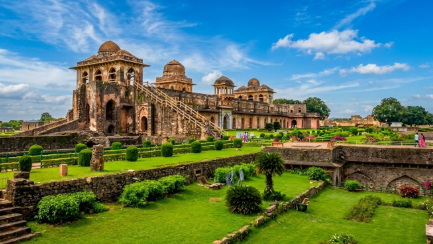
Among the architectural landmarks, Jahaz Mahal stands out as the most iconic and visually dramatic structure in Mandav. Built on a narrow strip of land between two artificial lakes, this two-storeyed palace of considerable length takes on the appearance of a ship sailing between the waters on either side, an impression from which its name, meaning Ship Palace, is derived. The scale of the structure, its graceful arched corridors, domed pavilions, and the romantic interplay of architecture and water create a visual experience of extraordinary medieval atmosphere that remains one of the most memorable architectural encounters in all of Madhya Pradesh.
🌄 Rupmati Pavilion
The Rupmati Pavilion, perched dramatically on the southern edge of the plateau at its highest point, is another deeply significant highlight. From its elevated terraces, the view extends across the forested ravines below the plateau edge to the distant silver thread of the Narmada river winding through the plains far beneath, providing a combination of architectural grace and natural panorama of a kind that few heritage sites in India can match. The associations of the pavilion with the story of Rupmati and Baz Bahadur lend this already remarkable viewpoint a depth of feeling that elevates it well beyond a simple scenic overlook.
🕌 Jami Masjid
The Jami Masjid, one of the largest mosques in central India and modeled in its ambition on the great mosque at Damascus, is a highlight of considerable architectural gravity. Its vast pillared prayer hall, expansive courtyard, and the simplicity and confidence of its stone construction offer a compelling encounter with medieval Islamic architecture at a scale and quality that commands genuine admiration and unhurried contemplation.
🌧️ Seasonal Beauty
The visual experience of Mandav changes dramatically with the seasons, as the monsoon transforms the plateau into a vivid green landscape of mist, low cloud, and rain-washed stone that many visitors consider the most beautiful and atmospheric time to visit, while the winter months bring clear skies, comfortable temperatures, and the sharpest views from the plateau edge across the Narmada valley far below.
🚶 Activities
Exploring the distributed monuments of the Mandav plateau by jeep, bicycle, or on foot is the defining activity of a visit, with the principal heritage group near the main entrance, the Rewa Kund group in the south, and the Sagar Talao group in the center of the plateau together composing a full day of deeply rewarding architectural discovery. Moving between these clusters across the open plateau landscape, with its wide views and quiet rural character, is itself a pleasurable and contemplative experience that adds to the cumulative satisfaction of the visit.
Watching the sunrise or sunset from the Rupmati Pavilion is a particularly celebrated and atmospheric activity, as the quality of light across the ravines and the distant Narmada valley during these transitional hours creates conditions of extraordinary natural and emotional beauty. The silence of the plateau at dawn, broken only by birdsong and the distant sound of wind through the ruins, offers a quality of experience that is rare at any heritage destination in India.
Photography of the medieval ruins in the context of the plateau landscape, particularly during the monsoon when green vegetation fills every surface and low cloud drifts across the stone structures, is a widely undertaken and deeply rewarding pursuit that draws serious and amateur photographers alike to Mandav during the rainy season. Exploring the baolis, the stepped tanks, and the smaller garden pavilions scattered between the principal monuments rewards those who venture beyond the main sites with quieter and more intimate architectural encounters of considerable charm.
📅 Best Time to Visit
The most favorable period to visit Mandav is from October to March, when temperatures on the plateau are pleasantly cool, the skies are clear, and the open landscape of the heritage site is comfortable for extended walking and exploration. During these months, the moderate weather and excellent visibility make visiting the full circuit of monuments across the plateau particularly enjoyable, and the clear winter air sharpens the views from the Rupmati Pavilion and the plateau edge to their most dramatic and rewarding extent.
The monsoon season from July to September is widely considered by those familiar with Mandav to be the most atmospherically extraordinary time to visit, as the plateau transforms into a richly green and mist-laden landscape of considerable romantic and visual power. The ruins of the medieval city, draped in monsoon vegetation and partially obscured by drifting cloud and rain, take on a quality of romantic melancholy and natural beauty that is deeply distinctive and unlike the experience available at any other time of year. However, some roads to and within the plateau may become difficult during heavy rainfall, requiring some preparation and flexibility.
The summer months from April to June bring considerable heat to this part of Madhya Pradesh, though the plateau elevation provides some moderation compared to the surrounding plains, and early morning and evening visits to the principal monuments remain rewarding for those who plan their timings carefully.
🚗 Connectivity
Mandav is conveniently accessible from Indore, located approximately 100 kilometres away, which serves as the most practical gateway city and the most comfortable base for day trips or overnight visits to the plateau. The journey from Indore by road takes approximately two and a half to three hours through the scenic landscape of the Malwa plateau, passing through Dhar and ascending to the plateau by a winding road that itself offers rewarding views across the surrounding countryside.
Indore is one of the best-connected cities in Madhya Pradesh, served by the Devi Ahilya Bai Holkar Airport with regular domestic flights from Delhi, Mumbai, Bengaluru, and several other major Indian cities, and by Indore Junction with regular rail services from major cities across central and western India. Road connectivity from Indore, Dhar, Dhamnod, and Maheshwar is efficient and well maintained, making Mandav a highly practical inclusion in western Madhya Pradesh heritage itineraries, as well as a natural companion destination for travelers exploring Maheshwar, Omkareshwar, Mhow, and the broader cultural and historical landscape of the Malwa and Nimar regions of Madhya Pradesh.
nearby places
- ```