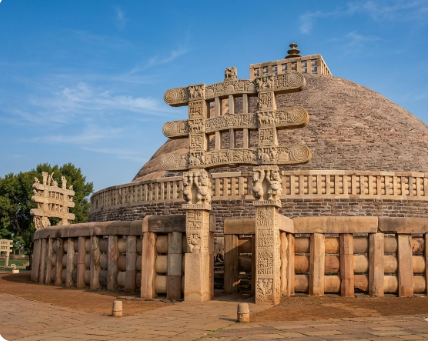
🛕 Sanchi Stupa (Madhya Pradesh)
📖 Overview
The Sanchi Stupa is one of India’s most significant Buddhist heritage sites and a UNESCO World Heritage Site that reflects the spiritual, artistic, and architectural achievements of ancient India. Located atop a serene hill, Sanchi represents over a thousand years of continuous religious activity, dating from the 3rd century BCE to the 12th century CE. Commissioned originally by Emperor Ashoka, the Great Stupa at Sanchi is among the oldest stone structures in India and remains remarkably well preserved.
Sanchi is not associated directly with any major event in the life of Buddha, which makes it unique among Buddhist pilgrimage sites. Instead, it evolved into a major monastic and learning center, attracting monks, scholars, and devotees over centuries. The site is an exceptional representation of Buddhist art and symbolism, showcasing stupas, monasteries, temples, pillars, and intricately carved gateways known as toranas.
✨ Why Visit Sanchi
Sanchi offers a deeply peaceful and contemplative experience, far removed from the crowds of more commercial destinations. It is ideal for travelers seeking spiritual enrichment, historical depth, and architectural elegance. The site’s significance lies not only in its age but also in the evolution of Buddhist art that it represents.
The carvings on the toranas are among the finest examples of early Indian narrative sculpture. They depict stories from the Jataka tales, symbolizing the previous lives of Buddha, along with scenes of devotion, nature, and daily life. Interestingly, Buddha is not depicted in human form in these early carvings but is represented symbolically through footprints, empty thrones, and the Bodhi tree.
🏛️ Key Highlights
The Great Stupa (Stupa No. 1) is the centerpiece of the complex. Its hemispherical dome symbolizes the universe, while the central relic chamber is believed to house sacred remains. The four elaborately carved gateways face the cardinal directions and are masterpieces of storytelling through stone.
Stupa No. 2 and Stupa No. 3 are also important, featuring relics of Buddhist monks and additional carvings. The Ashokan Pillar, though partially broken, is a testament to the Mauryan emperor’s influence and his role in spreading Buddhism.
The surrounding monasteries and temples provide insight into the daily life of monks and the evolution of Buddhist architecture over centuries.
🚶 Activities
Visitors can engage in guided heritage walks to fully understand the symbolism and historical significance of the site. Photography is highly rewarding due to the intricate carvings and scenic setting.
Meditation and quiet reflection are natural activities here, as the environment encourages mindfulness and spiritual connection. The site is also ideal for academic and cultural exploration.
🌤️ Best Time to Visit
October to March is the best time, offering pleasant weather for exploration. Summers can be extremely hot, while monsoons bring greenery but may affect accessibility.
🚗 Connectivity
The nearest airport is in Bhopal, approximately 50 km away. Bhopal is also the nearest major railway station. Sanchi is well connected by road, making it easily accessible for day trips.
Must visit place