Jaisalmer- Desert- Festival : Where "The Golden Sand Alive With Culture"
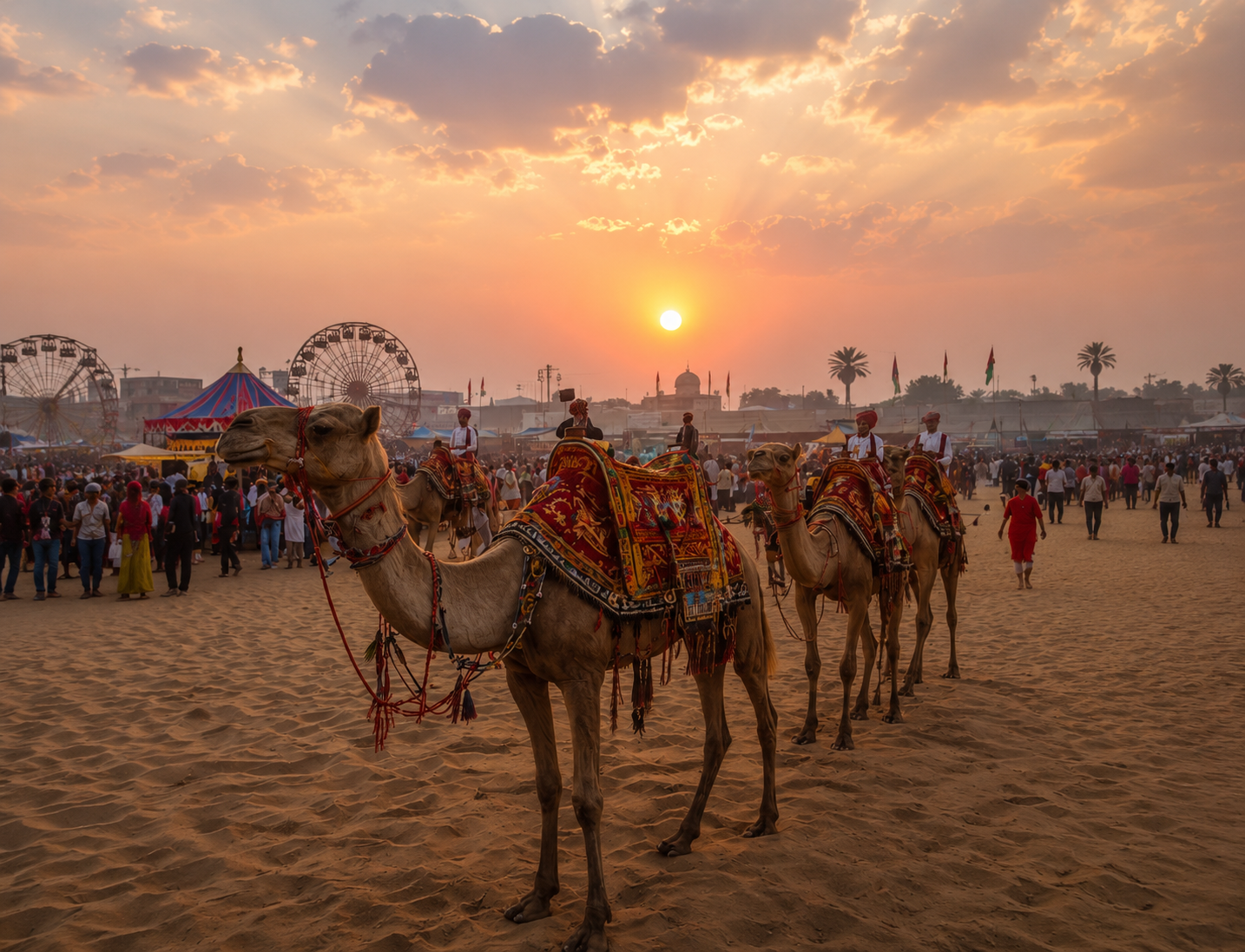
Somewhere between the golden ramparts of Jaisalmer Fort and the endless folds of the Thar Desert, sand stops being sand for three days every winter and becomes a stage. Drums echo across the dunes, camels parade in mirrored finery, and turbans of saffron, magenta, and indigo bob through crowds thick with anticipation. This is the Jaisalmer Desert Festival, one of Rajasthan's most cherished cultural celebrations and a living window into the resilience, artistry, and warmth of desert life. For visitors chasing an authentic slice of Indian heritage and tourism, few events capture it as vividly as this one.
🏜️ Jaisalmer Desert Festival: Where the Thar Comes Alive in Colour and Song
🌅 Overview
Somewhere between the golden ramparts of Jaisalmer Fort and the endless folds of the Thar Desert, sand stops being sand for three days every winter and becomes a stage. Drums echo across the dunes, camels parade in mirrored finery, and turbans of saffron, magenta, and indigo bob through crowds thick with anticipation. This is the Jaisalmer Desert Festival, one of Rajasthan's most cherished cultural celebrations and a living window into the resilience, artistry, and warmth of desert life. For visitors chasing an authentic slice of Indian heritage and tourism, few events capture it as vividly as this one.
Held annually in the heart of the Thar, the festival is far more than a tourist spectacle. It is a heartfelt expression of how a community shaped by scarcity, sun, and silence has built a culture overflowing with music, colour, and celebration. To understand the festival is to understand Jaisalmer itself — a city that turns hardship into art.
👑 A Festival Born of Royal Legacy
The roots of the Jaisalmer Desert Festival trace back to the Bhati Rajput dynasty, whose rulers governed this remote desert kingdom for centuries. The city's founding by Rawal Jaiswal was marked by grand celebrations across the kingdom, and over time these royal festivities evolved into what is now known as the Jaisalmer Desert Fair Festival. What began as a commemoration of a king's vision for his desert stronghold gradually transformed into a broader celebration of local heritage, eventually shaped into its present form by the Rajasthan Tourism Department to showcase the region's culture to the wider world.
There is something poetic about a festival that emerged from royal pageantry and grew into a celebration belonging to ordinary people — farmers, herders, folk musicians, and artisans whose ancestors have called the Thar home for generations. The festival's timing is itself steeped in tradition: it is scheduled around the full moon of the Hindu month of Magh, so that its final night culminates beneath a luminous desert moon, turning the dunes silver and the celebration almost otherworldly.
🎶 Three Days of Music, Competition, and Desert Spirit
The festival traditionally unfolds across three days, with the opening events held within Jaisalmer city and the closing chapter staged amid the Sam Sand Dunes, roughly 40 kilometres from the town centre. The celebration typically begins with a vibrant procession winding out from Jaisalmer Fort, performers and decorated camels moving through narrow lanes lined with sandstone havelis before the festivities shift to the open desert.
What makes the Jaisalmer Desert Festival genuinely distinctive is its commitment to authenticity. Rather than staged performances built purely for spectators, the events reflect the real rhythms of desert life. Camel races and camel polo unfold across the sand, while turban-tying competitions test speed and skill with metres of brightly dyed cloth. The much-loved "Mr. Desert" moustache and personality contest celebrates the rugged elegance long associated with Rajasthani men, drawing enthusiastic crowds and good-natured cheering.
Music remains the soul of the festival. Folk singers perform haunting ballads of love, valour, and loss, accompanied by instruments like the kamaicha, ravanhatta, and khartal — sounds that have travelled through generations of desert storytelling.
👗 Traditional Attire and Dress Code
Clothing at the Jaisalmer Desert Festival is itself a celebration. Men often wear vibrant turbans known as pagris, tied in styles that vary by region and community, paired with angrakhas or kurtas and dhotis in earthy or jewel tones. Women dress in flowing ghagra-choli ensembles adorned with mirror work, intricate embroidery, and silver jewellery that catches the desert light with every movement.
🍛 Local Food and Special Dishes
No Rajasthani celebration is complete without its food, and the festival grounds brim with stalls serving the region's most beloved dishes. Visitors can sample local delicacies like Ker Sangri, Dal Baati Churma, and Ghevar at food stalls set up around the venue.
🏜️ Best Places to Experience the Festival
While the festival officially unfolds across Jaisalmer city and the Sam Sand Dunes, certain spots offer particularly memorable experiences. The festival's base remains at the dunes of the Thar Desert, roughly 42 kilometres from the main city of Jaisalmer, though several events also take place at Jaisalmer Fort and its adjoining areas. The fort's golden ramparts provide a dramatic setting for the opening ceremonies, while the Sam Sand Dunes deliver the festival's most cinematic moments — folk performances under starlit skies, desert camps glowing with bonfires, and the haunting beauty of moonlit sand stretching toward the horizon.
📈 Tourism Significance
The Jaisalmer Desert Festival plays an outsized role in Rajasthan's winter tourism economy and in keeping centuries-old folk traditions alive for new generations. For local artisans, musicians, and dancers, the festival is a vital platform to showcase skills passed down through families, while for the wider Jaisalmer economy, it draws crucial footfall to hotels, desert camps, handicraft markets, and transport services during peak season.
✨ Interesting Facts
The festival's final day is deliberately timed to align with the full moon, lending the closing celebrations an almost mystical glow across the dunes. Camel decoration is taken so seriously that owners spend weeks preparing intricate patterns, tassels, and coloured embroidery before the grand camel parade.
💡 Did You Know?
Many of the folk musicians who perform at the festival, such as the Manganiyar and Langa communities, have been hereditary court musicians for the Bhati rulers and continue a musical lineage stretching back hundreds of years.
🚆 How to Reach the Festival Destination
Jaisalmer has a domestic airport with flights connecting from major Indian cities like Delhi and Jaipur, making air travel the fastest option for visitors short on time. The city is also well connected by rail, with regular trains arriving from Jaipur, Jodhpur, and Delhi.
📅 Best Time to Visit
The festival is scheduled for 30 January to 1 February in 2026, placing it firmly within Rajasthan's pleasant winter season. Days are warm and golden, ideal for exploring the fort and dunes, while evenings turn distinctly cold, so carrying warm layers is essential.
🎒 Travel Tips for Visitors
Booking accommodation well in advance is strongly advised, since hotels and desert camps fill up quickly during festival dates. Carrying layered clothing helps visitors manage the desert's wide day-to-night temperature swing, and comfortable footwear is essential for walking across sand and uneven fort terrain.
❤️ Why You Should Experience This Festival
There are festivals that entertain, and there are festivals that reveal something true about a place. The Jaisalmer Desert Festival belongs firmly to the second category. It offers travellers a rare chance to witness Rajasthan's folk heritage not as a curated performance for outsiders, but as a living tradition still cherished by the very communities who created it.
As the final bonfire dims and the last notes of a folk ballad drift across the cooling sand, what lingers isn't just the memory of camels in golden light or dancers spinning beneath a full moon — it's the quiet understanding that some traditions are too vibrant, too deeply loved, to ever fade. The Jaisalmer Desert Festival doesn't just showcase Rajasthan's heritage; it breathes life into it, year after year, inviting the world to fall in love with the golden city and the desert that shaped its soul