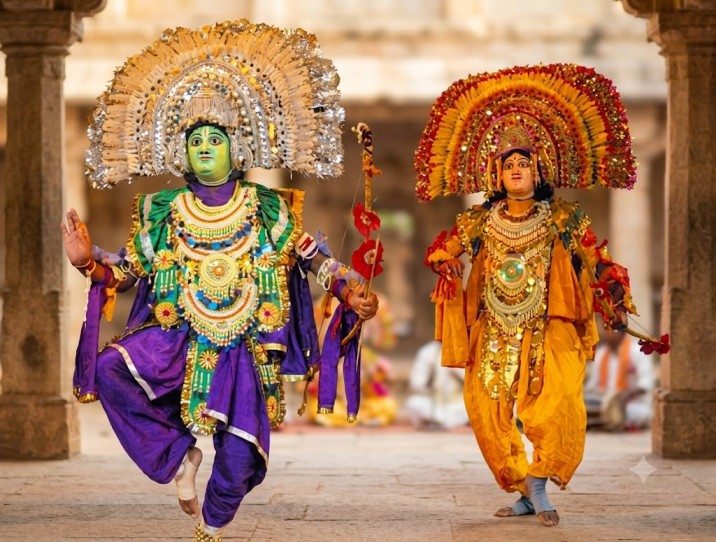
A Dance Born from the Borderlands of Three States
There are performing arts that entertain, and then there are those that carry entire civilizations within them. Chhau dance belongs firmly in the second category.
Practiced across the tribal and rural belts of three eastern Indian states — Jharkhand, West Bengal, and Odisha — Chhau is a semi-classical dance tradition that blends martial movement, folk theatre, and devotional storytelling into a single, electrifying art form. In 2010, UNESCO inscribed Chhau on its Representative List of Intangible Cultural Heritage of Humanity, acknowledging what communities across eastern India have known for centuries: this is not simply a dance, it is a living repository of warrior culture, mythology, and community identity.
Origins, History, and Regional Roots
The word Chhau is believed to derive either from the Sanskrit chhaya (shadow or image) or from chhauni (military camp), and both etymologies point toward the dance's dual nature — part ritual, part combat training transformed into art. Its origins are traced to the 18th century, though many scholars believe its roots stretch back further into the martial traditions of the Malla kings of Odisha and the warrior communities of the Chota Nagpur plateau.
Chhau exists in three distinct regional styles, each with its own character, community, and performance tradition:
Seraikella Chhau
Seraikella Chhau, from Jharkhand's Seraikella-Kharsawan district, is the most lyrical of the three. Historically patronized by the royal family of Seraikella, it features delicate, abstract movements and uses masks that cover only the upper portion of the face, allowing subtle expression beneath.
Purulia Chhau
Purulia Chhau, from West Bengal's Purulia district, is the most vibrant and widely recognized style. It uses large, vividly painted masks that cover the entire face and is known for its acrobatic energy, dramatic leaps, and deeply devotional character. This style draws its largest audiences during the Chaitra Parva festival.
Mayurbhanj Chhau
Mayurbhanj Chhau, from Odisha's Mayurbhanj district, is unique in that performers wear no masks at all, relying entirely on facial expression and body movement. It is considered the most technically demanding of the three forms and has the strongest links to classical Indian dance grammar.
Performance Style, Costume, and Music
Chhau performances are typically held outdoors at night, continuing from dusk until dawn during festival seasons. The movement vocabulary is athletic and expansive — performers execute high leaps, spinning jumps, combat sequences, and animal imitations drawn from nature. Stories are sourced from the Mahabharata, Ramayana, and Puranic legends, with episodes featuring Durga battling Mahishasura, the Pandava heroes, Lord Shiva, and forest creatures appearing regularly in the repertoire.
Costumes & Masks
Costumes are elaborate and theatrical. In Purulia and Seraikella styles, the masks are the defining visual element — hand-crafted by specialized artisan communities using papier-mâché, clay, and natural pigments, each mask representing a specific deity, demon, or character type. Headdresses, skirts, and body armour are layered to create silhouettes that are immediately recognizable from a distance, designed for large open-air audiences.
The Music — Pure Percussion
The music that accompanies Chhau is entirely percussive and powerfully rhythmic. The primary instruments include the dhol (barrel drum), dhamsa (large kettle drum), and mahuri (a double-reed wind instrument similar to a shehnai). There are no vocalists narrating the story — the music alone sets the mood, signals character entries, and drives the narrative pace. This gives Chhau a raw, primal energy that is unlike any other classical or folk dance tradition in India.
Experiencing Chhau as a Visitor
For travellers interested in India's living folk traditions, Chhau offers an experience that is both visually spectacular and culturally immersive. The most important occasion to witness authentic Chhau is the Chaitra Parva festival, held annually in March–April across Purulia district in West Bengal and parts of Jharkhand and Odisha. During this festival, entire village communities gather for overnight performances that mark the end of the Bengali calendar year — the atmosphere is festive, communal, and deeply rooted in local faith.
Purulia town in West Bengal is the most accessible destination for Chhau tourism. The district hosts multiple performance troupes year-round, and several cultural organizations offer workshops where visitors can observe mask-making, interact with performers, and learn basic movement sequences.
Baripada in Odisha's Mayurbhanj district is the centre for the maskless style and hosts the annual Mayurbhanj Chhau Mahotsav, a dedicated festival that draws audiences and researchers from across India.
Mask-making villages around Purulia — particularly Charida village, sometimes called the mask village of India — are a remarkable cultural stop in themselves. Artisan families here have produced Chhau masks for generations, and visitors can watch the craft process from raw materials to the finished painted mask.
Festival performances · Chaitra Parva
Workshops · Cultural centres · Pleasant travel
The ideal time to visit for Chhau experiences is March to April for festival performances and October to February for workshops, cultural centre visits, and travel without the monsoon.
Cultural Importance and Global Standing
Global Recognition
Beyond its UNESCO recognition, Chhau has been performed at national republic day events in New Delhi and at international festivals across France, the United Kingdom, Japan, and the United States. India's Sangeet Natak Akademi actively documents and supports all three regional styles, and several Chhau masters have received the Padma awards for their contributions to Indian performing arts.
For cultural tourists, heritage travellers, and anyone curious about the deeper layers of Indian civilization, Chhau dance offers something rare — an art form that has never lost its connection to the communities that created it. It remains performed by the same families, in the same villages, for the same festivals, generation after generation. That continuity is perhaps Chhau's most remarkable achievement of all.