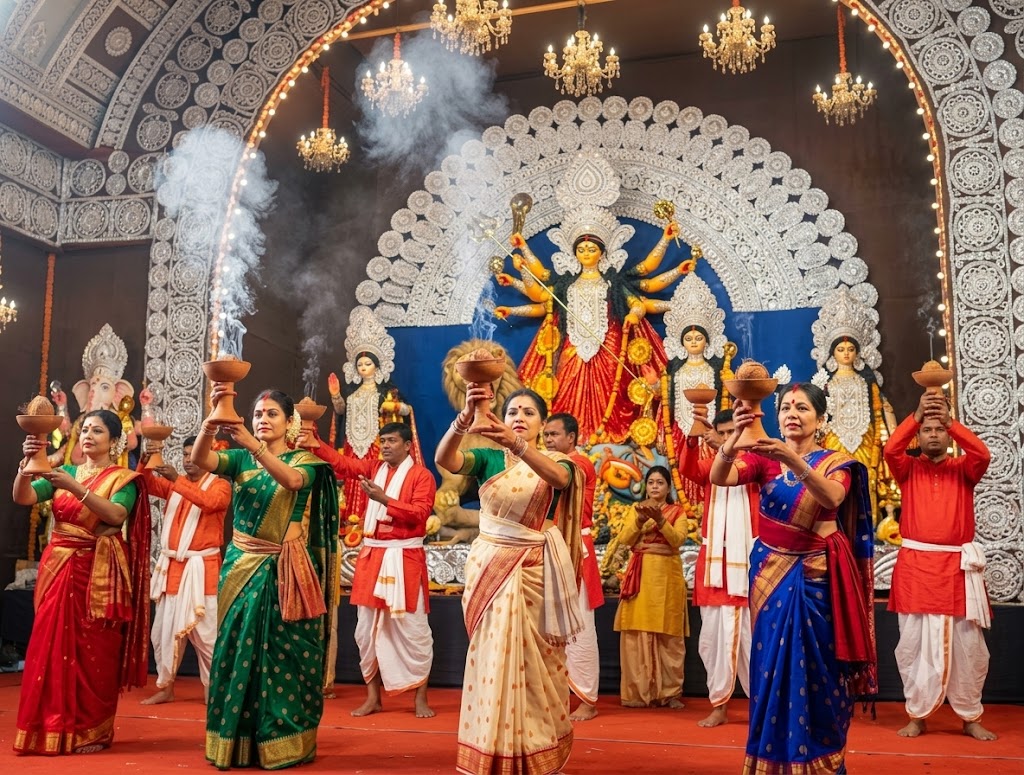
Durga Pooja : Festival Of Devotion And Joy
Durga Puja commemorates the victory of Goddess Durga over the buffalo demon Mahishasura — a triumph of good over evil that Hindu scripture recounts in the Devi Mahatmya. But for Bengalis, the festival carries a meaning that goes beyond mythology. Durga is also Uma, the beloved daughter who comes home to her earthly family for five days before returning to her husband Shiva in the Himalayas. Her arrival is a homecoming, and Kolkata receives her the way a family receives a child it hasn't seen in a year: with open arms, overwhelming affection, and no small amount of noise.
🙏 The Heart of the Celebration: What Durga Puja Means
Durga Puja commemorates the victory of Goddess Durga over the buffalo demon Mahishasura — a triumph of good over evil that Hindu scripture recounts in the Devi Mahatmya. But for Bengalis, the festival carries a meaning that goes beyond mythology. Durga is also Uma, the beloved daughter who comes home to her earthly family for five days before returning to her husband Shiva in the Himalayas. Her arrival is a homecoming, and Kolkata receives her the way a family receives a child it hasn't seen in a year: with open arms, overwhelming affection, and no small amount of noise.
In 2021, UNESCO inscribed Durga Puja on its Representative List of Intangible Cultural Heritage of Humanity — recognition that what happens in Kolkata each October is not merely a religious festival but a living, breathing cultural phenomenon.
📜 Origins and History
The large-scale, community-organised celebration of Durga Puja in Kolkata is generally traced to the late 16th and 17th centuries, when wealthy zamindars (landowners) began hosting elaborate pujas in their family mansions. The Sabarna Roy Choudhury family of Barisha is often credited with one of the earliest recorded community celebrations, dating to 1610.
The shift from private, aristocratic observance to the baroari (community) puja model began in 1790 in Guptipara, West Bengal, and gradually took root in Kolkata. By the 20th century, neighbourhood committees — called puja committees — had taken over as the primary organisers, democratising the festival and making it truly public. Today, over 2,500 puja committees operate across Kolkata alone, each competing to create the most spectacular pandal, or temporary temple.
🕯️ The Five Days: A City on a Different Clock
Durga Puja officially spans five days — Shashthi, Saptami, Ashtami, Navami, and Dashami — though preparations begin weeks, sometimes months, in advance. Each day carries distinct rituals.
🌺 Shashthi
Shashthi marks the goddess's arrival. Priests perform the Bodhon ceremony, awakening the deity, while artisans make final touches to clay idols that have taken months to craft.
🪔 Saptami, Ashtami, and Navami
Saptami, Ashtami, and Navami are the peak days of worship. The Sandhi Puja, held at the junction of Ashtami and Navami, is considered the most sacred moment — when 108 earthen lamps are lit and offerings made to Chamunda, the fiercest form of the goddess.
🌹 Dashami
Dashami, the final day, brings Sindoor Khela — married women smear red sindoor on the goddess and on each other in a joyful, messy ritual of blessing and farewell. Then the idols are carried in procession to the Hooghly River for immersion (visarjan), dissolving back into water as the city watches, often in tears.
🎨 The Pandals: Art Installations at a Civic Scale
What distinguishes Kolkata's Durga Puja from celebrations elsewhere is the sheer ambition of its pandals. These temporary structures — built from bamboo, cloth, thermocol, recycled materials, and occasionally steel — are architectural and artistic statements. Themes range from replicas of famous global monuments to abstract commentaries on climate change, political events, or social inequality.
The College Square, Kumartuli Park, Mohammad Ali Park, Bagbazar, and Sreebhumi pandals consistently draw enormous crowds and media attention. Some committees spend upwards of several crore rupees on a single installation, staffing it with professional artists, lighting designers, and sound engineers.
Kumartuli — the traditional potters' quarter in north Kolkata — deserves a visit in its own right. Here, hereditary artisans called kumors craft the goddess's idols using clay from the banks of the Ganges, following techniques passed down for generations.
🍛 Food, Music, and the Street Experience
Durga Puja is inseparable from its food. Street stalls materialise overnight, selling kathi rolls, jhalmuri (spiced puffed rice), phuchka (Kolkata's beloved pani puri), and biryani. Sweets like sandesh and mishti doi flow freely. Restaurants stay open through the night. Eating becomes an act of celebration.
Traditional dhak drummers — dhakis — travel from rural Bengal to beat their large barrel drums throughout the festival, a sound so associated with Durga Puja that it can evoke the season instantly for any Bengali. Contemporary pandals often pair this with light shows, theatrical performances, and live classical or folk music.
Clothing matters enormously. New clothes are almost mandatory — many families buy multiple outfits specifically for different puja days. The sight of Kolkata dressed up, with women in silk sarees and men in kurtas streaming through illuminated streets at two in the morning, is unlike anything the city looks like for the remaining fifty weeks of the year.
✈️ Tourism and the Puja Economy
Durga Puja is one of India's most significant tourism events. The West Bengal government organises carnival processions, cultural programmes, and guided pandal-hopping tours that attract visitors from across India and abroad. Hotels in Kolkata are booked months in advance. Airlines increase frequency on Kolkata routes. The festival generates thousands of crores in economic activity — for artisans, vendors, hospitality workers, and the broader creative economy.
International visitors, particularly those from Bangladesh (where Durga Puja is also celebrated), the Bengali diaspora in Europe and North America, and curious travellers drawn by word of mouth, add to the cosmopolitan texture of the celebrations.
✨ Why Durga Puja Stays With You
There's a particular quality to Durga Puja in Kolkata that is difficult to articulate and impossible to forget. It is the combination of the sacred and the thoroughly human — priests chanting ancient Sanskrit verses a few feet from teenagers taking selfies; the smell of incense competing with the smell of street food; grief and joy arriving simultaneously on Dashami morning.
For five days, Kolkata is not simply a city celebrating a festival. It becomes the festival itself — chaotic, warm, exhausting, and profoundly alive.