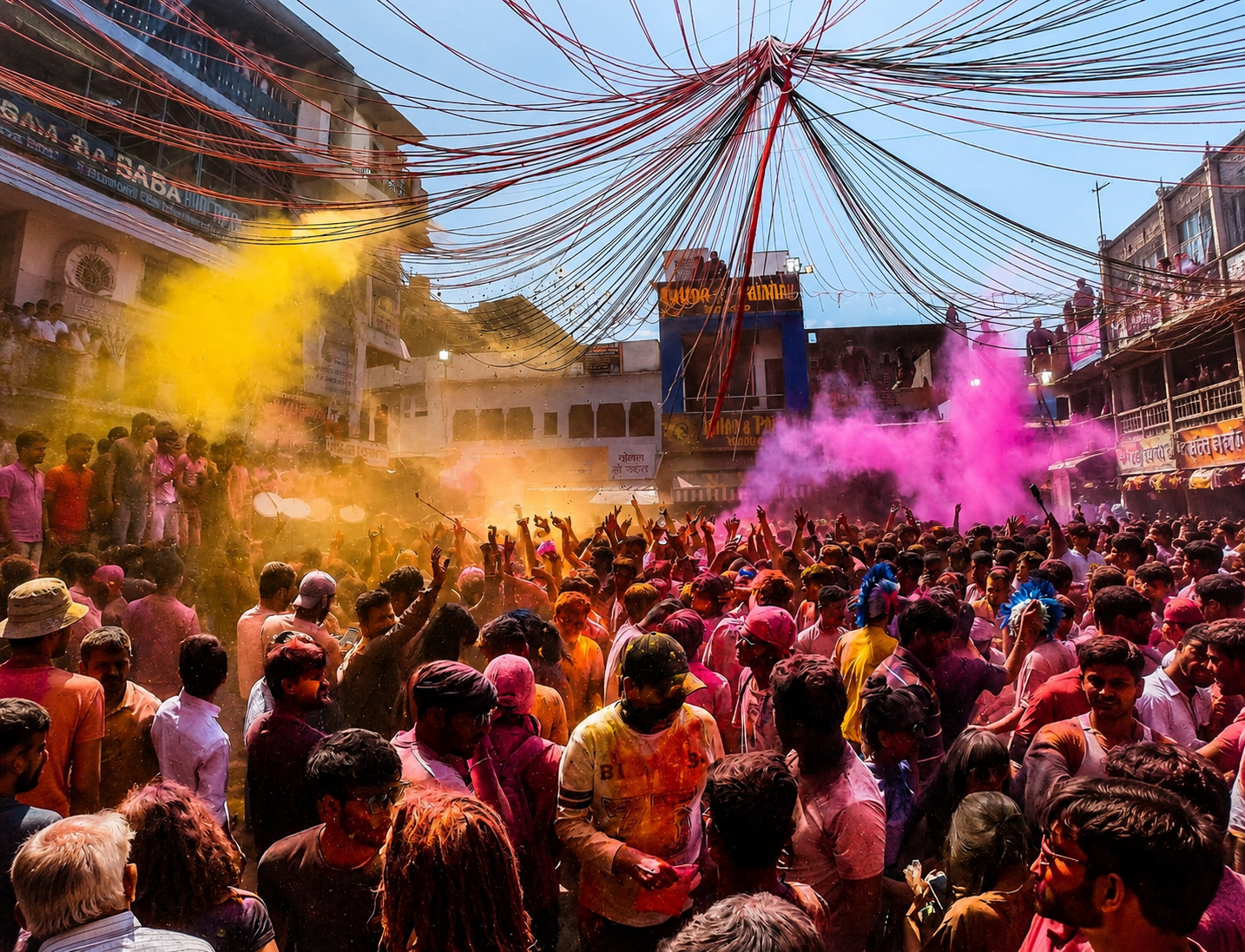
Holi : Festival Of Colour And Joy
Holi holds both spiritual and social meaning for millions of people across India and the Indian diaspora worldwide. Rooted in Hindu tradition, it marks the arrival of spring, the triumph of good over evil, and the renewal of relationships. It is a time to forgive old grievances, reconnect with loved ones, and embrace the abundance of a new season. The festival typically falls on the full moon day of the Hindu month of Phalguna, usually in late February or March. Beyond religion, Holi is a profoundly inclusive celebration. It transcends caste, class, and community. On this day, social hierarchies blur. Everyone is equally drenched, equally colorful, and equally joyful.
🎨 Holi in India: The Festival of Colors That Paints the Soul
Every year, as winter loosens its grip and spring begins to stir, India erupts in an explosion of color, laughter, and music. Holi — the festival of colors — is one of the most joyous and visually spectacular celebrations on earth. It is the one day of the year when strangers become friends, grudges dissolve, and streets transform into a living canvas of pink, yellow, green, and red. More than just a festival, Holi is a feeling — raw, unfiltered, and deeply human.
🌸 The Significance of Holi
Holi holds both spiritual and social meaning for millions of people across India and the Indian diaspora worldwide. Rooted in Hindu tradition, it marks the arrival of spring, the triumph of good over evil, and the renewal of relationships. It is a time to forgive old grievances, reconnect with loved ones, and embrace the abundance of a new season. The festival typically falls on the full moon day of the Hindu month of Phalguna, usually in late February or March.
Beyond religion, Holi is a profoundly inclusive celebration. It transcends caste, class, and community. On this day, social hierarchies blur. Everyone is equally drenched, equally colorful, and equally joyful.
🔥 Origins and Mythology
The story behind Holi is as vivid as the colors used to celebrate it. The most widely known legend involves Prahlada, a young devotee of Lord Vishnu, and his demoness aunt Holika. Prahlada's father, the demon king Hiranyakashipu, despised his son's devotion to Vishnu and attempted to have him killed. Holika, believed to be immune to fire, tricked Prahlada into sitting with her on a pyre. But divine protection shielded the boy, and Holika was consumed by the flames instead. The bonfire lit on the eve of Holi — called Holika Dahan — commemorates this victory of devotion over arrogance.
Another beloved story ties Holi to the playful divine love of Lord Krishna and Radha. Krishna, who had dark blue skin, was insecure about whether the fair-skinned Radha could ever love him. His mother Yashoda, in jest, told him to color Radha's face any shade he liked. This playful smearing of color became the origin of the tradition we know today, especially celebrated in the Braj region of Uttar Pradesh.
🎊 How Holi Is Celebrated
🔥 Holika Dahan — The Night Before
Celebrations begin the evening before the main event with Holika Dahan. Communities gather around large bonfires, sing devotional songs, perform circumambulations, and offer prayers. The fire symbolizes the burning of evil and the cleansing of negativity. Families roast grains and coconut in the flames as a blessing for the harvest season.
🌈 Rangwali Holi — The Day of Color
The morning after brings Rangwali Holi, and nothing quite prepares you for it. Armed with pichkaris (water guns), packets of gulal (colored powder), and buckets of colored water, people pour into the streets. Friends ambush each other. Neighbors drench passersby. Children squeal with delight. Adults rediscover the joy of being completely, gloriously messy.
Traditional colors were once made from flowers like marigold and turmeric, neem, and henna. While synthetic colors dominate today, there is a growing movement back toward natural, skin-friendly pigments — especially in eco-conscious communities.
🍬 Food, Music, and Festive Customs
No Holi celebration is complete without thandai, a chilled milk drink spiced with rose petals, almonds, cardamom, and saffron — sometimes infused with bhang (a preparation from cannabis leaves), particularly in Rajasthan and Uttar Pradesh. Gujiya, a sweet dumpling filled with khoya and dry fruits, is the quintessential Holi mithai. Homes also prepare puran poli, malpua, dahi bhalla, and a spread of savory snacks.
Music fills the air from dawn. Folk songs called Holi ke geet echo through neighborhoods. In Vrindavan and Mathura, classical compositions known as dhrupad and dadra are performed at temples. Drums beat, cymbals clash, and spontaneous dance breaks out in every lane.
People dress in white — the perfect blank canvas to display every color thrown their way — or in bright festive kurtas and salwar suits.
🗺️ Regional Variations Across India
🏏 Lathmar Holi (Barsana, Uttar Pradesh)
Women playfully beat men with sticks (lathis) while men shield themselves with shields. It re-enacts a legend of Krishna visiting Radha's village.
🎶 Phaguwa (Bihar)
Celebrated with folk songs and community gatherings, with an emphasis on family reunions.
🚩 Shigmo (Goa)
The coastal state celebrates a version of Holi called Shigmo, featuring elaborate street processions, folk dances, and floats.
🌼 Dol Jatra (West Bengal and Odisha)
A more serene, devotional version where idols of Radha and Krishna are carried in processions and worshipped with flowers and color.
🎭 Yaosang (Manipur)
A five-day festival that coincides with Holi and features traditional sports and dances unique to the region.
📍 Best Places to Experience Holi
For travelers — domestic and international — certain destinations offer an unmatched Holi experience.
Mathura and Vrindavan remain the spiritual epicenter of Holi. The town of Vrindavan celebrates for nearly a week, including a breathtaking Phoolon ki Holi (festival of flowers) at Banke Bihari Temple. Barsana's Lathmar Holi draws thousands of visitors each year for its theatrical, high-energy spectacle.
Jaipur in Rajasthan offers a royal Holi celebrated at palaces, complete with elephants, folk performers, and traditional Rajasthani cuisine. Udaipur stages celebrations on the lake ghats, with fire processions and royal ceremony at the City Palace.
In recent years, Holi has become a significant driver of cultural tourism. International visitors from Europe, the Americas, and Southeast Asia increasingly plan trips to India around the festival, drawn by its visual drama and genuine warmth.
✨ What Makes Holi Truly Special
Holi strips away pretense. You cannot be aloof when someone has smeared vermillion on your cheeks. You cannot stay guarded when a child has soaked you with a water gun. The festival has a democratizing magic — for a few hours, everyone plays, everyone laughs, and everyone belongs.
It also carries a quiet ecological message in its ancient form: the colors come from the earth, the bonfire returns to ash, and the spring celebrated is a reminder of nature's generosity.
Whether you experience Holi in a small village temple or at a rooftop celebration in Mumbai, the feeling is the same: a loosening of the chest, a rush of delight, and the simple, uncomplicated joy of being alive in color.
Holi is more than a festival on the calendar. It is a reminder that joy is contagious, that renewal is always possible, and that sometimes, the most profound things in life come in the brightest colors.