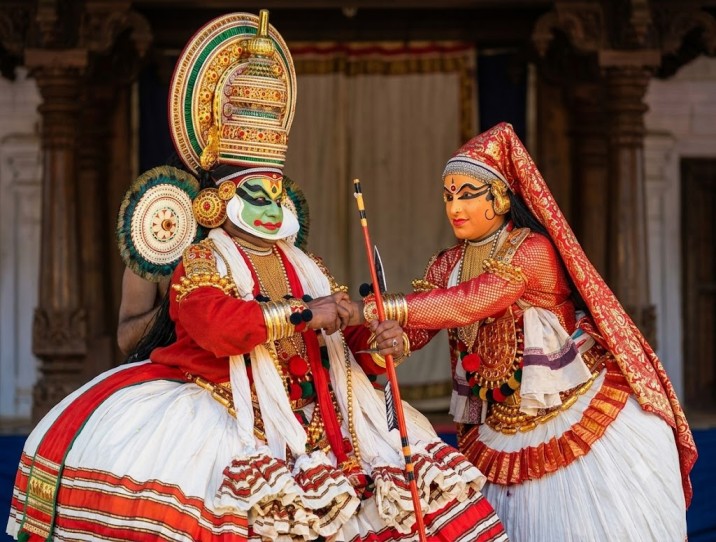
A Living Tradition Rooted in Kerala's Soil
Few performing arts in the world carry the visual power and cultural depth of Kathakali.
Originating in the southwestern Indian state of Kerala, this classical dance drama is one of India's oldest and most distinctive theatrical traditions. More than just a performance, Kathakali is a complete artistic universe — where elaborate costume, vivid facial makeup, precise gesture, and ancient storytelling merge into something genuinely unforgettable. Recognized by UNESCO and celebrated across the globe, Kathakali remains a living, breathing expression of Kerala's spiritual life and artistic identity.
History and Origins
Kathakali traces its roots to the early 17th century, evolving from older performance traditions such as Krishnanattam, Ramanattam, and Koodiyattam — ancient Sanskrit theatre forms practiced in Kerala's temples. The word itself combines two Malayalam terms: katha (story) and kali (performance or play). Early Kathakali performances were staged exclusively in temple courtyards and royal courts, often running through the night by torchlight, with stories drawn from the Mahabharata, Ramayana, and Puranic literature.
Royal Patronage & Refinement
Over the following centuries, several regional schools and royal patronages shaped the art form. The kingdoms of Travancore and Calicut played important roles in refining its grammar, and legendary teachers known as acharyas codified the training systems that students follow even today.
By the 20th century, reformers such as Mahakavi Vallathol Narayana Menon established dedicated training institutions — most notably Kerala Kalamandalam in 1930 — which transformed Kathakali from a temple tradition into a carefully preserved classical art with structured pedagogy.
The Visual Language of Kathakali
What makes Kathakali immediately recognizable is its extraordinary visual vocabulary. Performers spend years mastering mudras — a codified system of over 600 hand gestures — combined with precise eye movements, facial expressions (navarasas), and body postures. Together, these elements communicate entire narratives without spoken dialogue.
The costumes are architectural in scale. Performers wear towering headgear, layered skirts, and ornate chest plates that can take hours to assemble. The makeup, known as chutti, is applied with rice paste and natural pigments and transforms the face into a stylized mask.
This colour-coded system allows audiences familiar with the tradition to read a character's moral nature before a single gesture is made.
Musical Accompaniment
The musical accompaniment — performed live — features two distinct drum styles, the chenda and maddalam, alongside the chengila (gong) and ilathalam (cymbals). Vocalists sing the narrative in classical Malayalam, while performers enact it entirely through movement.
Experiencing Kathakali as a Visitor
For travellers, encountering Kathakali is one of the richest cultural experiences Kerala offers.
Home to Kerala Kalamandalam, a UNESCO-recognized heritage institution where visitors can observe training sessions and watch formal performances.
Thiruvananthapuram, Kochi, and Kozhikode all host regular Kathakali performances at cultural centres, particularly at the Kerala Tourism-supported venues in Fort Kochi.
The ideal time to experience authentic Kathakali is during October to March, when the weather is pleasant and major festivals — including Thrissur Pooram, Onam celebrations, and temple festivals across central Kerala — feature full-length overnight performances.
Many cultural centres offer introductory workshops where visitors can have the makeup applied and learn basic gestures from trained artists, making it a participatory rather than purely observational experience.
Cultural Significance and Global Recognition
UNESCO Intangible Cultural Heritage
Kathakali was inscribed on UNESCO's Representative List of Intangible Cultural Heritage, placing it alongside the world's most significant living traditions. It has been performed at major international arts festivals across Europe, the Americas, and Asia, earning admiration not only as ethnic spectacle but as a sophisticated theatrical system comparable to classical opera or Noh theatre.
For heritage travellers and culture seekers, Kathakali is not simply a show to watch — it is a 400-year-old conversation between human artistry, mythology, devotion, and community, still very much alive in the villages and cities of Kerala today.