🕯️ Where 2,000 Years of Theatre Still Breathes
Where 2,000 Years of Theatre Still Breathes
There are performing arts, and then there is Koodiyattam. Practiced in Kerala for over two millennia, Koodiyattam — also spelled Kutiyattam — is widely recognized as the oldest continuously performed theatre tradition in the world. In 2001, UNESCO made that recognition official, declaring it a Masterpiece of the Oral and Intangible Heritage of Humanity, the first Indian performing art to receive this distinction. Yet despite its global standing, Koodiyattam remains deeply intimate — performed in small temple theatres, sustained by a handful of dedicated families, and rooted in a spiritual and artistic framework that has remained essentially unchanged since the early centuries of the Common Era.
For anyone genuinely interested in Indian classical arts, ancient Sanskrit drama, or the archaeology of human performance, Koodiyattam is not simply worth experiencing — it is irreplaceable.
📜 Origins & History
Origins, History, and the Families Who Kept It Alive
The word Koodiyattam comes from the Malayalam words koodi (combined) and attam (acting), referring to its defining feature: joint or ensemble performance of Sanskrit plays. Its origins are traced to the Kerala tradition of Sanskrit theatre codified in Bharata Muni's Natyashastra, the foundational Indian treatise on the performing arts, composed roughly between 200 BCE and 200 CE.
For centuries, Koodiyattam was performed exclusively within Koothambalams — specially constructed theatre halls attached to Kerala's major Hindu temples. Two communities were the traditional custodians of this art: the Chakyar community, who performed the male roles and narrated the plays, and the Nangyar community, women who played female roles and also performed the solo form known as Nangyarkoothu. These roles were hereditary and carried immense social and spiritual responsibility. Performing Koodiyattam was not merely artistic — it was an act of ritual offering to the deity of the temple.
The tradition came close to extinction in the colonial period, when patronage from temples and royal courts declined sharply. The revival efforts of scholars and practitioners in the 20th century — particularly the legendary Painkulam Rama Chakyar and later Ammannur Madhava Chakyar — combined with institutional support from Kerala Kalamandalam and the Sangeet Natak Akademi, pulled Koodiyattam back from the edge. Today, several dedicated institutions and a new generation of performers carry it forward, including artists from outside the traditional communities.
🎨 Artistic Grammar
The Artistic Grammar of Koodiyattam
Koodiyattam is not theatre in the way most audiences understand the word. A single act of a Sanskrit play — not the full play, but one act — can unfold over multiple evenings, sometimes extending across five to fourteen nights. This is because the performance tradition demands extraordinary internal elaboration: a single verse or even a single word can expand into hours of gestural interpretation, facial expression, and narrative digression.
The performance vocabulary rests on the Hastha Lakshana Deepika, a Kerala-specific manual of hand gestures (mudras) that codifies 24 root gestures capable of expressing hundreds of meanings depending on context, orientation, and combination. Eye movements — precisely choreographed and trained over years — are considered equally expressive. Facial muscles are trained to convey the nine classical rasas or emotional states with a subtlety that can take decades to master.
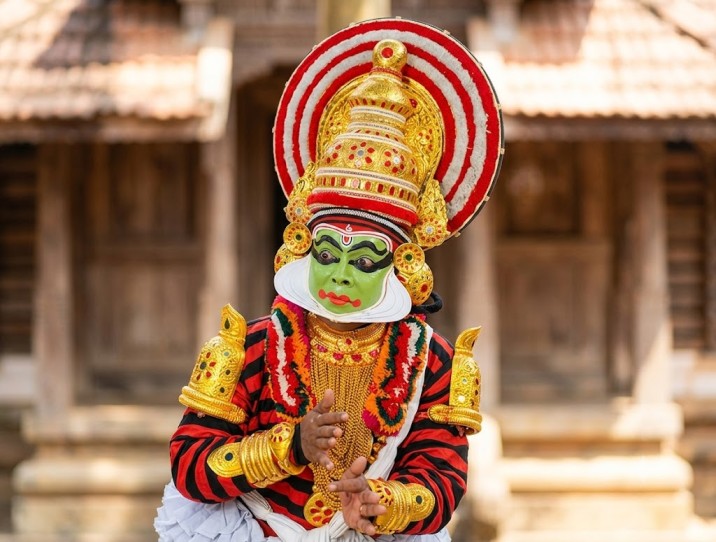
Costumes are elaborate and symbolic. Male characters of noble standing wear the kireedam (a large crown), layered robes, and ornate jewellery. The makeup system, while similar in structure to Kathakali, has its own distinct conventions: vella theppu for divine and heroic characters, specific colour patterns denoting demons, sages, and royalty. The application of makeup alone can require two to three hours of meticulous work.
The musical accompaniment uses the mizhavu — a large copper percussion instrument unique to Koodiyattam — along with the edakka (an hourglass drum), kuzhithalam (cymbals), and kurumkuzhal (a wind instrument). The vocalist sings Sanskrit verses while the performer translates each syllable into physical expression, creating a counterpoint between voice and body that is unlike anything else in world theatre.