🪔 What Is Navratri and Why Does It Matter?
Navratri, meaning "nine nights" in Sanskrit, is one of Hinduism's most widely observed festivals. Celebrated across India, it honors the divine feminine — specifically the goddess Durga and her many forms. Over nine nights, devotees worship different avatars of the goddess, each representing a unique aspect of power, wisdom, and grace.
But while Navratri is observed in various ways across the country, Gujarat has made it something uniquely its own. The state's version is so distinctive and so exuberant that UNESCO inscribed the Gujarati Garba dance on its Representative List of the Intangible Cultural Heritage of Humanity in 2023. That recognition says everything.
🌾 The Origins: A Festival Rooted in Ancient Earth
The roots of Navratri stretch back thousands of years. Ancient Hindu texts describe the festival as a period when the goddess Durga battles and ultimately defeats the demon Mahishasura — a victory of good over evil that the faithful celebrate with fasting, prayer, and music.
In Gujarat, the festival also draws from agricultural rhythms. Historically, Navratri fell at the transition between the monsoon and the harvest season. Communities gathered to thank the goddess for rain, to pray for a good crop, and to celebrate the earth's abundance. The circular dance form of Garba — where participants move in concentric rings around an earthen pot or image of the goddess — mirrors this connection to cycles: of seasons, of life, of divine energy.
Over centuries, these agrarian rituals evolved into the elaborate cultural spectacle Gujarat is known for today, without losing their spiritual core.
🎶 Garba and Dandiya: The Soul of Gujarat's Navratri
💫 Garba
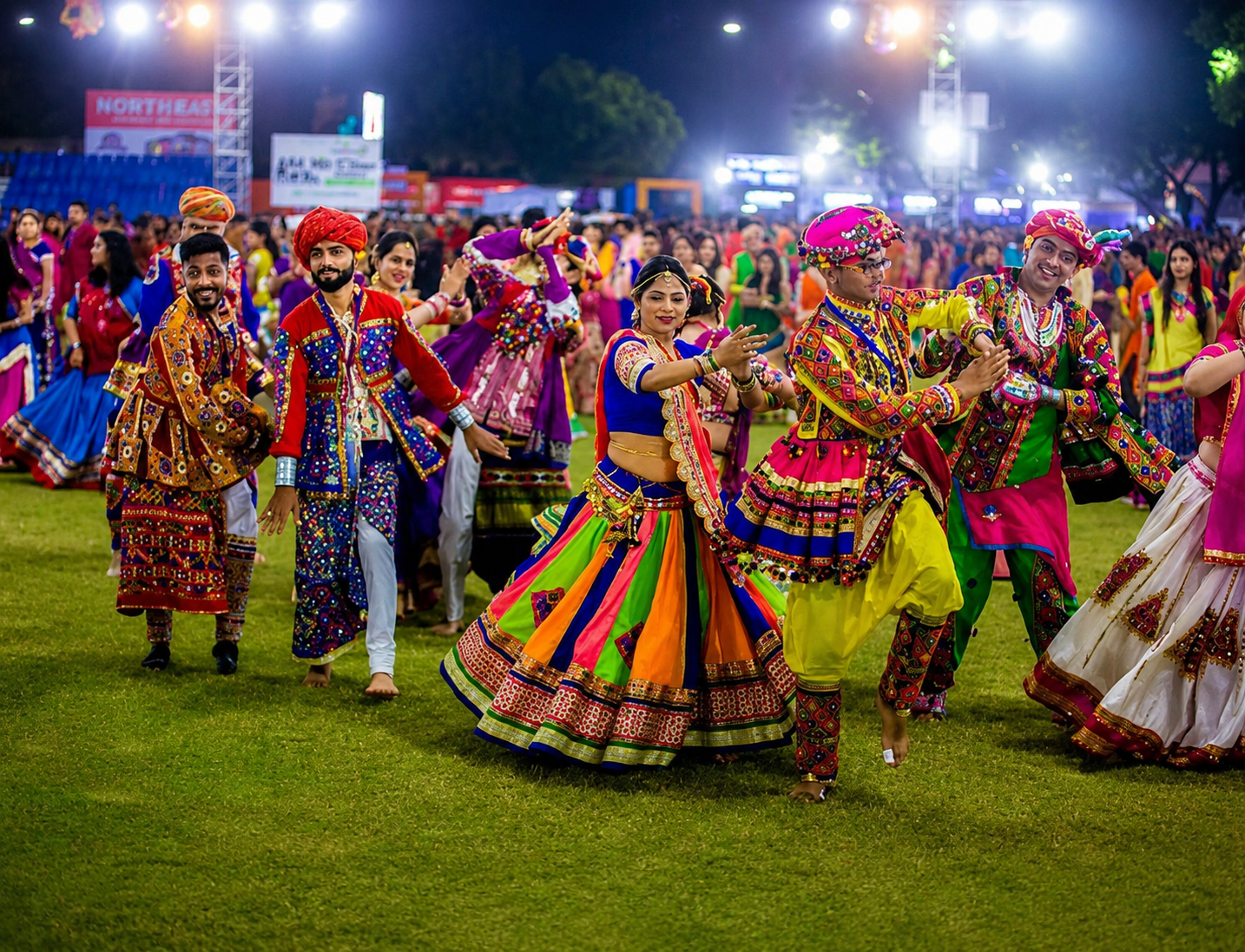
Garba is the older, more devotional of the two. Performed primarily by women, though now inclusive of all, Garba involves graceful, swirling movements in circular patterns around a central lamp or idol. The hands clap, the feet stamp, the waist sways — all in rhythmic unison with folk songs that invoke the goddess. Traditional Garba songs are called "Garbi," and they tell stories of Durga, of Krishna, of the natural world. Experienced performers can sustain this for hours, their feet barely seeming to touch the ground.
🥁 Dandiya Raas
Dandiya Raas comes later in the evening and carries a more playful energy. Dancers — men and women together — use short decorated sticks to tap against each other's sticks as they move in rotating pairs. The tempo builds as the night deepens, with live orchestras or folk musicians driving the rhythm faster and faster. By midnight, the scene is electric.
Both dances are learned from childhood. In Gujarat, Navratri is not a performance for an audience — everyone participates.
👗 What to Wear, What to Eat, What to Expect
Clothing during Navratri is taken seriously. Women traditionally wear the chaniya choli — a long, flared skirt paired with a cropped blouse and a dupatta, all heavily embroidered and adorned with mirrors, beads, and threadwork. Men wear kediyu (a traditional short kurta) with dhoti or churidar. The colors are deliberately vivid: saffron, emerald, royal blue, hot pink. In recent decades, fashion designers have elevated festival wear into a whole seasonal industry, and matching accessories like bangles and mojdi footwear complete the look.
Food during Navratri varies by family and practice. Devout observers fast for all nine days, eating only specific ingredients like sabudana (tapioca), kuttu (buckwheat flour) dishes, fruits, and dairy. Others fast on select days. But outside the religious observance, Navratri is also a time for communal eating — street stalls near dance grounds sell farsan snacks, chai, and sweets late into the night.
📍 The Best Places to Experience Navratri in Gujarat
🏙️ Ahmedabad
Ahmedabad hosts some of the largest and most spectacular Garba events in the world. The city's grounds — particularly venues like GMDC and Sindhu Bhavan Road — attract hundreds of thousands of participants nightly. The scale is genuinely staggering.
🏛️ Vadodara (Baroda)
Vadodara (Baroda) is known for preserving classical Garba traditions alongside modern celebrations. The Navratri here has a more royal, heritage feel, with events organized in palace courtyards and historic locations.
🌟 Surat
Surat brings its own brand of festivity, with the city's prosperous merchant community throwing lavish Garba events that blend tradition with contemporary music and lighting.
🛕 Dwarka and Somnath
Dwarka and Somnath, as ancient temple towns, offer a more spiritual dimension. Here, Navratri is inseparable from temple rituals and devotional singing that continues through the night in a way that feels timeless.
🎨 Anand, Rajkot, and Bhavnagar
Smaller towns like Anand, Rajkot, and Bhavnagar each have distinct regional flavors — different traditional songs, slightly different dance styles, variations in costume embroidery — that reward those willing to explore beyond the big-city spectacles.
🌍 Navratri and Tourism: A Global Phenomenon
Navratri in Gujarat now draws visitors from across India and from abroad. Hotels in Ahmedabad and Vadodara are booked months in advance. The Indian diaspora — from the United Kingdom, the United States, East Africa, and beyond — often plans trips specifically around the festival, reconnecting with cultural roots through the shared language of dance.
The tourism impact is significant. The Gujarat government has actively promoted Navratri as a cultural tourism event, organizing heritage performances and inviting international guests. Several travel operators now offer curated Navratri experiences that include costume rentals, dance workshops, and guided temple visits.
For international visitors unfamiliar with the festival, the experience is both accessible and deeply moving. The circles of dancers, the blaze of color, the live music that seems to pulse through the ground — it requires no prior knowledge to feel its pull.
✨ What Makes Gujarat's Navratri Truly Special
What sets Gujarat apart is not just the scale, but the continuity. This is not a festival that was revived or reconstructed for tourism. Garba has been danced here, in these circular patterns, invoking the same goddess, for generations. Grandmothers teach granddaughters the steps. Communities maintain their specific song traditions. The religious and the joyful coexist without tension.
There is also a striking egalitarianism to the dance floor. During Navratri, the circles expand to include everyone. Social hierarchies soften. Strangers become partners for a round of dandiya. The nine nights create a temporary but genuine sense of community that Gujarat's people speak about with real affection.
💖 A Festival That Stays With You
Navratri in Gujarat is one of those experiences that is difficult to fully describe because the atmosphere is as much felt as observed. The sound of thousands of feet in unison, the warmth of oil lamps against a cool October night, the pride on a young dancer's face as she perfects a turn she has practiced for months — these are the textures of a living tradition.
If you ever have the chance to stand at the edge of a Garba ground in Ahmedabad on the seventh night of Navratri, when the tempo is fastest and the crowd is largest and the night feels like it might go on forever, you will understand why this festival has endured for millennia — and why Gujarat has made it so entirely, magnificently its own.