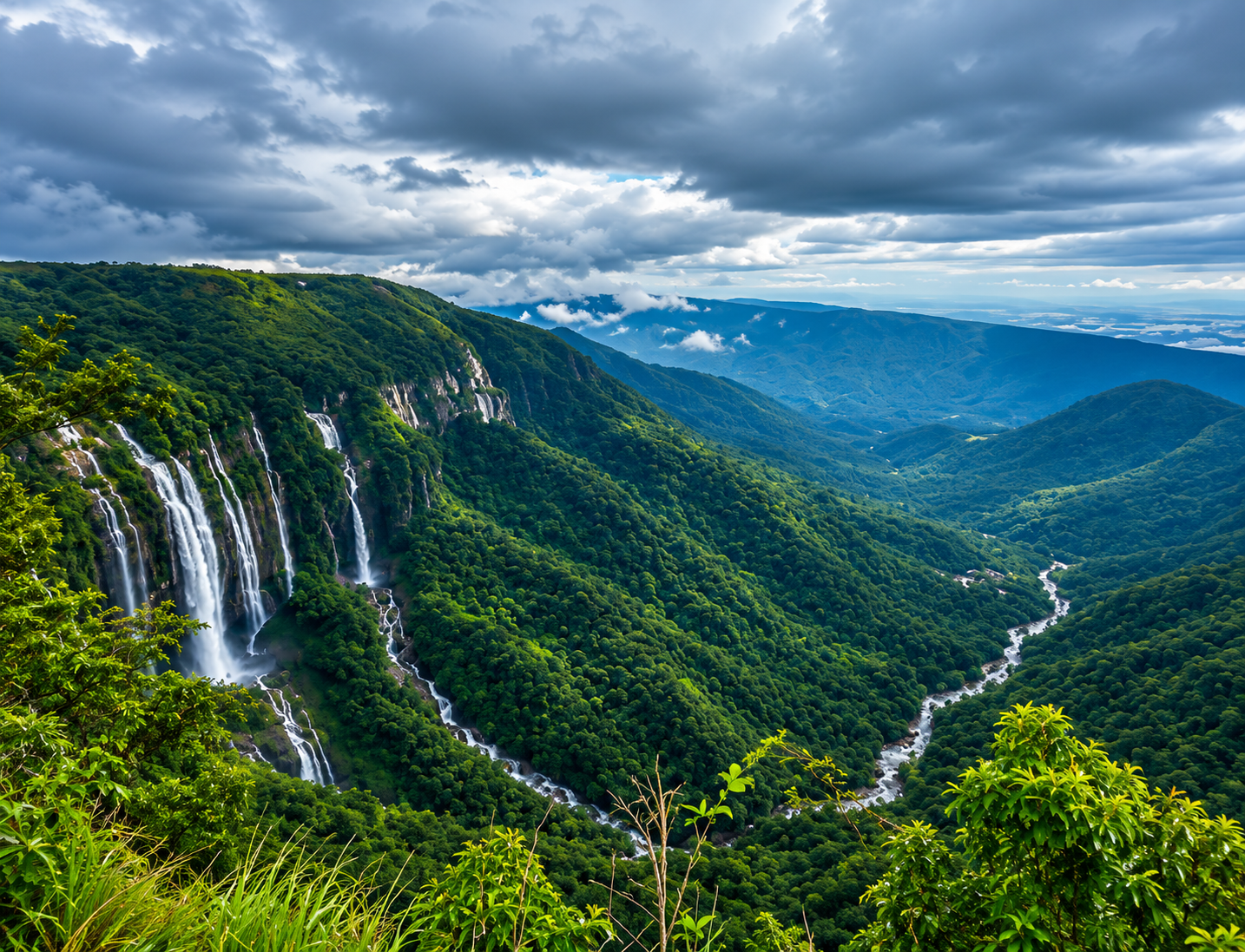
Cherrapunji's global fame rests on its extraordinary rainfall — it has long been cited as one of the wettest places on Earth, with rainfall levels that are genuinely difficult to comprehend for visitors coming from drier climates. But this isn't simply a statistical curiosity; the sheer volume of rainfall this region receives has shaped its entire landscape, creating the dramatic waterfalls, lush vegetation, and unique geological features — including the famous living root bridges — that make Cherrapunji one of Meghalaya's must-visit destinations.
Beyond the rainfall itself, Cherrapunji offers a landscape of dramatic limestone formations, deep gorges, and viewpoints that, on clear days, extend views across the plains of Bangladesh below — a reminder of just how close this region sits to the international border, and how the landscape transitions from highland Meghalaya into the lowland plains beyond.
📍 Key Attractions
🌊 Nohkalikai Falls
Among the most dramatic waterfalls in the entire region, Nohkalikai Falls plunges from a significant height into a pool below, creating a spectacle that's particularly powerful during and after monsoon season when water volumes are at their peak. The falls are associated with local legend, adding a layer of cultural narrative to what is already one of the most visually striking natural features in Meghalaya. Viewpoints near the falls offer dramatic perspectives, though the sheer scale of the falls means that photographs often struggle to fully capture the experience of seeing them in person.
🌿 Root Bridges
While living root bridges can be found in various locations throughout Meghalaya, the Cherrapunji area is home to some of the most accessible and well-known examples. These structures — created by training the roots of rubber trees across rivers and streams over generations until they form sturdy, usable bridges — represent a remarkable example of indigenous engineering that works in harmony with the local environment rather than against it. Visiting these bridges typically involves treks through forested terrain, often descending into valleys where the bridges span rivers and streams, with the trek itself becoming part of the overall experience.
🕳️ Caves
Cherrapunji and the surrounding area are home to extensive cave systems, many of which remain relatively unexplored compared to more famous cave destinations elsewhere in the world. For visitors interested in caving, these systems offer opportunities ranging from relatively accessible show caves to more challenging routes for those with caving experience and appropriate equipment. The limestone geology of the region, shaped over millennia by the area's extraordinary rainfall, has created cave systems with distinctive formations that reward exploration.
🥾 Activities for Visitors
Adventure activities in and around Cherrapunji often center on the area's unique geography — from cave exploration to trekking through the valleys and gorges that define much of the landscape here. The combination of dramatic terrain and abundant water features creates opportunities for adventure that go beyond typical sightseeing.
Trekking is often essential for accessing some of Cherrapunji's most famous attractions, particularly the living root bridges, which typically require descending into valleys along forest paths before reaching the bridges themselves. These treks vary in difficulty and length, but generally reward effort with access to some of the most unique sights in the entire region.
Photography opportunities throughout Cherrapunji are exceptional, from the dramatic scale of Nohkalikai Falls to the intricate, almost sculptural quality of the living root bridges, and the broader landscape views that, on clear days, extend across vast distances toward the plains below.