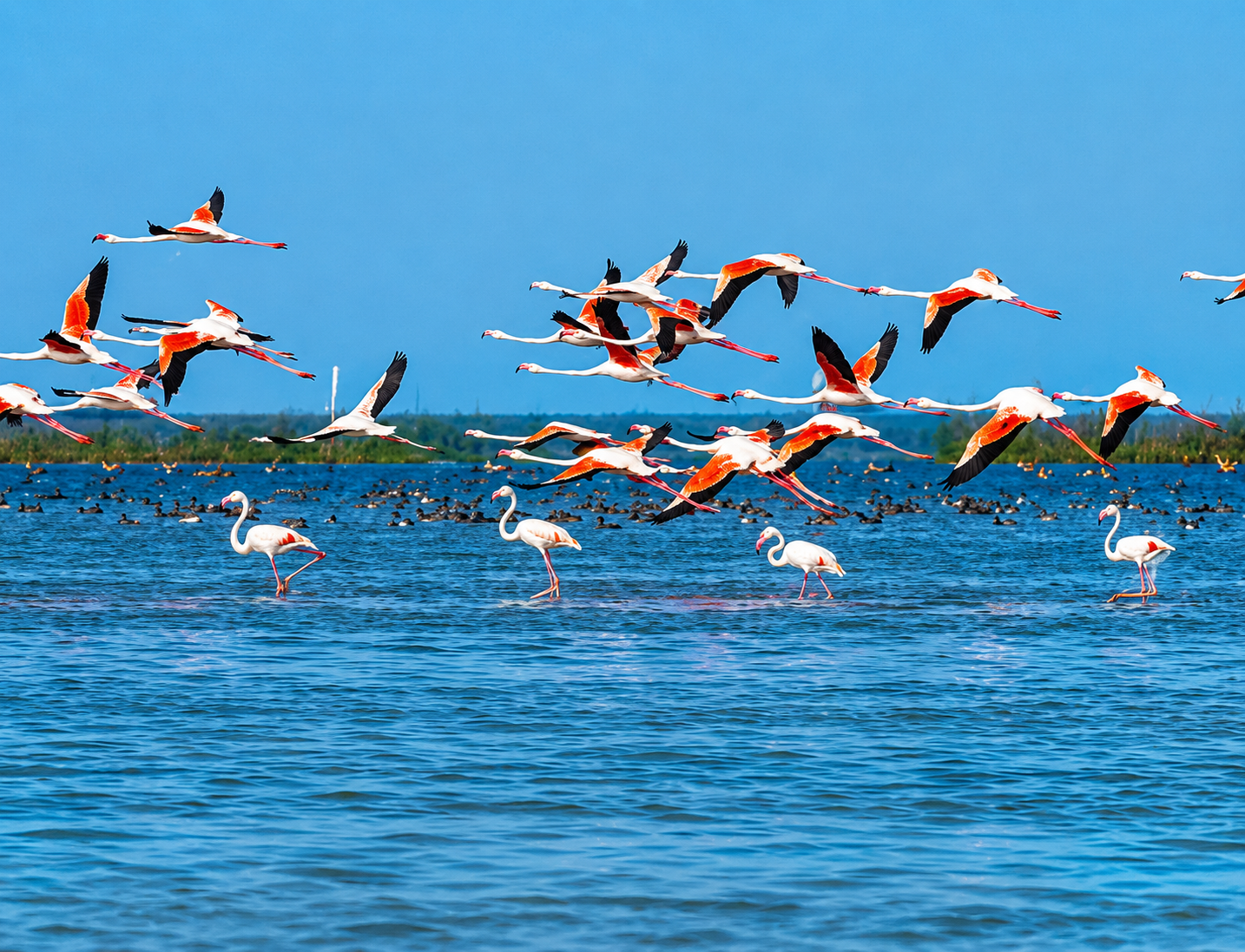
🌊 Chilika Lake (Odisha)
📖 Overview
Chilika Lake stands as one of the most magnificent and ecologically significant natural destinations in India, a vast brackish water lagoon of breathtaking scale and biological richness that holds the distinction of being the largest coastal lagoon in Asia and one of the most important wetland ecosystems in the world. Located along the eastern coastline of Odisha, spread across the districts of Puri, Khurda, and Ganjam, the lake covers an area that fluctuates between approximately one thousand one hundred square kilometres in the dry season and over eleven hundred square kilometres during the monsoon, creating a shimmering inland sea of shallow waters, reed beds, mudflats, and open channels that supports a staggering diversity of aquatic and avian life. The destination draws birdwatchers, naturalists, wildlife enthusiasts, pilgrims visiting the sacred Kalijai temple island, and travelers drawn by the extraordinary spectacle of one of the greatest migratory bird congregations in Asia, which transforms the lake each winter into a landscape of almost incomprehensible biological abundance.
What distinguishes Chilika from other wetland destinations in India is the extraordinary combination of ecological scale, biodiversity, cultural significance, and scenic beauty compressed within a single water body whose character shifts dramatically with the seasons, the tides, and the movement of the millions of migratory birds that descend upon it each winter from breeding grounds as distant as Central Asia, Siberia, and the high Himalayas. The lake's designation as India's first Ramsar Wetland of International Importance reflects a scientific consensus on its global ecological significance, while the communities of fishermen, the sacred islands, and the living traditions of the surrounding villages give Chilika a human depth that enriches the natural experience with layers of cultural meaning that few purely wildlife destinations can offer.
✨ Why Visit Chilika Lake
The designation of Chilika as a Ramsar Wetland of International Importance places it among the most ecologically significant water bodies on the planet, recognised for its role as a critical stopover and wintering ground for migratory birds traveling the Central Asian Flyway, as a nursery for commercially important fish and crustacean species, and as the habitat of the Irrawaddy dolphin population that inhabits the lake's deeper channels in one of their largest concentrations anywhere in the world. A visit to Chilika is thus an engagement with a natural system of global consequence whose complexity and richness reveal themselves progressively to those who approach it with curiosity and patience.
One of the most compelling reasons to visit is the winter bird spectacle, during which the lake receives an estimated one million or more migratory waterbirds from across Asia, creating concentrations of flamingos, bar-headed geese, greylag geese, pintails, shovelers, pochards, and dozens of other species that cover the shallower portions of the lake in dense, animated masses of colour and movement. The scale of this congregation is genuinely overwhelming when witnessed from a boat in the midst of the lake, with birds in their thousands rising and settling across every visible surface of water and the air filled with their calls in a natural spectacle of the first order.
Additionally, Chilika offers the remarkable opportunity to observe the Irrawaddy dolphin, a rare and increasingly threatened cetacean species whose largest known population in India inhabits the lake's deeper channels, particularly in the Satapada area where boat-based dolphin watching has become one of the most celebrated wildlife experiences in Odisha. These stocky, rounded dolphins, so different in appearance and behaviour from the more familiar river dolphins, surface regularly in the open waters near Satapada and their presence in a brackish lagoon rather than the open sea gives Chilika a wildlife highlight of genuine rarity and international significance.
🦜 Key Highlights Within the Lake
The Nalabana Bird Sanctuary, designated as a protected area within the lake and accessible by boat from the main entry points, represents the most wildlife-rich and carefully managed portion of Chilika's vast expanse, concentrating the highest densities of migratory waterbirds during the winter months within a defined area of shallow water and reed bed that is among the most productive birdwatching sites in India. The sanctuary's restricted access preserves the quality of the wildlife experience within its boundaries and the boat-based approach through the surrounding lake channels is itself deeply rewarding.
The Satapada area on the lake's seaward margin, where the deeper channels of the lagoon approach the barrier island separating Chilika from the Bay of Bengal, is the primary location for Irrawaddy dolphin observation and one of the most scenically dramatic portions of the lake, where the open water stretches to a horizon broken only by distant reed beds and the narrow strip of the barrier island beyond which the sea lies. Boat trips from Satapada combine dolphin watching with views of the outer channel and the sea mouth, creating an experience of expansive natural beauty alongside the wildlife highlight.
The Kalijai temple, situated on a small rocky island near the centre of the lake and accessible by boat from the main ghats, is one of the most important pilgrimage sites in Odisha, dedicated to the goddess Kalijai who is venerated as the protector of fishermen and the spirit of the lake itself. The approach to the island by boat across the open water, with the temple visible from a distance against the sky, and the atmosphere of devotion on the island itself combine to create an experience that adds a profound cultural and spiritual dimension to the predominantly natural character of a Chilika visit.
🚤 Activities
Boat-based exploration of the lake is the primary and most essential activity at Chilika, forming the foundation of every meaningful visit. The vast scale of the lake means that different entry points, Satapada, Barkul, Rambha, and Balugaon among the most significant, provide access to different sectors and wildlife concentrations, and choosing the right entry point for the particular experience desired is an important element of visit planning. Early morning departures are strongly recommended, as the first hours of daylight produce the most favorable light for bird observation, the calmest water conditions for boat travel, and the highest levels of wildlife activity across the lake's surface.
Birdwatching from the boat across the various sectors of the lake, guided by an experienced local boatman familiar with the seasonal distribution of bird species and the locations of the most productive concentrations, is the activity most wildlife enthusiasts prioritise at Chilika. The diversity of species visible across a single well-planned morning on the water during the peak winter months is exceptional, encompassing migratory waterfowl, resident waders, herons, egrets, terns, raptors, and the occasional glimpse of rarer species that draw dedicated birdwatchers from considerable distances.
📅 Best Time to Visit
❄️ November to February
The most favorable period to visit Chilika Lake is from November to February, when the winter months bring the great influx of migratory waterbirds that transforms the lake into one of the most spectacular wildlife destinations in Asia. The peak of the bird congregation typically occurs between December and January, when the lake supports its highest densities of migratory species and the combination of clear winter skies, calm water conditions, and the extraordinary scale of the bird life creates conditions for wildlife observation of the very highest order. The Irrawaddy dolphins are also reliably present throughout this period, making the winter months the most comprehensively rewarding for wildlife enthusiasts of every interest.
🌦 Shoulder Season
The months of October and March represent pleasant shoulder periods on either side of the peak winter season, with comfortable temperatures, reasonable bird diversity, and the practical advantages of reduced visitor numbers that allow a more unhurried engagement with the lake and its wildlife. The dolphin population is present year-round and remains observable from Satapada throughout these months.
🌧 Monsoon Season
The monsoon months from June to September bring heavy rainfall to the Odisha coastline, significantly expanding the lake's surface area as the surrounding rivers flood into the lagoon and transforming the landscape into a vast expanse of grey water under overcast skies. Boat travel during the monsoon is more challenging and the bird diversity is at its lowest as the migratory species have departed for their northern breeding grounds, though the local resident waterbird population remains and the dramatic monsoon light over the open water has its own austere beauty for those willing to experience the lake in this more challenging season.
🚆 Connectivity
Chilika Lake is accessible from several directions, with Bhubaneswar, the state capital of Odisha, serving as the primary air and rail gateway for visitors approaching from outside the state. Bhubaneswar Airport offers regular domestic flights from Delhi, Mumbai, Kolkata, Chennai, and other major cities, and the city's railway station is one of the best-connected on the eastern coast of India, served by numerous express trains on the Howrah to Chennai main line. From Bhubaneswar, the lake's principal entry points are reachable by road in between one and two hours depending on the destination, with Barkul approximately one hour away and Satapada approximately one and a half hours by road through the coastal landscape of Odisha.
The town of Berhampur in the Ganjam district provides an alternative access point for the southern sectors of the lake, and the main railway line running along the Odisha coast passes through or near several of the lake's entry points, making rail travel a practical option for visitors approaching from Kolkata, Chennai, or other points along the eastern coast. The Odisha Tourism Development Corporation operates guesthouses and boating facilities at Barkul and Rambha that provide comfortable and well-located bases for lake exploration, and advance booking of both accommodation and boat services during the peak winter months is strongly recommended given the increasing popularity of Chilika as one of Odisha's premier natural destinations.
Top Attractions Near Chilika lake