```html
🏔️ Darjeeling
Queen of the Himalayan Hills
📖 Overview
Darjeeling stands as one of the most iconic and enduringly beloved hill destinations in India, a place whose name carries associations of mist-covered ridges, terraced tea gardens, colonial architecture, and one of the most celebrated mountain panoramas in the world. Located in the Darjeeling district of West Bengal, nestled in the lower ranges of the eastern Himalayas at an elevation of approximately two thousand one hundred metres, the town commands a position of remarkable natural drama, with the Kangchenjunga massif, the third highest mountain on earth, dominating the northwestern horizon on clear days with a presence that stops visitors in their tracks. The destination draws travelers from across India and the world, drawn by a combination of mountain scenery, tea culture, colonial heritage, Tibetan and Nepali cultural richness, and the unique atmosphere of a hill town that has been welcoming visitors for nearly two centuries.
What distinguishes Darjeeling from other hill stations in India is the particular density of experiences it offers within a compact, walkable town set against a backdrop of extraordinary Himalayan scale. The famous Darjeeling Himalayan Railway, a UNESCO World Heritage Site, the sunrise view from Tiger Hill over Kangchenjunga, the living culture of the tea gardens that surround the town, the monasteries and Buddhist institutions that dot the hillsides, and the vibrant Chowk Bazaar that pulses at the town's heart all combine to create a destination of layered richness that rewards extended stays and repeated visits in equal measure.
✨ Why Visit Darjeeling
The recognition of the Darjeeling Himalayan Railway as a UNESCO World Heritage Site reflects the global significance of a destination whose appeal extends well beyond scenic beauty alone. Darjeeling represents a confluence of natural grandeur, cultural plurality, and historical depth that places it in a category of hill destinations occupied by very few places in the subcontinent, offering a quality of experience that is simultaneously relaxing and intellectually engaging.
One of the most compelling reasons to visit is the opportunity to witness the Kangchenjunga sunrise from Tiger Hill, an experience that has drawn travelers to Darjeeling for well over a century and retains a power that no amount of familiarity can diminish. The spectacle of first light striking the snow-covered summit of Kangchenjunga while the valleys below remain submerged in darkness, followed by the gradual illumination of the entire range from Everest in the far west to the nearer peaks of Sikkim, constitutes one of the great natural experiences available anywhere in the Himalayan region and remains the defining memory of most Darjeeling visits.
Additionally, Darjeeling offers a cultural richness rooted in the convergence of Nepali, Tibetan, Lepcha, Bengali, and British influences that has shaped the town's identity over generations. This plurality is visible in the architecture, the food, the religious institutions, the music, and the daily life of the bazaar in ways that reward curious and attentive travelers with a sense of a genuinely distinctive place rather than a generic hill resort. The living tea culture of the surrounding gardens, where some of the world's most prized teas are produced and can be experienced directly, adds a further dimension of agricultural and sensory richness that sets Darjeeling apart.
🌄 Key Highlights Within the Area
🌅 Tiger Hill
Tiger Hill, located approximately eleven kilometres from the town centre, is the most celebrated viewpoint in Darjeeling and one of the most renowned sunrise vantage points in the entire Himalayan region. Rising to an elevation of over two thousand five hundred metres, the hill offers on clear mornings an unobstructed panorama of the Kangchenjunga massif along with distant glimpses of Everest and Makalu to the west, a view of such scale and grandeur that it justifiably ranks among the great natural spectacles of India.
🚂 Darjeeling Himalayan Railway
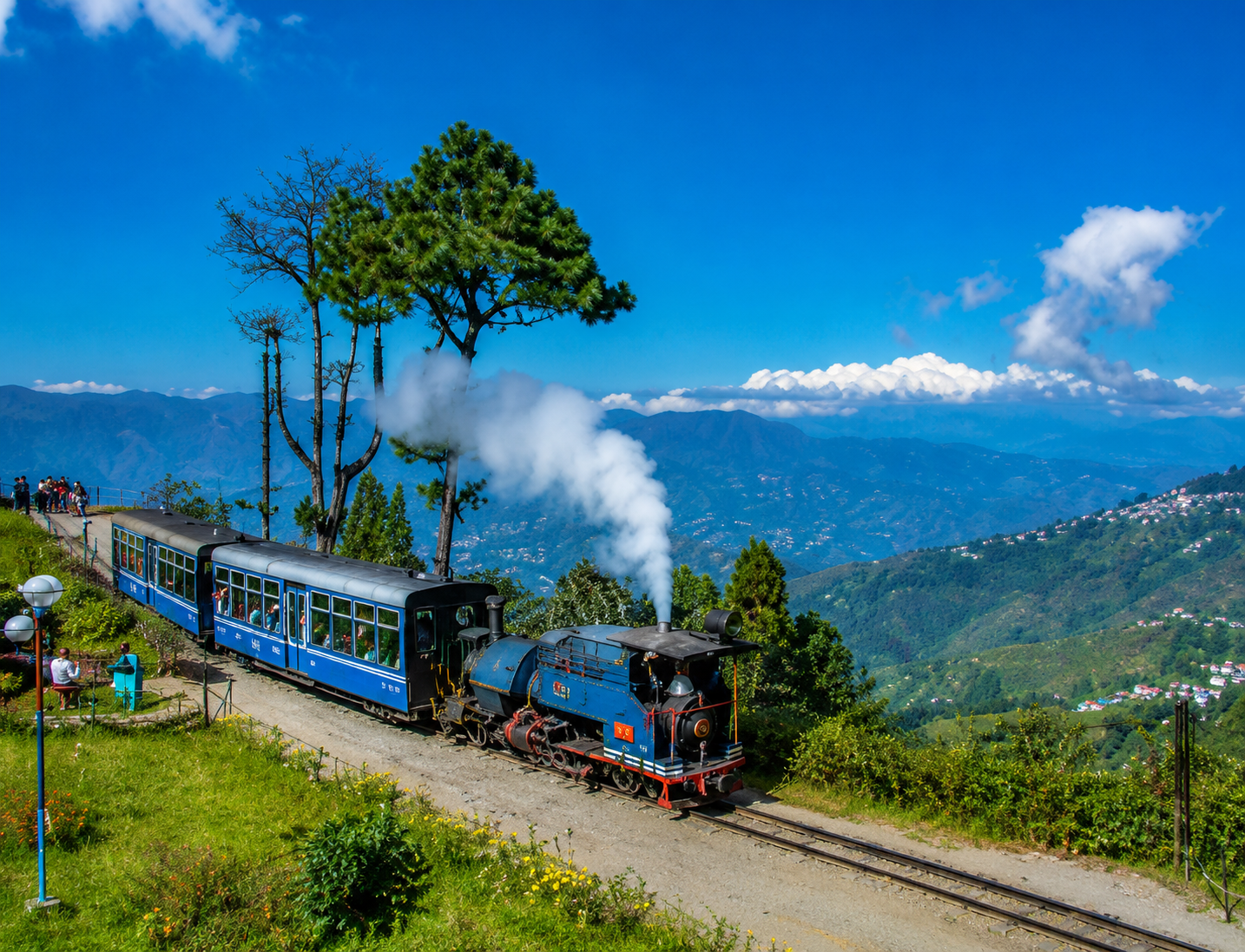
The Darjeeling Himalayan Railway, affectionately known as the Toy Train, is both a UNESCO World Heritage Site and one of the most characterful rail experiences available in the country. The narrow-gauge steam locomotive that has wound its way through the tea gardens and hill settlements between New Jalpaiguri and Darjeeling since 1881 offers a journey of extraordinary scenic beauty and historical charm, passing through a landscape of terraced gardens, forest patches, and mountain villages at a pace that allows genuine absorption of the surroundings.
🐾 Padmaja Naidu Himalayan Zoological Park
The Padmaja Naidu Himalayan Zoological Park, one of the highest altitude zoos in India, is home to significant conservation breeding programmes for the snow leopard, the red panda, and the Himalayan wolf, among other high-altitude species. The zoo's position on a forested hillside above the town, combined with the opportunity to observe these rare animals in conditions that approximate their natural habitat, makes it one of the most rewarding wildlife institutions in eastern India.
🛕 Ghoom Monastery
The Ghoom Monastery, formally known as Yiga Choeling Gompa, is among the oldest and most revered Tibetan Buddhist monasteries in the Darjeeling hills, housing a remarkable nine-foot statue of Maitreya, the future Buddha, along with an extensive collection of ancient thangkas, scriptures, and ritual objects. The monastery's atmosphere of genuine devotional life, set against the backdrop of the surrounding hills, offers a contemplative counterpoint to the town's more animated areas.
🍃 Tea Gardens
The tea gardens that cascade down the hillsides surrounding Darjeeling are among the most visually distinctive and culturally significant landscapes in the region, producing the first flush, second flush, and autumnal teas that command the highest prices in the global tea market. Several estates welcome visitors for guided tours of the plucking, withering, rolling, and drying processes, offering a complete sensory engagement with one of the world's most storied agricultural traditions.
🎯 Activities
The Tiger Hill sunrise excursion is the activity most visitors prioritise above all others at Darjeeling, typically departing from the town in the early hours of the morning by shared or private vehicle to reach the viewpoint before first light. The experience of waiting in the pre-dawn darkness among a gathered crowd and then witnessing the gradual illumination of the Kangchenjunga range is one that most visitors describe as transformative, and the return journey through the morning mist and waking tea gardens is itself deeply pleasurable.
A journey on the Darjeeling Himalayan Railway, whether the full route from New Jalpaiguri or the shorter joyride section that loops through the town and surrounding countryside, is an experience of both historical and scenic value that should not be overlooked. The rhythm of the narrow-gauge locomotive, the closeness of the passing landscape, and the sequence of views over the valleys and gardens combine to make this one of the most distinctive rail journeys in India.
Visiting one of the working tea estates for a guided tour and tasting is strongly recommended as a means of engaging directly with the agricultural tradition that has defined Darjeeling's identity and economy for over a century and a half. Several estates in the immediate vicinity of the town offer well-organised visitor programmes that move through the full production process from garden to cup, concluding with a structured tasting that illuminates the extraordinary range of flavour profiles produced by different flushes and processing methods.
Wandering through the Chowk Bazaar and the Mall Road area rewards those who approach it without haste, as the density of small shops, food stalls, monasteries, and viewpoints compressed into the town's compact central area means that almost every street offers something of interest. The bazaar is particularly animated in the early morning and evening hours, when local life reasserts itself most vividly and the town feels most authentically itself.
📅 Best Time to Visit
🌸 March to May
The most favorable period to visit Darjeeling is from March to May and again from October to November, the two windows that bracket the monsoon and offer the clearest skies, the most reliable mountain views, and the most pleasant walking conditions in the town and surrounding hills.
🍂 October to November
The spring months bring rhododendrons and other flowering shrubs into vivid bloom across the hillsides, adding a layer of natural colour to the already dramatic landscape, while October and November offer some of the clearest skies of the year and the most reliable chances of the celebrated Tiger Hill sunrise view over Kangchenjunga.
🌧️ June to September
The monsoon months from June to September bring heavy and persistent rainfall to the Darjeeling hills, obscuring the mountain views almost entirely for weeks at a time and making road travel occasionally difficult due to landslips along the hill roads.
❄️ December and February
The winter months of December and February bring cold temperatures to Darjeeling, occasionally accompanied by snowfall that transforms the town into a landscape of considerable beauty.
🚗 Connectivity
Darjeeling is accessible by multiple means, with the nearest airport at Bagdogra, located approximately ninety kilometres away in the plains below the hills, offering regular domestic flights from Kolkata, Delhi, Mumbai, and other major cities. From Bagdogra, Darjeeling is reached by road in approximately three hours through a journey of steadily increasing scenic interest as the road climbs from the plains through the tea garden belts and into the hill town itself. Shared taxis and private vehicles are readily available at the airport for this onward journey.
New Jalpaiguri, the major railway junction serving the Darjeeling region, is well connected to Kolkata, Delhi, and other major cities by numerous express and mail trains, making rail travel a comfortable and practical option for those approaching from within India. From New Jalpaiguri, road travel to Darjeeling follows the same route as from Bagdogra, taking approximately three to four hours. The historic Darjeeling Himalayan Railway also departs from New Jalpaiguri, offering a slower but infinitely more atmospheric ascent to the hill town for those with the time and inclination to experience the journey as a destination in itself.
Top Attractions Nearby
```