```html
🏛️ Kolkata (West Bengal)
📖 Overview
Kolkata stands as one of the most layered, intellectually alive, and historically significant cities in India, a metropolis whose identity has been shaped by centuries of trade, colonial transformation, political turbulence, and an extraordinarily rich tradition of literature, art, music, and philosophical inquiry that continues to animate its cultural life with uncommon vitality. Located on the eastern bank of the Hooghly river in the state of West Bengal, the city served as the capital of British India for well over a century, and the physical legacy of that period survives in a remarkable collection of colonial architecture, grand public institutions, and planned urban spaces that give Kolkata a visual character unlike any other city in the subcontinent. The destination draws historians, culture seekers, literary travelers, food enthusiasts, and those simply drawn to the particular energy of a city that has always taken its intellectual and artistic life with the utmost seriousness.
What distinguishes Kolkata from other major Indian cities is the quality of engagement it demands and rewards. This is a city that invites walking, conversation, and unhurried observation, where the grandeur of a nineteenth century building gives way without warning to a narrow lane of artisans, where a pavement bookstall yields unexpected literary treasure, and where the preparation and consumption of food is conducted with a devotion that reflects a culture in which culinary tradition is regarded as an expression of identity as serious as literature or music. The city's nickname, the City of Joy, earned through Dominique Lapierre's celebrated account of its contradictions, captures something genuine about a place that maintains a quality of human warmth and cultural pride that strikes most visitors with considerable force.
✨ Why Visit Kolkata
The recognition of Kolkata's colonial architectural heritage, its living traditions of art and intellectual life, and its position as the cultural capital of eastern India collectively establish it as one of the most rewarding urban destinations in the subcontinent for travelers with an appetite for history, culture, and the pleasures of a great city's street life. Unlike destinations defined by a single monument or landscape, Kolkata offers an entire urban environment of exceptional depth that reveals itself progressively to those willing to explore it on its own terms.
One of the most compelling reasons to visit is the opportunity to engage with a city that has produced an unparalleled concentration of Nobel laureates, pioneering filmmakers, revolutionary poets, and transformative social reformers within a relatively compact period of modern history. The Bengal Renaissance of the nineteenth and early twentieth centuries, which gave the world figures of the stature of Rabindranath Tagore, Swami Vivekananda, Raja Ram Mohan Roy, and Satyajit Ray, was rooted in this city, and the institutions, homes, and cultural spaces associated with these figures remain living presences rather than merely commemorative sites.
Additionally, Kolkata offers a quality of street life and public culture that is among the most engaging of any Indian city, from the morning rituals at the Mullick Ghat flower market and the intellectual debates of Coffee House on College Street to the evening promenade along the Hooghly riverfront and the fierce passions of a football match between the city's rival clubs. The city's festive calendar, anchored by the Durga Puja celebrations that transform every neighbourhood into an elaborately decorated open-air gallery for five days each autumn, represents one of the greatest public cultural events in India and a reason in itself to time a visit accordingly.
🌟 Key Highlights Within the City
The Victoria Memorial, standing in immaculate white marble at the southern end of the Maidan, is the most iconic single structure in Kolkata and one of the grandest monuments of the British colonial period anywhere in the world. Built to commemorate Queen Victoria and completed in 1921, the building combines Mughal and Italian Renaissance architectural elements beneath a central dome of considerable elegance, surrounded by formal gardens and approached through wide avenues that preserve the original sense of imperial grandeur. The museum within houses an extensive collection of paintings, manuscripts, arms, and archival material relating to the colonial period and the Bengal Renaissance, making it as intellectually rewarding as it is visually striking.
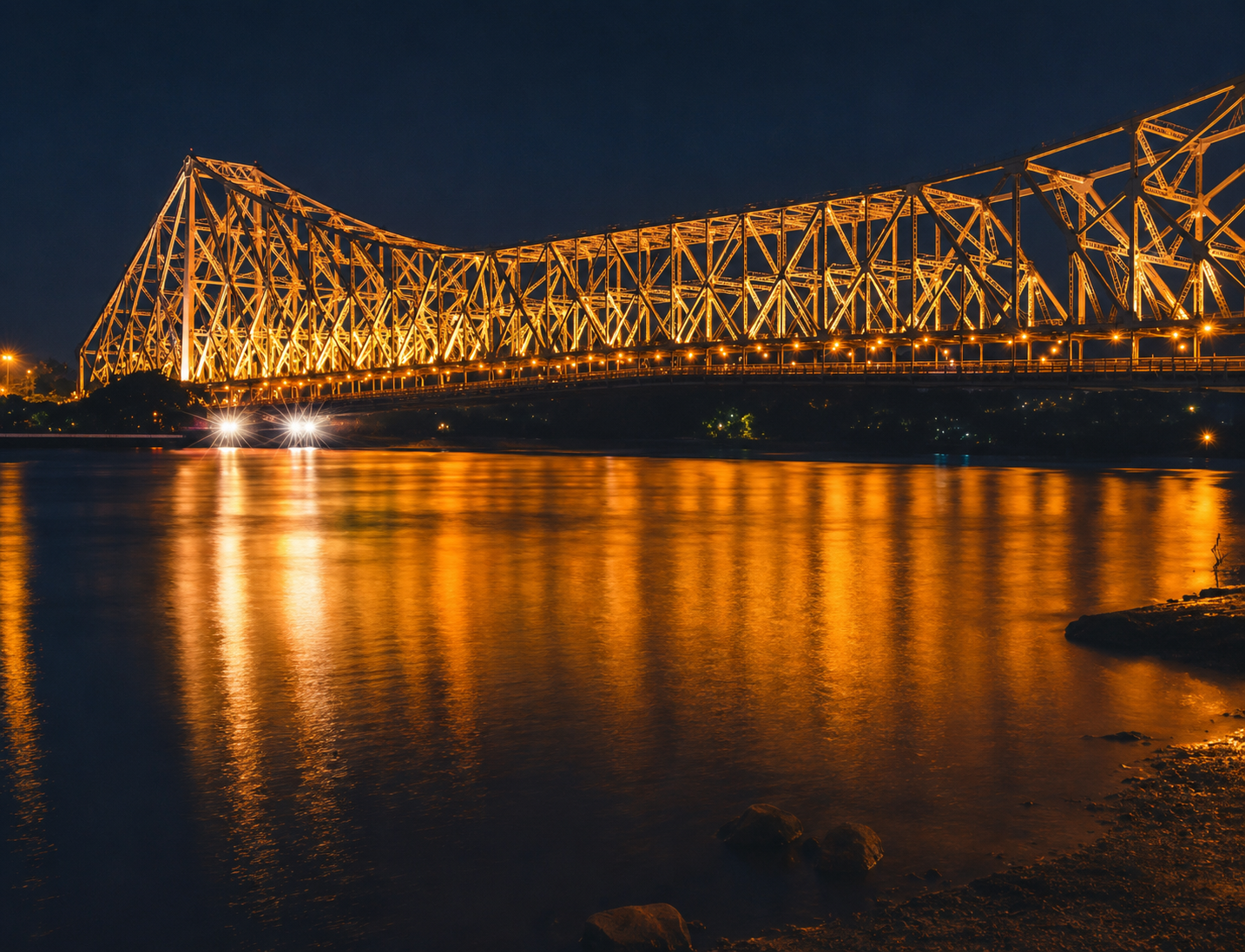
The Howrah Bridge, spanning the Hooghly river between Kolkata and Howrah in a single cantilever arch of extraordinary engineering ambition, is perhaps the most immediately recognisable image of the city and one of the busiest bridges in the world, carrying a daily volume of pedestrian and vehicular traffic that makes crossing it an experience of both physical and human drama. The bridge is particularly atmospheric in the early morning, when flower sellers, commuters, and the first light over the river combine to create a scene of concentrated urban life that has been photographed and painted more times than perhaps any other subject in the city.
The Indian Museum on Chowringhee Road, established in 1814 and thus the oldest and largest museum in India, houses a collection of breathtaking range and depth encompassing archaeological finds from across the subcontinent, natural history specimens, numismatic collections, Egyptian antiquities, and an art gallery of considerable importance. The building itself, a grand neoclassical structure arranged around a central courtyard, is as much an attraction as the collections it contains, and a thorough visit requires the better part of a full day.
The Marble Palace in the Jorasanko neighbourhood, a privately owned nineteenth century mansion filled with an extraordinary accumulation of European paintings, Chinese porcelain, Venetian chandeliers, marble statuary, and exotic taxidermy assembled by a wealthy Bengali merchant family, offers one of the most singular and atmospheric interior experiences in the city. The mansion's combination of eclectic collecting ambition, faded grandeur, and continued family occupation gives it a quality of living history that no conventional museum can replicate.
Rabindra Sarobar and the surrounding Jorasanko Thakur Bari, the ancestral home of the Tagore family and birthplace of Rabindranath Tagore, now preserved as the Rabindra Bharati Museum, together represent the most important cultural pilgrimage within the city for those drawn to the Bengal Renaissance and its enduring legacy. The mansion's rooms, preserved largely as they were during Tagore's lifetime, convey the domestic world from which one of the twentieth century's most extraordinary creative intellects emerged.
🎭 Activities
Exploring the colonial architectural heritage of Dalhousie Square, now renamed Binoy Badal Dinesh Bagh, and the surrounding streets of the old commercial quarter is among the most rewarding urban walks in India, moving through a concentration of grand Victorian and Edwardian buildings that include the Writers Building, the General Post Office, the High Court, and numerous former trading houses whose facades preserve the ambitions of a city that once styled itself the second city of the British Empire. A knowledgeable guide significantly enhances this walk, illuminating the history and human stories embedded in the architecture.
A morning visit to the Mullick Ghat flower market beneath the Howrah Bridge, followed by a walk across the bridge itself in the growing light, constitutes one of the most vivid and sensory urban experiences Kolkata offers. The scale and colour of the flower market, the density of human activity along the riverbank, and the drama of the bridge overhead combine to produce a concentrated impression of the city's energy and visual richness that rewards those willing to rise early.
College Street, the dense kilometre of pavement bookstalls, publishing houses, and coffee houses that runs through the heart of the city's university district, is an essential destination for anyone drawn to Kolkata's literary and intellectual culture. The Indian Coffee House, occupying the upper floors of a building on College Street since 1942, remains a gathering place of students, writers, and political discussants in a tradition of animated public debate that is one of the defining characteristics of Kolkata's cultural identity.
Experiencing Durga Puja, the five-day autumn festival during which every neighbourhood constructs elaborately themed pandals housing artistic interpretations of the goddess Durga, transforms Kolkata into what is arguably the largest open-air art festival in the world. Moving through the city by foot and taxi during the puja nights, visiting the most celebrated pandals across different neighbourhoods, and absorbing the extraordinary collective energy of a city fully given over to celebration is an experience that leaves most visitors with a permanent impression of Kolkata at its most joyful and most itself.
📅 Best Time to Visit
🍂 October to February
The most favorable period to visit Kolkata is from October to February, when the post-monsoon air carries a welcome coolness that makes extended walking and outdoor exploration genuinely pleasant. October is particularly special as it coincides with the Durga Puja festival, when the city undergoes its annual transformation into a landscape of creative and devotional spectacle that represents the fullest possible expression of Bengali cultural identity. The winter months of November through February offer the most comfortable daytime temperatures and clear skies that make the colonial architecture and riverside views at their most photogenic.
🌸 March and April
The spring months of March and April offer a brief transitional window before the onset of summer heat, during which the city's gardens are in bloom and the temperature, while rising, remains manageable for those willing to adjust their sightseeing to the cooler morning and evening hours. The Saraswati Puja and Holi celebrations during this period add further festive colour to the city's already animated cultural calendar.
🌧️ May to September
The summer months from May to June and the monsoon from July to September bring intense heat and humidity to Kolkata, making extended outdoor activity during the middle of the day uncomfortable for most visitors. The monsoon rains, arriving in June and persisting through September, can cause localised flooding in some parts of the city and complicate movement between sites, though the relief from the summer heat that the rains bring is welcomed by residents and the city retains its cultural vitality throughout this period.
🚆 Connectivity
Kolkata is one of the best connected cities in India, served by the Netaji Subhas Chandra Bose International Airport which offers extensive domestic connections to all major Indian cities and international flights to destinations across Asia, the Middle East, and beyond. The airport is located approximately fifteen kilometres from the city centre and is accessible by the Kolkata Metro's Airport Line, by prepaid taxi, and by app-based cab services, making the journey into the city straightforward for arriving travelers.
Howrah Junction and Sealdah Station, the two principal railway termini of Kolkata, together constitute one of the busiest and most comprehensively connected rail hubs in India, with services to virtually every major city in the country including multiple daily trains to Delhi, Mumbai, Chennai, and the key destinations of eastern India including Patna, Varanasi, Bhubaneswar, and Guwahati. The Kolkata Metro, India's oldest underground railway system, provides efficient connectivity across the city's north-south axis and its expanding network of new lines is progressively improving east-west and cross-river connections, making navigation within the city increasingly practical for visitors unfamiliar with its geography.
Top Places to Visit Around
```