🌄 Overview
Meghalaya stands as one of the most hauntingly beautiful and ecologically extraordinary destinations in India, a state whose very name — derived from Sanskrit meaning the Abode of the Clouds — captures the essence of what it offers to every traveller who crosses into its misty highlands. Carved out as an independent state in 1972 from Assam and situated in the northeastern corner of India, Meghalaya occupies a landscape of rolling hills, deep river gorges, living forests, and cascading waterfalls that together create one of the most visually dramatic natural environments anywhere on the subcontinent.
The state is home to three predominant tribal communities — the Khasi, the Jaintia, and the Garo — whose cultures, languages, traditions, and governance structures have shaped the character of the land for centuries and continue to define the social and spiritual identity of Meghalaya today. Each community inhabits a distinct hill range that bears its name — the Khasi Hills, the Jaintia Hills, and the Garo Hills — and each brings its own festivals, music, architecture, and craftsmanship to the rich cultural fabric of the state. The matrilineal social structure of the Khasi and Jaintia peoples, in which lineage and inheritance pass through the mother's line, is among the most distinctive cultural features of any community in India and lends Meghalaya a sociological character that is genuinely unlike anywhere else in the country.
What distinguishes Meghalaya from other hill states in northeast India is the convergence of record-breaking rainfall, some of the oldest living bridges in the world crafted from tree roots, an extraordinary cave system, and a capital city carrying a colonial heritage that has earned it the informal title of the Scotland of the East. This layered identity, where natural wonder, tribal culture, colonial history, and ecological significance are woven tightly together, elevates Meghalaya into a destination of rare and lasting depth.
🌿 Why Visit Meghalaya
The most compelling reason to visit Meghalaya is the singular quality of its landscape — a landscape shaped more intimately by rainfall than perhaps anywhere else on earth.
Cherrapunji, known locally as Sohra, and the nearby village of Mawsynram together hold records for the highest rainfall ever measured on the planet, a distinction that has shaped the terrain in extraordinary ways. The waterfalls here fall from remarkable heights into deep gorges, the rivers run fast and clear, the forests are saturated with moisture and life, and the clouds that give the state its name move through the valleys and over the hilltops as a constant, living presence.
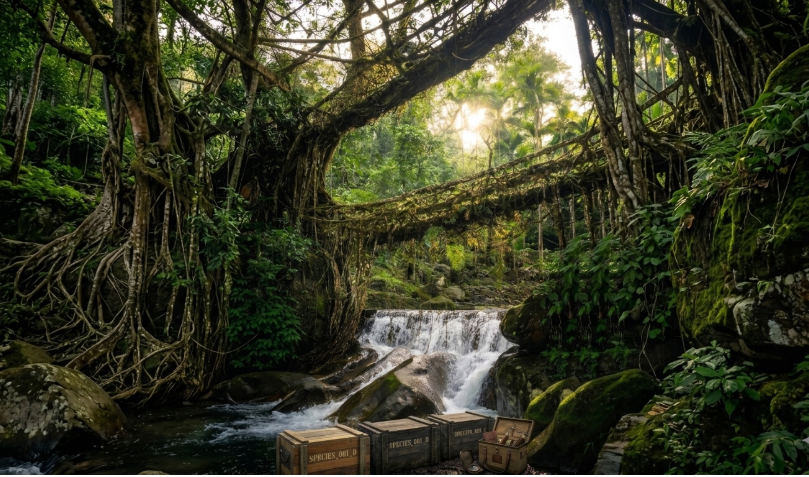
The living root bridges of the East Khasi Hills are among the most remarkable natural engineering achievements found anywhere in the world. Grown over generations by the Khasi people by training the aerial roots of rubber fig trees across river gorges, these bridges — some of which are double-decker structures hundreds of years old — have become both a symbol of Meghalaya and a destination of global significance for those interested in ecological ingenuity, indigenous knowledge, and the relationship between human communities and their natural environments.
Meghalaya also offers a quality of experience increasingly rare in Indian tourism: genuine solitude in a landscape of great beauty. Compared to the hill stations of the Himalayas or the coasts of the south, the state receives fewer visitors, its forests are less degraded, its villages more intact, and its cultural traditions more actively lived. For the traveller seeking a destination that rewards curiosity, patience, and a willingness to leave the main road, Meghalaya offers returns of unusual richness.
📍 Key Highlights Within the Area
🏙️ Shillong
Shillong, the capital city, is the natural starting point for any exploration of Meghalaya and a destination of considerable interest in its own right. Set at an altitude of approximately 1,500 metres in the Khasi Hills, the city combines Scottish colonial architecture, Presbyterian churches, bustling markets, a thriving live music scene, and a surrounding landscape of pine forests and waterfalls that prompted the original comparison with Scotland. Ward's Lake, the Shillong Peak viewpoint, the Elephant Falls, and the vibrant Police Bazaar shopping district are among the city's most visited landmarks, while the Don Bosco Centre for Indigenous Cultures houses one of the most comprehensive museums of northeastern tribal heritage in India.
🌊 Cherrapunji
Cherrapunji, situated approximately 56 kilometres from Shillong, is the most celebrated natural destination in the state, offering a dramatic landscape of limestone cliffs, deep gorges, cascading falls, and the entrance points to the living root bridge trails that lead down into the forested river valleys below. The Nohkalikai Falls, plunging 340 metres into a turquoise pool at the base of a cliff, are among the tallest waterfalls in India and one of the most visually striking natural features in the northeast. The Mawsmai Cave, a well-illuminated limestone cave system open to visitors, and the Seven Sisters Falls — a series of seven parallel streams that cascade down a single cliff face — add further geological and scenic interest to the Cherrapunji area.
🌉 Double Decker Living Root Bridge
The Double Decker Living Root Bridge at Nongriat, reached after a descent of over 3,000 stone steps through dense forest, is arguably the most iconic image associated with Meghalaya and one of the most extraordinary natural structures in India. Growing stronger with age and capable of supporting the weight of fifty or more people, this double-storeyed bridge of intertwined roots above a clear forest stream has become one of the defining experiences of travel in the northeast.
🚣 Dawki & Mawlynnong
Dawki, on the border with Bangladesh, is home to the Umngot River, whose waters are so clear that boats appear to float on glass above the riverbed — a sight that has drawn considerable attention in recent years and made Dawki one of the most photographed river destinations in the country. The Mawlynnong Village in the East Khasi Hills, widely recognised as one of the cleanest villages in Asia, offers a window into the orderly, community-managed rural life of the Khasi people and a viewpoint over the plains of Bangladesh from its canopy walkway.
🎭 Cultural Festivals
The Nongkrem Dance Festival, celebrated annually in the Khasi Hills, and the Wangala Festival of the Garo people are among the most culturally vibrant events in the northeast, drawing visitors who come to witness elaborate traditional dress, music, and ritual that connect living communities to centuries-old traditions.
🥾 Activities
Trekking is one of the most rewarding activities Meghalaya offers, with trails ranging from the demanding descent to the Nongriat root bridges to longer multi-day routes across the Khasi and Jaintia Hills through villages, forests, and river valleys that see very few visitors. The David Scott Trail, a historic mule track from the British period running approximately sixteen kilometres through forested highland, is one of the most popular and historically evocative treks in the state.
Caving is a major attraction for adventure travellers, as Meghalaya is home to the longest cave systems in South Asia. The Krem Liat Prah system in the Jaintia Hills stretches for over thirty kilometres underground and forms part of an expanding network of passages that cave explorers continue to map. The Siju Cave in the Garo Hills, known for its impressive stalactite formations and bat population, is another significant destination for those drawn to underground landscapes.
Kayaking and river activities on the fast-flowing streams of the Khasi Hills, camping in the forests around Cherrapunji and Mawsynram, rock climbing on the limestone outcrops of the Jaintia Hills, and mountain biking across the highland roads of the state provide a full range of adventure options. Photography, particularly of the root bridges, the waterfalls, the river valleys, and the cultural festivals, rewards extensive time and exploration across all three hill ranges.
Shopping for locally woven textiles, bamboo crafts, tribal jewellery, and the distinctive handloom products of the Garo, Khasi, and Jaintia communities at the markets of Shillong and in village craft centres is a meaningful way to engage with the state's cultural economy and bring home something genuinely representative of Meghalaya.