```html
🎓 Nalanda (Bihar)
📖 Overview
Nalanda stands as one of the most intellectually and spiritually resonant destinations in India, embodying the legacy of what was once the greatest centre of learning in the ancient world. Located in the Nalanda district of Bihar, approximately ninety kilometres southeast of Patna, the site preserves the magnificent ruins of a monastic university that flourished for several centuries before its destruction in the twelfth century. The destination draws scholars, Buddhist pilgrims, historians, and curious travelers from across the globe, drawn by a landscape of beautifully excavated monasteries, temples, and lecture halls that speak to a civilization of extraordinary intellectual ambition.
What distinguishes Nalanda from other ancient sites in the subcontinent is not merely the scale of its ruins, but the depth of the intellectual tradition they represent. At its height, the university is said to have hosted thousands of scholars and students from across Asia, including China, Korea, Tibet, and Central Asia, establishing it as a truly cosmopolitan centre of Buddhist philosophy, logic, grammar, medicine, and the arts. The UNESCO World Heritage Site designation, along with the adjacent Nalanda Archaeological Museum and the modern Nalanda University nearby, reinforces the destination's identity as a place where ancient memory continues to inspire present-day intellectual endeavour.
✨ Why Visit Nalanda
The recognition of Nalanda as a UNESCO World Heritage Site reflects its unparalleled importance within the history of human civilization. Unlike sites associated with a single ruler or religious event, Nalanda represents centuries of sustained scholarly achievement, drawing together the brightest minds of the ancient world within a single campus of remarkable architectural sophistication.
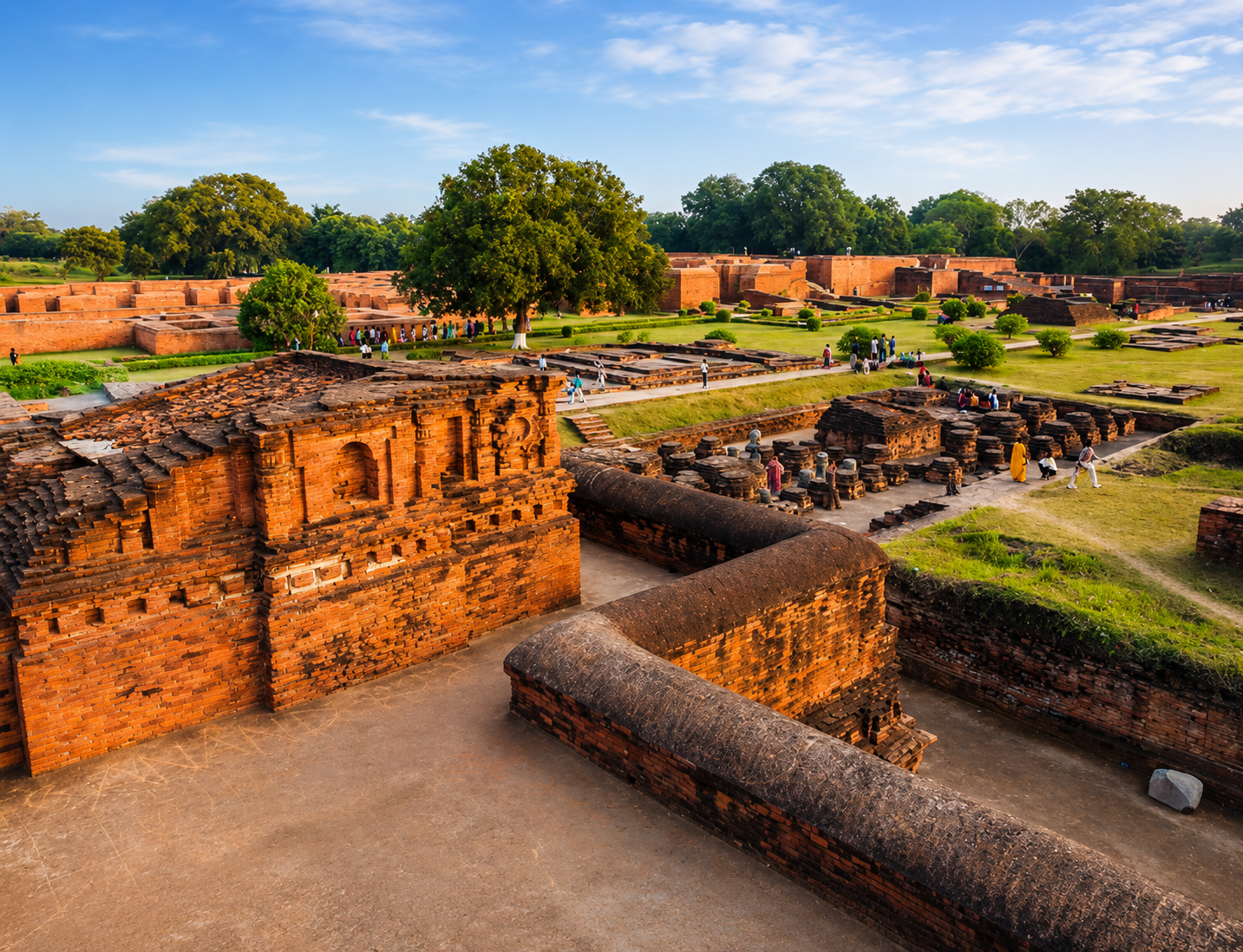
One of the most compelling reasons to visit is the rare opportunity to walk through the physical remains of an institution that shaped the intellectual contours of Buddhism across Asia. The excavated ruins reveal a carefully planned campus with multiple monasteries arranged in orderly rows, meditation courtyards, and elevated temple platforms that convey a sophisticated vision of communal scholarly life. The site is closely associated with figures of immense historical importance, including the Chinese pilgrim Xuanzang, whose seventh-century accounts of Nalanda remain among the most vivid primary sources for understanding the university at its peak.
Additionally, Nalanda benefits from its position within one of Bihar's most rewarding heritage corridors. Its proximity to Rajgir, Bodh Gaya, and Vaishali means that a visit can be meaningfully combined with other major Buddhist and historical sites, making it a central anchor for those exploring the broader landscape of ancient India. The serene atmosphere of the ruins, set amid well-maintained gardens, further distinguishes the experience as one of quiet contemplation rather than simple sightseeing.
🏛️ Key Highlights Within the Area
🛕 Great Stupa of Sariputta
Among the archaeological remains, the great stupa of Sariputta is the most visually commanding feature of the excavated site. Rising in a series of terraced platforms adorned with decorative niches, votive stupas, and panels of sculptural detail, this structure stands as the architectural and spiritual centrepiece of Nalanda, associated with one of the Buddha's foremost disciples. The layered construction, representing successive phases of expansion over many centuries, gives the stupa a monumental presence that rewards close inspection.
🏫 Excavated Monasteries
The excavated monasteries, arranged along orderly north-south corridors, offer a vivid sense of daily life at the ancient university. Each monastery follows a similar layout of individual cells arranged around a central courtyard, with wells, kitchens, and shrines indicating the self-sufficient character of monastic life. Walking through these open-air ruins conveys both the scale of the institution and an intimate sense of the human activity that once animated this campus.
🏺 Nalanda Archaeological Museum
The Nalanda Archaeological Museum, located just outside the main excavation site, houses an impressive collection of sculptures, bronzes, terracottas, and inscriptions recovered from the ruins. Its galleries contextualise the material culture of the university and provide essential background for understanding the significance of what one encounters within the site itself.
🌏 Xuanzang Memorial Hall
The nearby Xuanzang Memorial Hall, built in recognition of the Chinese scholar-pilgrim who studied at Nalanda in the seventh century, adds an important cross-cultural dimension to the visit, illustrating the extraordinary reach of the university's influence across the Asian world.
🚶 Activities
Exploring the excavated ruins is the primary activity at Nalanda, with the well-laid pathways allowing visitors to move methodically through the monasteries, temples, and lecture hall remains at their own pace. Engaging a local guide enriches the experience considerably, as many structural details, sculptural fragments, and historical associations are not immediately apparent without contextual knowledge.
A visit to the Nalanda Archaeological Museum is strongly recommended as a companion to the ruins, ideally undertaken either before entering the site for context or afterward to deepen understanding of the objects and architectural details encountered during the walk. The museum's collection of Buddhist sculpture and decorative arts represents some of the finest examples recovered from the site.
The modern Nalanda University campus, established in recent years as a revival of the ancient institution, welcomes visitors and offers a thoughtful counterpoint to the ruins, illustrating the enduring aspiration to restore Nalanda's identity as a centre of international learning. A combined day trip incorporating both Nalanda and the nearby heritage sites of Rajgir is widely undertaken, providing a deeply rewarding experience of Bihar's ancient past within a single itinerary.
📅 Best Time to Visit
🍂 October to March
The most favorable period to visit Nalanda is from October to March, when temperatures across the Bihar plains are pleasantly cool and conditions are ideal for extended outdoor exploration of the open-air ruins.
🌧️ July to September
The monsoon season from July to September brings relief from the summer heat and transforms the surrounding landscape with patches of greenery, lending the ruins a more atmospheric quality.
☀️ April to June
The summer months from April to June bring intense heat to the plains, making daytime exploration of the open ruins physically demanding.
🚗 Connectivity
Nalanda is conveniently accessible from several major urban centres in Bihar. Patna, located approximately ninety kilometres to the northwest, serves as the primary air and rail gateway, with the airport offering regular domestic flights from Delhi, Mumbai, Kolkata, and other major cities. From Patna, Nalanda is reachable by road in roughly two hours, making a day trip entirely feasible for those based in the state capital.
Road connectivity is well established, with Nalanda linked by good quality routes to Patna, Rajgir, Bodh Gaya, and Gaya, all within comfortable driving distance. Rajgir, just fifteen kilometres away, is the most natural pairing destination, and the two are frequently combined within a single day's itinerary. Gaya Junction, one of the region's major railway stations, provides an additional rail access point for visitors approaching from southern Bihar or from Kolkata.
Famous places nearby
```