```html
🏛️ Rajgir
📖 Overview
Rajgir stands as one of the most historically layered and spiritually significant destinations in India, representing a rare convergence of ancient political power and multi-faith pilgrimage. Situated amid a ring of low rocky hills in the Nalanda district of Bihar, Rajgir was once the capital of the powerful Magadha Empire and is closely associated with the lives of both Gautama Buddha and Lord Mahavira. The destination draws pilgrims, historians, and travelers from across the world, offering a landscape defined by ancient fortifications, sacred hilltop shrines, and a setting where successive empires and faiths have left their mark across more than two and a half thousand years.
What distinguishes Rajgir from other heritage destinations in the region is not merely its antiquity, but the unique combination of imperial history, living religious tradition, and natural hot springs embedded within this compact hill-ringed town. The area is anchored by the Cyclopean Wall that once encircled the ancient city, the Griddhakuta Hill where the Buddha is believed to have delivered key sermons, and the gleaming Vishwa Shanti Stupa that crowns one of the surrounding peaks. This layered character elevates Rajgir beyond a simple historical site into a destination of genuine archaeological and spiritual discovery.
✨ Why Visit Rajgir
The recognition of Rajgir as one of ancient India's great capitals reflects its unparalleled importance within the subcontinent's political and religious history. Unlike isolated monuments or single-faith pilgrimage spots, Rajgir offers a cohesive experience where Buddhist, Jain, and Hindu traditions intersect with imperial ruins to create a deeply layered destination.
One of the most compelling reasons to visit is the sheer continuity of sacred and political memory the town preserves. The Buddha is said to have spent several monsoon retreats here, delivering sermons on Griddhakuta Hill, while Mahavira, the founder of Jainism, spent considerable time meditating in the surrounding hills, making Rajgir one of the few places where both traditions converge so closely. The hilltop Vishwa Shanti Stupa, reached by a scenic ropeway, offers a calm, reflective environment that draws monks, pilgrims, and curious travelers alike, regardless of personal faith.
Additionally, Rajgir showcases a strong sense of natural and therapeutic appeal through its sulphur hot springs at Brahmakund, considered sacred by Hindu pilgrims for their believed healing properties. The combination of deep history, multi-faith pilgrimage, and proximity to the ancient university town of Nalanda further strengthens its appeal as a meaningful heritage destination.
🌄 Key Highlights Within the Area
🪨 Cyclopean Wall
Among the historical landmarks, the Cyclopean Wall stands out as the most evocative and atmospherically distinctive feature of Rajgir. Built from massive unhewn stones stacked without mortar, this ancient fortification once stretched for many kilometres around the city and offers a striking glimpse into the engineering of a civilization more than two millennia old. The weathered stonework, set against the surrounding hills, creates a visual experience that feels remarkably intact given its age.
☮️ Vishwa Shanti Stupa
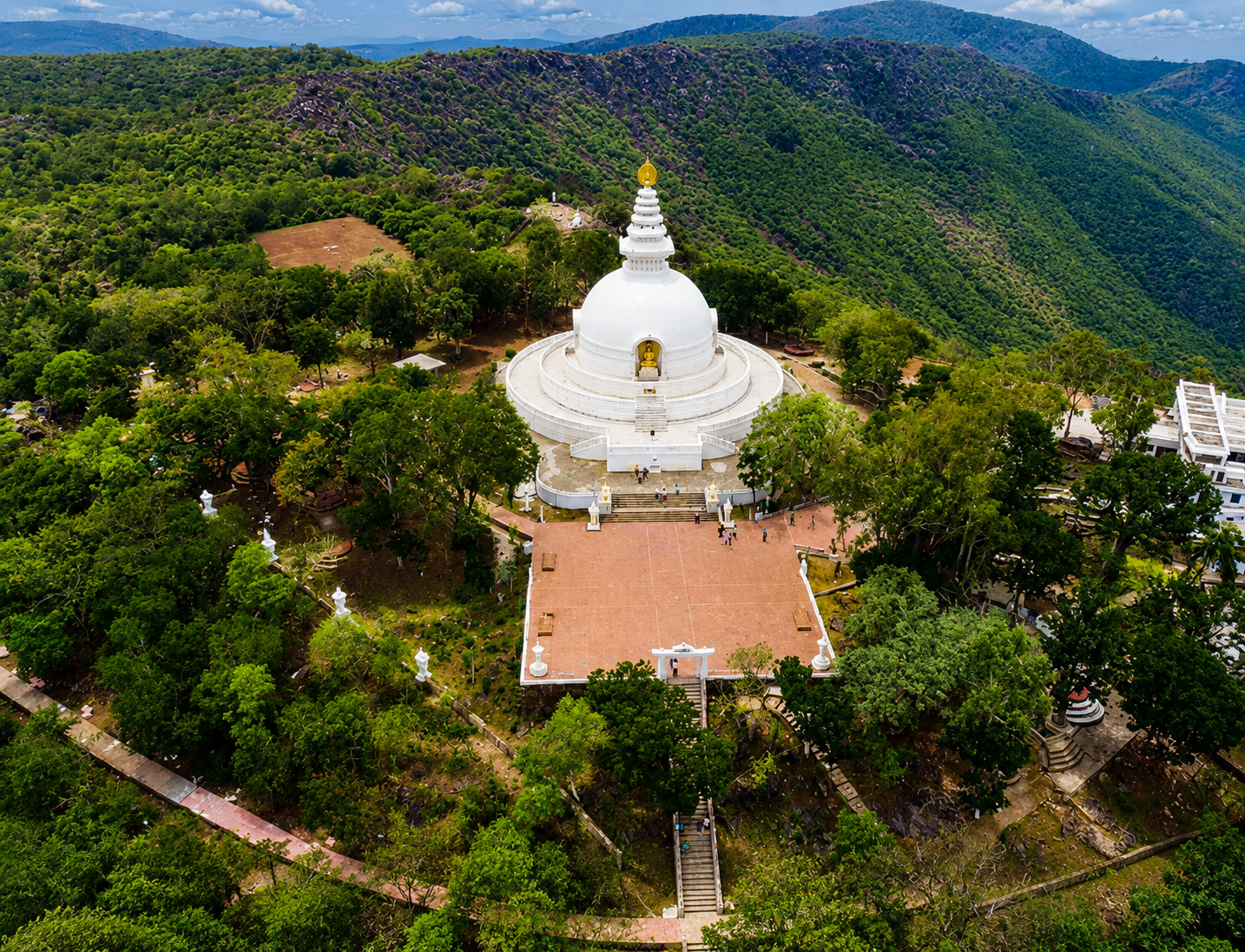
The Vishwa Shanti Stupa, a gleaming white peace pagoda perched atop Ratnagiri Hill, is another significant highlight. Accessible by India's only ropeway operating over a Buddhist pilgrimage site, the stupa offers commanding panoramic views of the valley below and the layered ridgelines surrounding Rajgir, providing a compelling combination of modern devotion and natural scenery in a single vantage point.
🌉 Rajgir Glass Bridge
The Rajgir Glass Bridge, a recently constructed skywalk suspended high above a forested gorge, adds a contemporary adventure dimension to the visit, particularly for younger visitors and thrill-seekers, offering a structure that connects people meaningfully with the dramatic terrain below.
🍃 Seasonal Beauty
The visual experience of Rajgir changes considerably with the seasons, as winter brings a crisp clarity to the hilltop views, while the monsoon transforms the surrounding hills into vivid shades of green. This seasonal variation adds depth to the visitor experience, making repeat visits particularly rewarding.
🥾 Activities
Hilltop pilgrimage walks are the primary activities at Rajgir, with routes leading to Griddhakuta Hill, the Saptaparni Caves, and the Vishwa Shanti Stupa offering varying lengths and difficulty levels. These walks provide opportunities to visit sites associated with early Buddhist councils and to take in sweeping views across the surrounding hills.
Bathing in the Brahmakund hot springs is a popular ritual activity, offering pilgrims a chance to experience the sulphur-rich waters believed to carry healing properties. Early morning hours are particularly favorable, as the relative quiet allows for a more contemplative visit to the kund and surrounding temples.
The nearby Son Bhandar Caves and Jarasandh ki Baithak, associated with ancient legend and rock-cut architecture, offer further historical and cultural interest, drawing curious visitors alike. A day trip to the nearby ruins of Nalanda University is also widely undertaken, rewarding those who make the effort with insight into one of the ancient world's great centers of learning.
📅 Best Time to Visit
🌤️ October to March
The most favorable period to visit Rajgir is from October to March, when temperatures are pleasant and the skies tend to be clear, allowing for comfortable hilltop walks and extended time at outdoor sites. During these months, the cool air and moderate conditions make exploring the ropeway route and surrounding ruins particularly enjoyable.
🌧️ July to September
The monsoon season from July to September transforms the hills with lush greenery and a refreshing atmosphere that many visitors find appealing, recalling the season in which the Buddha himself is said to have retreated here. However, intermittent rainfall and humidity require some preparation.
☀️ April to June
The summer months from April to June bring intense heat to this part of Bihar, making outdoor exploration considerably more demanding, though early mornings and the cooler hot spring waters still draw dedicated pilgrims during this period.
🚆 Connectivity
Rajgir is conveniently accessible from several major urban centers in Bihar. Patna, located approximately 100 kilometres away, is the nearest major city and serves as the most practical air and rail gateway, with Patna's airport offering regular domestic flights from Delhi, Mumbai, and other major cities. Rajgir also has its own railway station with direct connections to Patna and nearby towns.
Road connectivity is efficient, with well-maintained routes linking Rajgir to Patna, Nalanda, and Bodh Gaya, all within a few hours' drive. This makes it a highly practical inclusion in heritage and pilgrimage circuits across Bihar, as well as a popular destination for travelers combining visits to Nalanda and Bodh Gaya within the same itinerary.
Top Attractions Nearby
```