```html
🎨 Shantiniketan (West Bengal)
📖 Overview
Shantiniketan stands as one of the most culturally singular and spiritually serene destinations in India, a place whose identity is inseparable from the vision of Rabindranath Tagore, the Nobel laureate poet, philosopher, and educator who transformed a modest ashram established by his father Debendranath Tagore into one of the most extraordinary experiments in humanistic education and artistic creativity that the subcontinent has ever seen. Located in the Birbhum district of West Bengal, approximately one hundred and sixty kilometres northwest of Kolkata, Shantiniketan occupies a landscape of laterite soil, sal and palm trees, and wide open skies that Tagore found deeply congenial to the life of the mind and the spirit, and whose distinctive visual character permeates the art, poetry, and institutional architecture he created here over several decades. The destination draws literary pilgrims, art enthusiasts, cultural travelers, students, and those seeking a quality of quiet and reflective engagement with one of the most influential creative legacies in modern Indian history.
What distinguishes Shantiniketan from other heritage destinations in India is the living quality of the cultural tradition it embodies. Unlike sites associated with figures whose influence is primarily commemorated through museums and preserved buildings, Shantiniketan continues to function as a living university through Visva-Bharati, the institution Tagore founded in 1921, whose open-air classrooms, art faculties, music departments, and dance schools carry forward a pedagogical philosophy of learning in direct engagement with nature that remains as distinctive and thought-provoking today as it was a century ago. The UNESCO World Heritage Site inscription awarded in 2023 formally recognised what visitors have long understood, that Shantiniketan represents a cultural landscape of universal significance whose influence on Indian art, music, literature, and educational thought has been profound and enduring.
✨ Why Visit Shantiniketan
The recent UNESCO World Heritage Site designation of Shantiniketan reflects international recognition of a place that has functioned for well over a century as a crucible of creative and intellectual life of the first order. Unlike most heritage designations that honour the past, Shantiniketan's significance is equally rooted in a continuing present, in the students who still gather under trees for instruction, the artists who work in studios descended directly from those Tagore established, and the seasonal festivals that animate the campus with music, dance, and colour in traditions that have continued unbroken for generations.
One of the most compelling reasons to visit is the opportunity to engage directly with the physical environment that shaped and was shaped by Tagore's creative imagination. Walking through the ashram grounds, visiting Uttarayan, the complex of distinctive buildings Tagore designed and inhabited, and sitting in the open-air classrooms where the Visva-Bharati philosophy of nature-immersed learning was first practised allows a quality of imaginative connection with one of the twentieth century's most extraordinary minds that no amount of reading about Tagore from a distance can replicate. The landscape itself, with its characteristic red laterite paths, ancient trees, and wide horizon, exerts a quality of calm that visitors consistently describe as immediate and palpable.
Additionally, Shantiniketan occupies a central position in the living culture of Bengal, serving as the institutional home of Rabindra Sangeet, the body of songs composed by Tagore that remains one of the most beloved musical traditions in the Bengali-speaking world, and as the birthplace of a distinctive school of visual art whose influence on modern Indian painting has been transformative. The presence of working artists, musicians, dancers, and scholars on the Visva-Bharati campus gives the destination a quality of creative vitality that enriches every visit with encounters and observations beyond the purely commemorative.
🏛️ Key Highlights Within Shantiniketan
Uttarayan, the complex of buildings within the ashram grounds that Tagore designed and lived in across different periods of his life, represents the most intimate and architecturally distinctive heritage experience Shantiniketan offers. The five structures of the complex, each reflecting Tagore's eclectic and deeply personal architectural sensibility that drew on Mughal, rural Bengali, and modernist influences in equal measure, house the Rabindra Bhavana museum and archive, which holds the most comprehensive collection of Tagore's manuscripts, letters, artworks, personal belongings, and photographic records anywhere in the world. Moving through these rooms, where Tagore wrote, painted, and received visitors of international significance, produces a quality of historical proximity that is deeply moving.
The open-air classrooms of Visva-Bharati, where instruction has traditionally been conducted beneath the shade of ancient trees in direct accordance with Tagore's conviction that learning flourishes most naturally in the presence of the living world, remain one of the most visually distinctive and philosophically resonant features of the Shantiniketan landscape. Observing classes conducted in this manner, even briefly, communicates the essence of Tagore's educational philosophy more directly than any description of it can achieve.
The Sangit Bhavana, the faculty of music at Visva-Bharati, is the institutional home of Rabindra Sangeet and one of the most important centres of classical and folk musical education in Bengal. The music that drifts from its practice rooms and open courtyards at various hours of the day contributes significantly to the distinctive sensory atmosphere of the ashram and serves as a constant reminder of the living creative tradition that Shantiniketan sustains.
The Poush Mela, the annual fair held in the month of Poush according to the Bengali calendar, typically falling in late December, is one of the most celebrated and culturally rich fairs in West Bengal, drawing Baul singers, craftspeople, weavers, potters, and performers from across the region to the Shantiniketan grounds for several days of music, commerce, and festivity. Attending the Poush Mela offers an experience of Bengali folk culture at its most concentrated and joyful, set against the backdrop of the ashram landscape, and represents one of the most rewarding reasons to time a visit to coincide with this annual event.
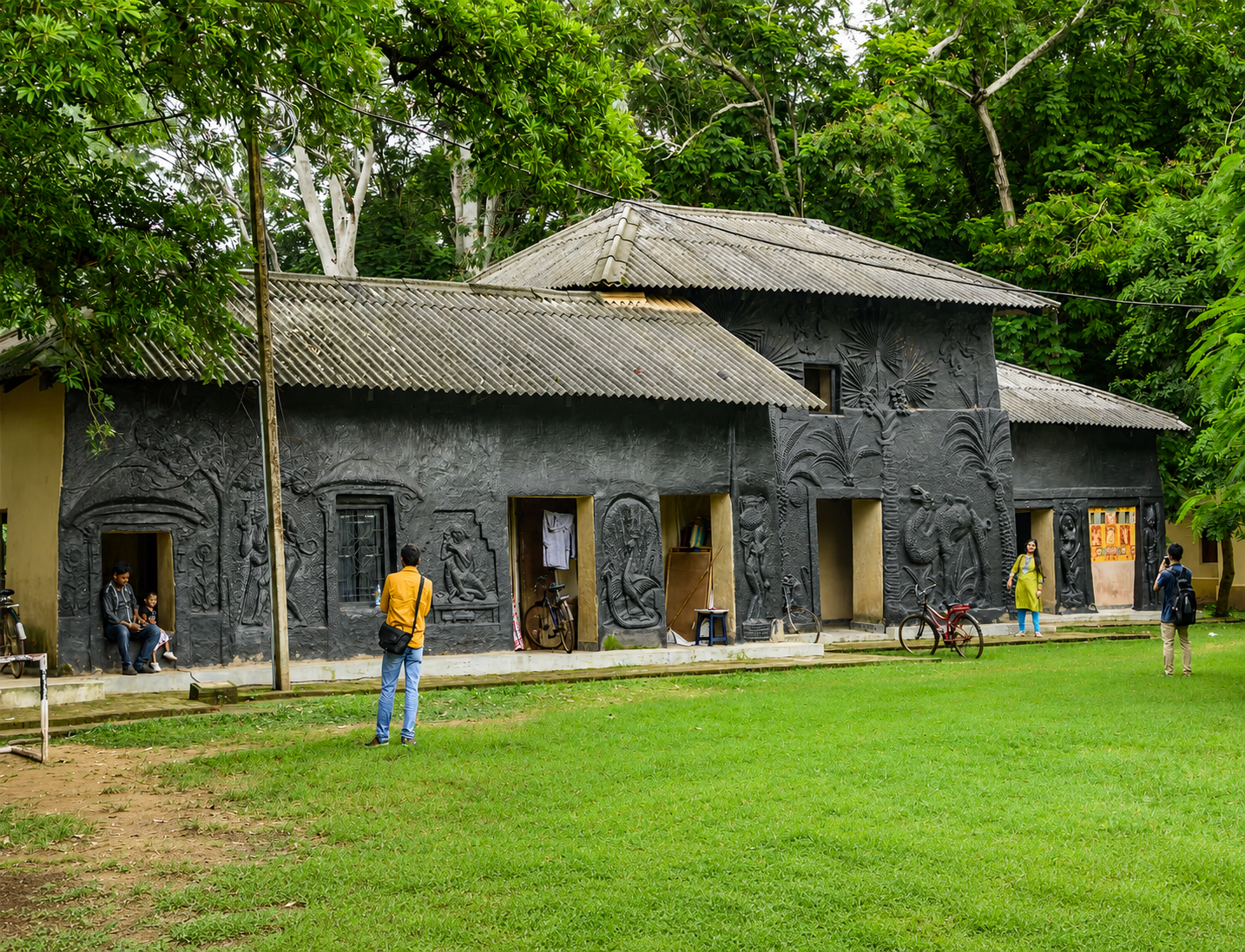
The local Santhali tribal culture visible in and around the Shantiniketan area, including the painted mud houses, distinctive textile traditions, and musical practices of the Santhali communities of Birbhum, adds a layer of anthropological and artistic richness to the destination that Tagore himself engaged with deeply and that continues to inform the artistic life of the institution he founded.
🎭 Activities
Exploring the Uttarayan complex and the Rabindra Bhavana museum at a reflective and unhurried pace is the central activity of any Shantiniketan visit, allowing time to move through Tagore's personal spaces, engage with the archival collections, and absorb the architectural character of buildings that embody one man's creative vision with unusual completeness. Arranging a guided tour through the museum's collections is strongly recommended, as the depth and range of the archive, encompassing Tagore's literary manuscripts, personal correspondence, original paintings, and Nobel Prize materials, is best appreciated with informed contextualisation.
Walking the ashram grounds and the broader Visva-Bharati campus during the morning and evening hours, when the quality of light over the laterite landscape is at its most beautiful and the campus is animated by the movement of students and the sounds of music from various faculties, offers an experience of place that is both aesthetically rewarding and intellectually stimulating. The distinctive landscape of red paths, ancient trees, and open sky that Tagore found so congenial to creative thought exerts a genuine quality of calm that most visitors find immediately affecting.
Visiting the local craft village of Sonajhuri and the weekly Sonajhuri haat, a Saturday market where Baul musicians perform and local artisans sell Kantha textiles, Dokra metalwork, terracotta, and leather goods from the Birbhum tradition, provides a vibrant and direct engagement with the folk artistic traditions of the region that complement the more formal cultural heritage of the Visva-Bharati campus. The Baul music, performed by wandering minstrels in the orange robes of their tradition, is among the most distinctive and moving musical experiences the Shantiniketan area offers.
Attending one of the seasonal festivals celebrated on the Visva-Bharati campus, including Basanta Utsav, the spring festival celebrated with colour and song on the day of Holi, Barsha Mangal marking the arrival of the monsoon, and the Poush Mela in December, transforms a visit to Shantiniketan from a heritage experience into a direct participation in living cultural traditions that have continued uninterrupted since Tagore himself established them. These festivals draw large numbers of visitors from across Bengal and beyond, and timing a visit to coincide with one of them significantly deepens the overall Shantiniketan experience.
📅 Best Time to Visit
🍂 October to March
The most favorable period to visit Shantiniketan is from October to March, when the cooler months bring pleasant temperatures to the Birbhum laterite landscape and the quality of light across the open ashram grounds is at its most beautiful. The post-monsoon months of October and November, when the vegetation is still green from the rains but the air has turned clear and cool, are particularly lovely, and the approach of the Poush Mela in December makes the later winter months especially rewarding for those wishing to experience the full cultural vitality of the destination.
🌸 March Festival Season
The spring month of March holds particular significance at Shantiniketan as the season of Basanta Utsav, the festival of colour and song that Tagore established as a celebration of the Bengali new year's approach and the arrival of spring. The campus during this period is transformed by music, dance, and the vivid colours of festival dress against the backdrop of flowering trees, creating an atmosphere of joyful celebration that is among the most memorable experiences the destination offers.
🌧️ Monsoon & Summer
The summer months from April to June bring considerable heat to the open laterite landscape of Birbhum, making extended outdoor exploration less comfortable during the midday hours, though the early mornings remain pleasant and the campus retains its characteristic tranquility. The monsoon months of July to September transform the landscape dramatically, with the red laterite soil deepening in colour against the vivid green of the rain-washed vegetation, and Tagore's own deep feeling for the monsoon, expressed throughout his poetry and music, lends this season a particular resonance for those who come to Shantiniketan with his work in mind.
🚆 Connectivity
Shantiniketan is most conveniently accessible from Kolkata, with the Bolpur railway station, located approximately three kilometres from the ashram grounds, served by regular express and mail trains from Howrah and Sealdah stations. The journey from Kolkata to Bolpur takes approximately two to two and a half hours on the faster services, making a day trip feasible for those based in Kolkata, though an overnight or two-night stay is strongly recommended to allow the unhurried pace of exploration that Shantiniketan most rewards. The Shatabdi Express connecting Kolkata and Bolpur is among the most practical and comfortable options for this journey.
Road connectivity from Kolkata is also well established, with the distance of approximately one hundred and sixty kilometres typically covered in three to three and a half hours depending on traffic conditions, particularly through the urban outskirts of Kolkata. Private vehicles and hired cars provide the greatest flexibility for those wishing to combine Shantiniketan with nearby destinations such as the Bishnupur terracotta temple complex in Bankura or the Tarapith temple and Kenduli Mela sites within the Birbhum district, all of which fall within comfortable driving distance and together constitute one of the most culturally rich multi-destination itineraries available in West Bengal.
Best Places to Explore Nearby
```