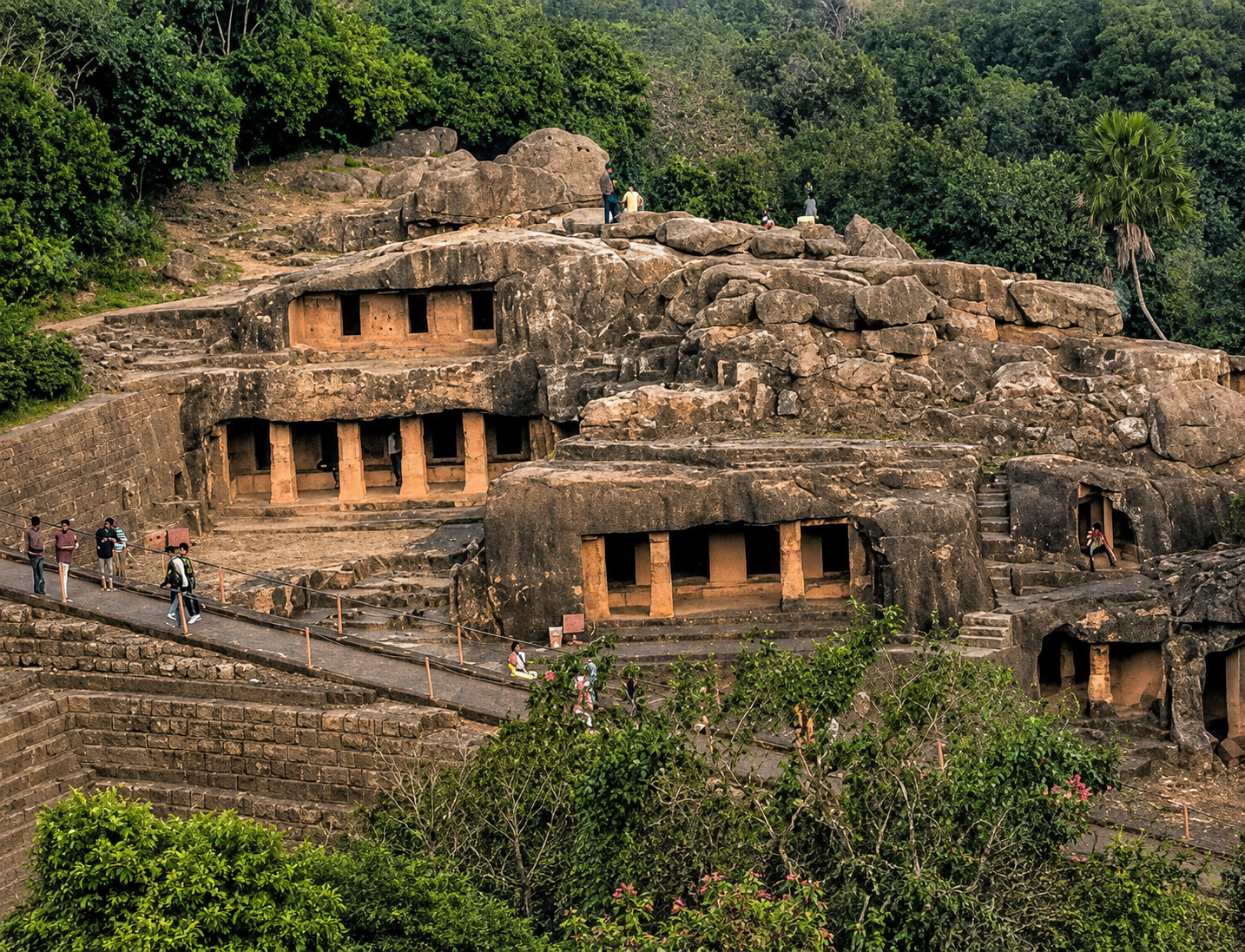
🏛️ Udayagiri & Khandagiri Caves (Odisha)
📖 Overview
Udayagiri and Khandagiri Caves stand as one of the most remarkable archaeological and historically layered destinations in India, representing far more than a pair of hillside rock shelters. Situated on two adjacent hills about three kilometres south of Bhubaneswar in Odisha, these caves are partly natural and partly artificial, carrying archaeological, historical, and religious importance that spans over two millennia. Carved into the sandstone hills overlooking the city, they serve as a window into the lives of ascetics, monks, and scholars who once inhabited these sacred spaces.
Udayagiri, meaning "Sunrise Hill," houses 18 caves, while Khandagiri, meaning "Broken Hill," contains 15. Built somewhere around the second century BCE by King Kharavela of the Meghavahana dynasty, widely regarded as the most powerful king in the annals of Odisha's history, the caves were carved for Jain monks as a place to stay and meditate. The architecture and intricate sculptures on the walls depict stories from mythology and history, noteworthy for having been carved entirely by hand using simple, basic tools.
What distinguishes Udayagiri and Khandagiri from other heritage destinations in eastern India is the combination of Jain spiritual heritage, royal patronage, epigraphic records, and sculptural artistry embedded in a twin-hill setting on the edge of a living city. The site is maintained by the Archaeological Survey of India and has been designated as an Adarsh Smarak Monument, reflecting its national importance as a heritage asset worthy of preservation and sustained attention.
✨ Why Visit Udayagiri & Khandagiri Caves
The caves are not only a testament to ancient practices and architectural expertise but also offer a serene environment for visitors to explore and contemplate. The natural surroundings, including the verdant hillocks and the tranquility of the place, add to its charm, making a visit a holistic experience.
One of the most compelling reasons to visit is the extraordinary depth of historical record preserved here. The Hathigumpha inscription, written by Raja Kharavela during the second century BCE, consists of seventeen lines incised in deep-cut Brahmi letters on the overhanging brow of a natural cavern, and it faces the rock edicts of Ashoka at Dhauli, situated about six miles away. This proximity and dialogue between two great ancient inscriptions makes the site exceptional in the context of Indian epigraphy and early political history.
One of the most interesting inscriptions found at these caves relates to the infamous Kalinga War, which has been deeply etched in the history of Odisha. These inscriptions not only speak of political episodes but also illuminate the social, cultural, and religious conditions of that period. For travelers drawn to a destination where stone itself carries centuries of meaning, Udayagiri and Khandagiri offer an engagement with the past that very few sites across the country can match.
The caves are a part of Odisha's popular Golden Triangle, along with the cities of Puri and Konark, which strengthens their appeal as a natural and rewarding inclusion in any heritage itinerary across the state.
🗿 Key Highlights Within the Area
🏰 Rani Gumpha
Among the cave shrines, the Rani Gumpha stands out as the most iconic feature of Udayagiri. Also known as the Queen's Palace Cave, it represents a double-storeyed monastery and is the largest and most elaborately carved structure in the entire complex. It has a double-storey structure with each storey featuring a central wing and three other wings. In the central wing, there are striking depictions of animals, human figures, trees, and women playing musical instruments, while the lower storey's right wing features carvings of royal scenes, animals, and arched gateways.
🪨 Ancient Cave Sculptures
Hathi Gumpha and Ganesha Gumpha in Udayagiri are especially well known for their historically important sculptures and reliefs. The Navamuni Gumpha carries sculptures depicting nine Jain Tirthankaras, while the Ananta Gumpha features ancient Jain motifs such as swastikas and serpents. Vyaghra Gumpha, though in ruins, has an entrance carved in the form of a tiger's mouth, with the single cell forming the tiger's throat — a remarkable instance of sculptural imagination that continues to captivate visitors.
🌅 Hilltop Views
The panoramic views from the hilltops, especially during sunrise and sunset, are a sight to behold. Khandagiri in particular offers sweeping views back over Bhubaneswar from its summit, providing a visual contrast between the ancient hillside and the modern capital that surrounds it.
🚶 Activities
Cave exploration and guided walks are the primary activities at Udayagiri and Khandagiri, with the ASI-maintained pathways leading visitors through a sequence of carved chambers, inscribed walls, and sculptural panels that reward both the casual visitor and the serious student of history. Visitors can participate in heritage walks organized by local authorities and heritage organizations.
Those planning a visit should keep sufficient time to explore the intricate carvings and sculptures, as each cave has much to offer, especially the famous Rani Gumpha and Hathi Gumpha. Early morning visits are particularly rewarding, as the quality of light on the sandstone surfaces shifts beautifully in the hours after sunrise, and the relative quiet allows for a more contemplative experience.
Nearby attractions include the Lingaraja Temple and the Dhauli Shanti Stupa, both of which pair naturally with a visit to the caves and can be combined into a fuller day of heritage exploration around Bhubaneswar. Photography enthusiasts will find the caves especially rewarding at the golden hours of dawn and dusk, when the carved reliefs are thrown into sharp relief by angled light.
📅 Best Time to Visit
❄️ November to February
The best time to visit the Udayagiri and Khandagiri Caves is from November to February, as the weather remains quite pleasant during this period.
🌤️ October to March
The period from October to March is broadly ideal for exploring the caves and the surrounding areas.
🌧️ Summer & Monsoon
The summer months from April to June bring intense heat to the Odisha plains, and while the monsoon season from July to September softens the landscape with greenery, humidity and intermittent rainfall can make open-air exploration less comfortable.
🚉 Connectivity
The Udayagiri and Khandagiri Caves are located on the outskirts of Bhubaneswar city. The Biju Patnaik International Airport is approximately 6.5 kilometres from the site, a distance that takes around 15 minutes to cover by road. Regular flights from major cities across India operate to Bhubaneswar, making the city easily reachable from most parts of the country. The Bhubaneswar Railway Station is approximately 9.2 kilometres from the caves, with well-established rail connections to Delhi, Kolkata, Chennai, and other major cities.
Local transport options including auto-rickshaws, city buses, and private cabs provide convenient onward connectivity from the city centre to the caves. The site's position within the Golden Triangle of Bhubaneswar, Puri, and Konark makes it a highly practical and natural inclusion in both short regional itineraries and extended heritage tours across eastern India.