```html
🌄 Introduction
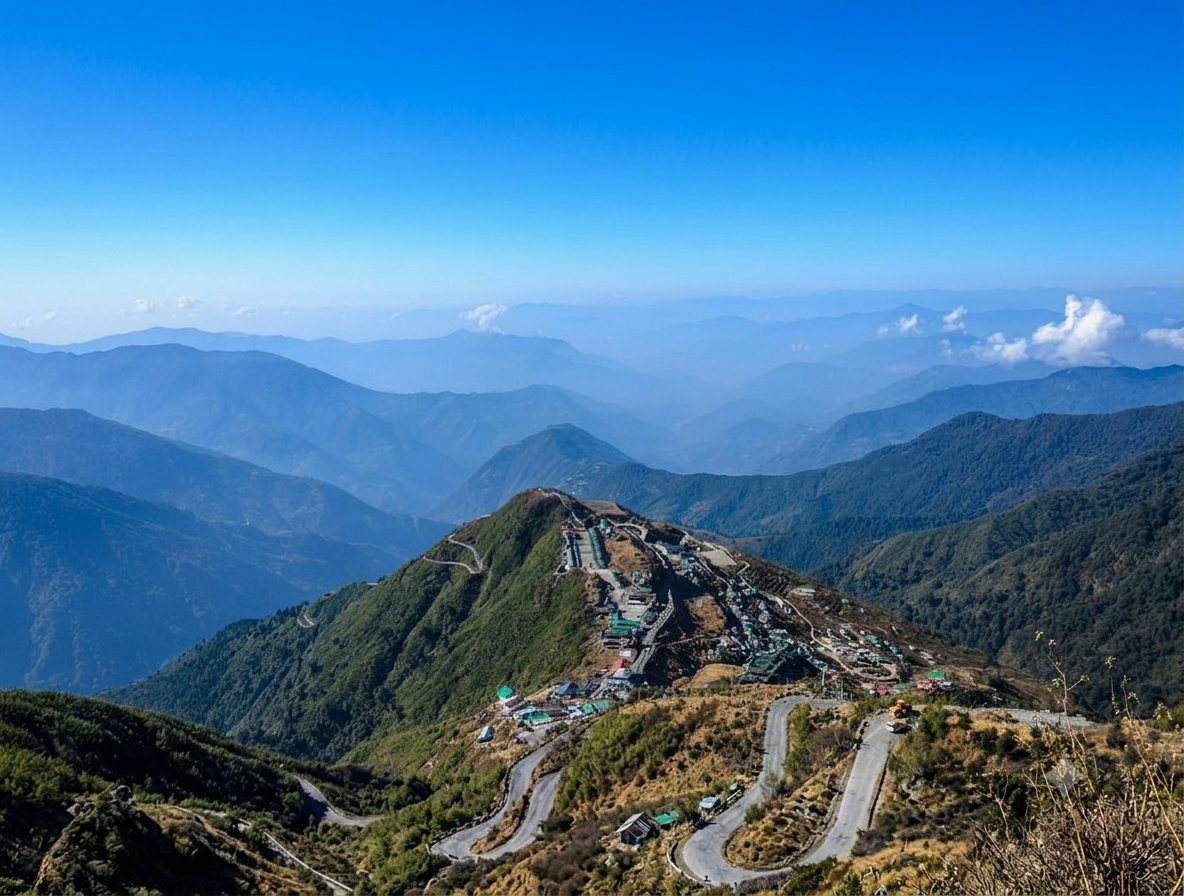
Perched at an altitude of nearly 10,000 feet in the eastern corner of Sikkim, Zuluk is a tiny village that most Indians have never heard of — and that is precisely its greatest charm. A former resting point on the ancient Silk Route that once connected India to Tibet and China, Zuluk today is a quiet, unhurried hamlet of a few dozen homes, monastery bells, and panoramic Himalayan views so vast they make you feel genuinely small. It sits in the Nathang Valley along the Old Silk Trading Route, surrounded by rhododendron forests, high-altitude meadows, and hairpin bends that have become legendary among road trippers and photographers alike. If you have ever wanted to feel like you've discovered somewhere the world hasn't caught up to yet — Zuluk is that place.
❤️ The Soul of the Place
Zuluk is not a destination you visit for activities in the conventional sense. You visit it for the experience of being there — the silence at 10,000 feet, the cold that bites at your fingers even in October, the way the clouds drift below the road as you navigate the famous 32 hairpin bends of the Zuluk loop. The drive up alone is one of the most dramatic in the entire country, switchbacking through dense forest before suddenly opening up to exposed ridgelines with views that stretch all the way to Kanchenjunga and, on clear days, into Bhutan and Tibet. The village itself is tiny and unhurried — a few homestays, a handful of army checkposts, prayer flags snapping in the wind, and the occasional yak wandering across the road. There is no mall, no nightlife, no tourist trap. Just mountains, mist, and the quiet hum of a place that time has politely sidestepped.
📅 Best Time to Visit
🍂 October to Mid-December
October to mid-December is the finest time to visit by almost every measure. The skies after the monsoon are crystal clear, the air is sharp and cold, and the views of Kanchenjunga — the world's third highest peak — are at their most dramatic. The rhododendron and oak forests turn gold and rust in October, making the hairpin drive through them a photographer's fantasy. Temperatures drop sharply at night, often touching zero, so warm layers are non-negotiable.
🌸 March to May
March to May is the second-best window and arguably the most colourful. Rhododendrons bloom across the hillsides in vivid reds and pinks, the temperatures are more forgiving, and the roads are fully open after winter. This is when Zuluk is at its most photogenic in a gentler, warmer sense — flower-draped forests, softer light, and occasional views of snow still clinging to the higher peaks.
❄️ January and February
January and February bring heavy snowfall that can block roads entirely. Only highly experienced travellers with proper gear and local guidance should attempt Zuluk in these months. The cold is severe and the isolation is absolute.
🌧️ June to September
June to September is monsoon season. Landslides are common on the narrow mountain roads, visibility drops to near zero in the clouds, and travel becomes genuinely risky. This window is best avoided entirely.
⭐ Top Things to Do
🚗 Drive the 32 Hairpin Bends
This is Zuluk's signature experience and one of the most thrilling drives in India. The road from Rongli spirals upward through 32 numbered hairpin bends, climbing thousands of feet through forest and cloud before arriving at the Zuluk ridge. Every bend reveals a different view — valley below, mountain above, clouds at eye level. It is simultaneously nerve-wracking and utterly magnificent. Most visitors hire a local driver who knows every twist of the road, and that is the right call.
🌅 Watch the Sunrise over Kanchenjunga
Set your alarm for 4 AM. Wrap yourself in every layer you have. Walk or drive to the nearest open ridgeline and wait. As the sky lightens from black to deep blue to violet to gold, the silhouette of Kanchenjunga and the surrounding Himalayan peaks emerges from the darkness — first as shadows, then as vast snow-covered walls of rock blazing in the first light. It is, without exaggeration, one of the most powerful natural spectacles India has to offer. Clear skies between October and December give the best odds.
🛤️ Explore the Old Silk Route
The road through Zuluk follows the ancient trade route that merchants, monks, and armies once used to travel between the Indian subcontinent and Tibet. Small signboards and old stone markers along the way tell fragments of this history. The drive from Rongli through Zuluk to Nathang Valley and up to Thambi View Point traces this historic corridor and is a journey through both landscape and time.
🏔️ Visit Thambi View Point and Lungthung
Above Zuluk, the road climbs further to Thambi View Point at around 13,000 feet — a windswept promontory that on clear days offers a 180-degree panorama of the eastern Himalayas. Further still is Lungthung, where the landscape turns alpine and bare, with prayer flags marking the ridge and nothing between you and the sky. These upper reaches are cold, oxygen-thin, and absolutely breathtaking.
🌿 Nathang Valley
Often called the Kashmir of Sikkim, Nathang Valley sits above Zuluk at nearly 13,500 feet. A high-altitude meadow ringed by mountains, it is hauntingly beautiful — wide open grassland under a bowl of sky, with yaks grazing and army camps in the distance. In winter it fills with snow; in spring it blooms with wildflowers. It is not a place you do something — it is a place you simply stand and absorb.
🏞️ Tsomgo Lake Day Trip
On the way to or from Zuluk, most visitors stop at Tsomgo (Changu) Lake — a sacred glacial lake at 12,400 feet that reflects the surrounding peaks in its still, dark water. Yak rides are available around its shores and a small temple sits at its edge. It requires the same Inner Line Permit as Zuluk and fits naturally into the itinerary.
🛣️ Getting There — Connectivity
📜 The Permit Situation — Read This First
Zuluk lies in a restricted zone and requires an Inner Line Permit (ILP) for Indian nationals and a Protected Area Permit (PAP) for foreign nationals. These are obtained in Gangtok — your hotel or a local travel agent can arrange them with 24 hours notice. You cannot enter Zuluk without these permits. Carry multiple photocopies as army checkposts will ask for them repeatedly.
🚙 From Gangtok (by road — 90 km)
Gangtok is the gateway to Zuluk and the place where all permits are arranged. The drive takes approximately 4 to 5 hours via Rongli and the hairpin bends. The road is narrow, steep, and spectacular. Hiring a local SUV with an experienced driver from Gangtok is strongly recommended — this is not a route for self-driving newcomers.
✈️ Reaching Gangtok
The nearest airport is Bagdogra Airport in West Bengal, about 124 km from Gangtok. From Bagdogra, shared taxis and private cabs make the roughly 4-hour drive to Gangtok regularly. The nearest major railway station is New Jalpaiguri (NJP) in Siliguri, well connected to Kolkata, Delhi, and other major cities, from where Gangtok is again about 4 hours by road.
🌟 Final Reflection
Zuluk asks something of you that most travel destinations don't. It asks you to be comfortable with remoteness, to accept that your phone won't work, that the road will frighten you a little, that the cold will be real, and that there is nothing to do in the evenings except sit by a warm stove, eat home-cooked food, and watch the stars appear over mountains so high they seem to belong to another world entirely. In return, it gives you something increasingly rare in modern travel — the feeling of having genuinely gone somewhere. Not a curated somewhere. Not a polished, packaged somewhere. A real, raw, extraordinary somewhere that most people will never see.
The Silk Route once carried silk and spices across these mountains. What it carries now, for those willing to make the journey, is perspective.
Best Places to Explore Nearby
```