🌐 Overview
A Formidable Fortification of Exceptional Historical Importance
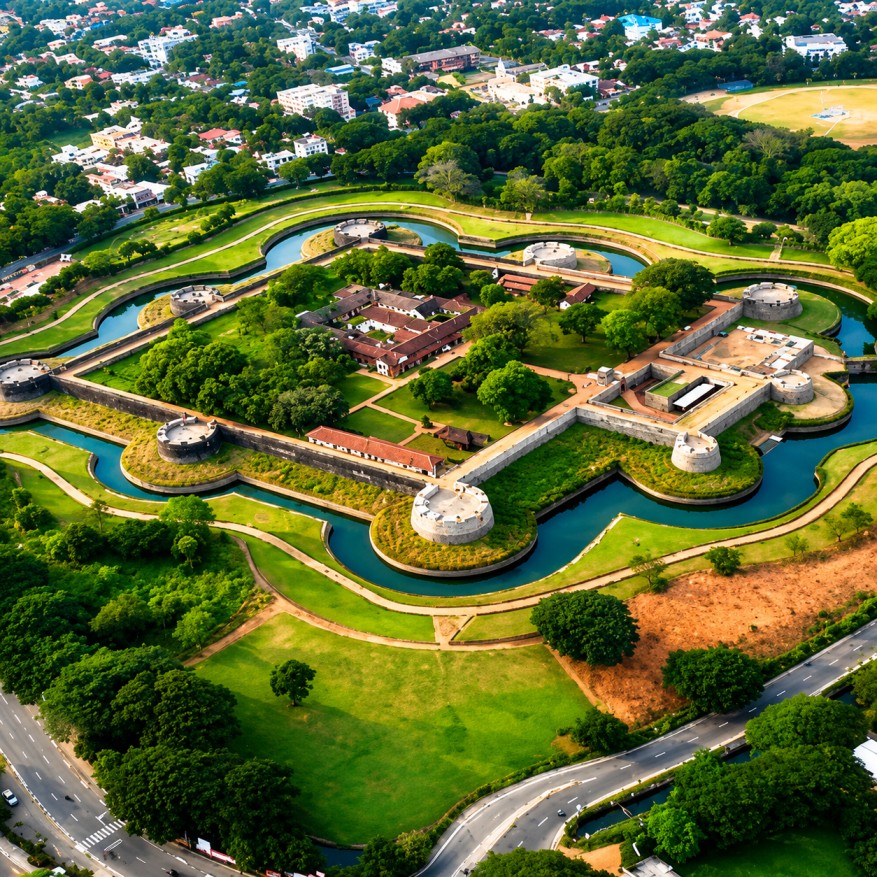
Palakkad Fort stands as one of the most historically significant and remarkably well-preserved heritage destinations in Kerala, representing a compact yet formidable military fortification of exceptional historical importance whose solid granite walls, deep dry moat, and carefully maintained bastions together compose one of the finest surviving examples of eighteenth century military architecture in southern India.
Situated at the very heart of the city of Palakkad in the district of the same name in Kerala, the fort occupies a position of considerable strategic logic at the gateway to the famous Palakkad Gap, the only significant natural break in the Western Ghats mountain range that has historically served as the primary overland passage between the Malabar Coast and the interior of the Tamil Nadu plateau.
The destination draws history enthusiasts, architecture lovers, heritage travelers, and curious visitors from across the country, offering an encounter with a fortification whose compact and geometrically precise design reflects the military engineering traditions of Hyder Ali of Mysore, who constructed the fort in 1766 to consolidate his control over this critical geographical passage, and whose subsequent history under Tipu Sultan and the British East India Company layers the structure with successive chapters of southern Indian political and military drama.
What distinguishes Palakkad Fort from other heritage destinations in Kerala is not merely its historical significance or its architectural completeness, but the unique combination of military architectural precision, extraordinary strategic geographical context, the living urban setting in which it sits, and the remarkable state of preservation that allows visitors to appreciate the original design and defensive logic of the fortification with unusual clarity. The fort is maintained by the Archaeological Survey of India and its surrounding gardens and moat present the structure in a condition of careful conservation that makes the visit a genuinely informative and architecturally rewarding experience. This layered character elevates Palakkad Fort beyond a simple historical monument into a destination of genuine military architectural interest, strategic geographical significance, and the particular pleasure of a well-preserved heritage site set within the energetic fabric of a living Kerala city.
✨ Why Visit
Architectural Coherence, Strategic Geography & Layered History
The recognition of Palakkad Fort as a centrally protected monument under the Archaeological Survey of India reflects its unparalleled importance within the military heritage landscape of Kerala, standing as one of the best-preserved pre-colonial and colonial era fortifications in the entire state. Unlike the coastal sea forts of Kerala built by the Portuguese and Dutch, Palakkad Fort represents a distinctly different military architectural tradition rooted in the Mysore Sultanate's inland fortification strategy and reflects the engineering priorities of a power seeking to control overland trade and military movement through the Palakkad Gap.
One of the most compelling reasons to visit is the architectural coherence and completeness of the fort, whose original design has survived in a state of remarkable integrity that allows the visitor to understand the defensive logic of the structure with unusual clarity. The square plan of the fort, its corner bastions positioned to provide overlapping fields of defensive fire, the deep dry moat encircling the entire perimeter, and the carefully designed entrance sequence together compose a textbook example of military fortification thinking that rewards careful observation and unhurried exploration. The historical narrative of the fort, passing through the hands of Hyder Ali, Tipu Sultan, and finally the British East India Company, adds successive layers of political and military drama to the architectural interest of the structure.
Additionally, Palakkad Fort showcases its significance through the broader geographical context of the Palakkad Gap, an understanding of which transforms the experience of visiting the fort from a simple heritage excursion into a genuine engagement with the strategic geography of southern India. The combination of architectural completeness, rich historical narrative, the unique geographical setting at the gateway to the Ghats, and the accessibility of the fort within the heart of a vibrant Kerala city further strengthens its appeal as a deeply rewarding and intellectually engaging heritage destination.
🔑 Key Highlights Within the Area
Landmarks of Architectural & Natural Significance
The Granite Bastions
Among the architectural features, the solid granite bastions at the four corners of the fort stand out as the most imposing and structurally impressive elements of the fortification. Each bastion is positioned to provide defensive coverage along the adjacent walls and across the surrounding moat, their rounded forms and carefully coursed granite construction conveying the military precision and engineering confidence of the Mysorean builders who raised them. The quality and scale of the granite masonry, sourced from the hard rock terrain of the surrounding region, gives the fort an air of solidity and permanence that distinguishes it from the laterite constructions more commonly encountered in Kerala's coastal heritage.
The Dry Moat
The dry moat encircling the full perimeter of the fort is another significant architectural highlight, its depth and width designed to prevent direct assault on the base of the walls and to channel any attacking force toward the defended gateways. Walking along the moat edge and observing the relationship between the moat, the battered base of the walls, and the bastions above provides a clear and immediate understanding of the defensive thinking embedded in the fort's design, making the exterior circuit of the moat one of the most instructive architectural walks available at any fort in Kerala.
Malampuzha Dam & the Palakkad Gap
The Kalpathipuzha River flowing near the fort and the Malampuzha Dam and Gardens situated a short distance from the city add a significant natural and recreational dimension to the visit, with the Malampuzha reservoir backed by the forested slopes of the Western Ghats offering a scenic and refreshing complement to the historical character of the fort. The Palakkad Gap itself, visible from elevated points around the city as the dramatic lowering of the Western Ghats ridgeline that has channeled the movement of armies, traders, and cultures between Kerala and Tamil Nadu for millennia, provides a compelling geographical context that deepens the historical significance of the fort considerably.
🎯 Activities
How to Experience Palakkad Fort & Its Surroundings
Exploring the fort interior and exterior is the primary and most rewarding activity at Palakkad Fort, with the well-maintained grounds, the accessible bastions, and the surrounding moat offering a comprehensive architectural experience that can be appreciated at a comfortable and unhurried pace within a few hours. The interior of the fort contains a small Hanuman temple that has been in continuous worship within the fort precincts and a children's park, and the open grounds allow visitors to appreciate the scale and geometry of the fortification from within while the exterior circuit provides the clearest understanding of the defensive design.
Visiting the Malampuzha Dam and Gardens, situated approximately ten kilometres from the fort, is a popular and scenic complementary activity that draws visitors to one of the largest earthen dams in Kerala, set against a dramatic backdrop of forested Western Ghats ridgelines. The gardens, the ropeway across the reservoir, and the sculptural park featuring works by the renowned sculptor Kanai Kunhiraman together offer a varied and enjoyable excursion that combines natural scenery with cultural interest in a setting of considerable beauty.
Exploring the Palakkad city market and the streets of the town center surrounding the fort offers a rewarding encounter with the commercial and cultural life of a Kerala city that carries a distinctly different character from the coastal towns of the state, reflecting its position as a meeting point of Malayali, Tamil, and Kongu cultural traditions shaped by centuries of cross-Ghat exchange. Visiting the nearby Jain Temple of considerable antiquity and the Kalpathi Agraharam, a heritage street of traditional Tamil Brahmin houses that hosts one of the oldest temple chariot festivals in Kerala, adds further cultural and architectural depth to the Palakkad itinerary.
🎪 Kalpathi Ratholsavam — A Festival Not to Miss
The Kalpathi Ratholsavam chariot festival, held annually in November at the Viswanathaswamy Temple in the Kalpathi Agraharam, brings a vibrant and deeply traditional festive energy to the Palakkad area during the peak visiting season and offers a compelling cultural experience that complements the historical character of the fort visit.
📅 Best Time to Visit
When to Plan Your Journey
❄️ November – February
The most favorable period to visit Palakkad Fort is from November to February, when the temperatures in the Palakkad valley are pleasantly moderate, the skies are clear, and the comfortable conditions make extended exploration of the fort exterior and interior particularly enjoyable. During these months the dry moat and granite walls of the fort are seen at their sharpest and most photogenic, and the surrounding city is at its most pleasant for the complementary exploration of the Kalpathi heritage street and the Malampuzha Gardens.
🌧️ June – September
The monsoon season from June to September brings heavy rainfall to the Palakkad region, and while the fort itself remains accessible, the surrounding landscape of the Western Ghats takes on a dramatic green intensity that makes the broader setting of the destination particularly scenic.
☀️ March – May
The summer months from March to May bring considerable heat to the Palakkad valley, which sits in the rain shadow of the Western Ghats and is known as one of the hottest locations in Kerala during the summer period, making midday visits to the open fort grounds uncomfortable and requiring visitors to plan their exploration around the cooler hours of early morning and late afternoon.
🚗 Connectivity
Getting to Palakkad Fort
Palakkad Fort is situated at the heart of Palakkad city, making it exceptionally accessible from every part of the urban area and from the major transportation hubs that serve the district. Palakkad Junction, one of the most important railway junctions in Kerala, offers regular and frequent train services from Kochi, Kozhikode, Chennai, Coimbatore, Mumbai, and other major cities across India, reflecting the historical importance of the Palakkad Gap as a passage for rail as well as road traffic between Kerala and Tamil Nadu.
Road connectivity from Kochi, Coimbatore, Kozhikode, and Thrissur is efficient and well maintained, with national highways passing through the Palakkad Gap and connecting the city to the broader road networks of both Kerala and Tamil Nadu. Coimbatore, situated approximately 55 kilometres from Palakkad in Tamil Nadu, provides the nearest major airport with regular domestic flights from Mumbai, Delhi, Bengaluru, Chennai, and other major Indian cities, making air access to the Palakkad region practical and convenient for visitors from across the country. This makes Palakkad Fort a highly practical inclusion in Kerala heritage and nature itineraries, as well as a natural companion destination for travelers combining the fort with visits to the Silent Valley National Park, the Malampuzha Gardens, the Nelliyampathy Hills, and the broader cultural and natural landscape of the Palakkad district.