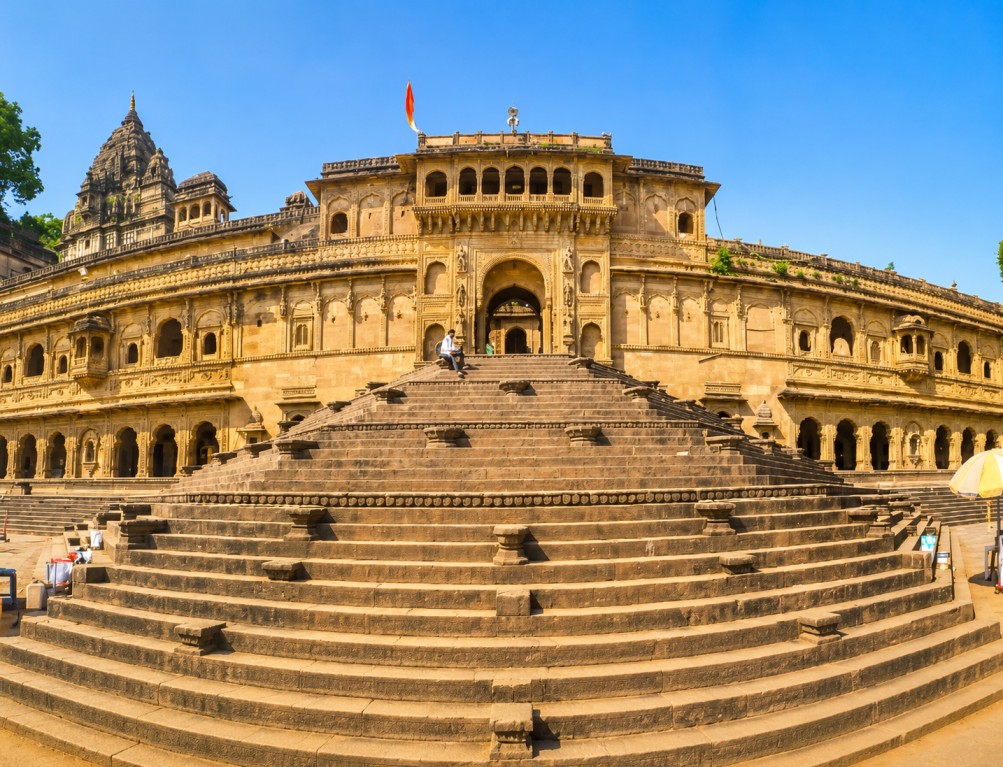
Ahilya Fort Experience — An 18th-Century Riverside Seat of the Holkar Dynasty
At Ocean Tripmakers, we build itineraries around sites where heritage is still lived rather than simply preserved. Ahilya Fort overlooks the Narmada at Maheshwar, the former residence of Maharani Ahilyabai Holkar — Maratha, Rajput and Mughal architecture sitting alongside working ghats, active temples, and a still-operating handloom weaving tradition.
Geography and Architecture
The fort sits on a hill above the Narmada, built in local stone with a blend of three regional architectural traditions rather than a single dominant style.
Perched above the Narmada, the fort connects directly to the Maheshwar Ghats, where stone steps descend to the water — fort and river frontage function as one continuous site.
Gateways, courtyards, carved balconies and arches draw on Maratha, Rajput and Mughal design, built throughout from locally sourced stone.
Holkar-Era History
The fort's significance rests on the reign of Maharani Ahilyabai Holkar and the wider religious building programme she directed from Maheshwar.
Ahilyabai Holkar assumes rule
Maheshwar becomes the seat of her administration, governed from the fort complex.
Maheshwar develops as a centre of culture, trade and religion
Temples, ghats, wells and dharamshalas are built across the town under her patronage, alongside promotion of the Maheshwari handloom tradition.
Restoration work extends beyond Maheshwar
Major projects include restoration at Kashi Vishwanath Temple in Varanasi and Somnath Temple in Gujarat, extending the Holkar building programme nationally.
End of her reign
The fort and town remain a lasting reference point for her administration, still shaping Maheshwar's civic and religious life today.
Product Themes
The site's core draws, organised by traveller interest.
Guided palace walks through courtyards, royal chambers and carved stone architecture — suited to history and architecture-focused itineraries.
Evening Narmada aarti, boat rides and riverside walks along the Maheshwar Ghats form the town's daily rhythm and its strongest visual product.
Ahilyeshwar Temple, Kashi Vishwanath Temple (Maheshwar), Rajarajeshwara Temple and Ek Mukhi Datta Temple sit within a compact walkable radius.
Maheshwari sarees, first promoted under Ahilyabai Holkar, can be seen produced at local weaving centres — a strong fit for textile and craft-focused groups.
The restored palace-hotel sections of the fort support a luxury heritage-stay product distinct from standard hotel inventory in the region.
Positioned within reach of Mandu, Omkareshwar and Indore, allowing Maheshwar to anchor a wider Malwa heritage-and-pilgrimage circuit.
Access and Routing
Road-linked from Indore, with limited direct rail access into Maheshwar itself.
Indore functions as the primary gateway, with regular bus and taxi links onward to Omkareshwar and Mandu. Best season for routing: October–March.
Notes for Itinerary Planning
Practical points relevant to routing and guest briefing.
Travel Partner Opportunity
For travel partners building Malwa heritage routings, Ahilya Fort offers a rare combination of a still-functioning riverside town, a luxury heritage-stay product, and a compact temple-and-craft circuit — all anchored within one site.
Paired with Mandu, Omkareshwar and Indore, it supports multi-day heritage, pilgrimage, and textile-focused programs without requiring a change of base.
A fort where the river, the loom, and the ghat still keep the same rhythm they kept under Ahilyabai Holkar.