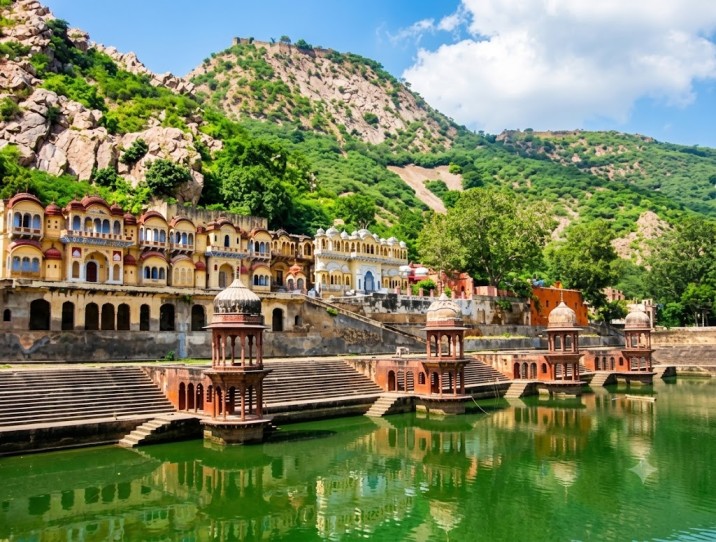
Alwar-Palace : Echoes of Alwar’s Maharajas
Alwar City Palace stands as one of the most architecturally magnificent yet comparatively undiscovered heritage destinations in Rajasthan, representing a sprawling royal residence of the Kachhwaha rulers of Alwar whose intricately carved sandstone and marble facades, ornate courtyards, and the dramatic backdrop of the towering Bala Quila fort rising on the hillside above together create a destination of considerable architectural grandeur that remains significantly less visited than its remarkable beauty would suggest. Situated in the heart of Alwar town in the Alwar district of Rajasthan, the City Palace, locally known as Vinay Vilas Mahal, was constructed in 1793 by Maharaja Bakhtawar Singh, its blend of Rajput and Mughal architectural elements reflecting the considerable wealth and cultural sophistication of the Alwar princely state during its period of greatest prosperity. The destination draws history enthusiasts, architecture lovers, and heritage travelers from across the country, offering an encounter with a palace complex that today houses both government offices in its lower sections and a museum of considerable historical richness in its upper chambers, its combination of living administrative function and preserved heritage character lending the building an atmosphere of continuity rarely found at more purely museumified palace destinations.
🏰 Alwar City Palace (Rajasthan)
📜 Overview
Alwar City Palace stands as one of the most architecturally magnificent yet comparatively undiscovered heritage destinations in Rajasthan, representing a sprawling royal residence of the Kachhwaha rulers of Alwar whose intricately carved sandstone and marble facades, ornate courtyards, and the dramatic backdrop of the towering Bala Quila fort rising on the hillside above together create a destination of considerable architectural grandeur that remains significantly less visited than its remarkable beauty would suggest. Situated in the heart of Alwar town in the Alwar district of Rajasthan, the City Palace, locally known as Vinay Vilas Mahal, was constructed in 1793 by Maharaja Bakhtawar Singh, its blend of Rajput and Mughal architectural elements reflecting the considerable wealth and cultural sophistication of the Alwar princely state during its period of greatest prosperity. The destination draws history enthusiasts, architecture lovers, and heritage travelers from across the country, offering an encounter with a palace complex that today houses both government offices in its lower sections and a museum of considerable historical richness in its upper chambers, its combination of living administrative function and preserved heritage character lending the building an atmosphere of continuity rarely found at more purely museumified palace destinations.
✨ Why Visit Alwar City Palace
The recognition of Alwar City Palace as one of the most architecturally accomplished yet underappreciated royal residences in Rajasthan reflects its considerable importance within the heritage landscape of the Shekhawati and Alwar region, a part of the state often overshadowed by the more famous tourist circuits centered on Jaipur and Udaipur despite possessing heritage architecture of comparable quality and historical depth. One of the most compelling reasons to visit is the palace's striking architectural composition, with its elaborately carved facade of arched windows, ornate balconies, and intricately worked stone screens creating a visual richness that rewards close and careful observation, particularly within the large open courtyard at the heart of the complex where the full scale and decorative ambition of the building becomes most apparent. The Alwar Museum housed within the upper floors of the palace offers a further highlight of considerable historical interest, its collection including an exceptional assemblage of miniature paintings from the distinctive Alwar school, along with royal manuscripts, weaponry, and decorative arts that together provide a rich and informative window into the cultural and artistic life of the Alwar court. The dramatic visual relationship between the City Palace below and the imposing Bala Quila fort perched on the rugged hill directly above adds a further dimension of scenic and historical grandeur to the visit, the two structures together forming one of the most visually striking royal complexes in the entire state.
🗺️ Key Highlights Within the Area
🏛️ The Grand Central Courtyard
The grand central courtyard of the City Palace stands out as the most architecturally impressive feature of the complex, its surrounding galleries of carved sandstone arches and balconies creating a sense of considerable royal scale and decorative refinement that rewards visitors with successive perspectives on the building's craftsmanship from different points within the open space.
🖼️ The Alwar Museum
The Alwar Museum, occupying portions of the upper palace, is a highlight of exceptional cultural significance, its collection of miniature paintings, manuscripts, and royal artifacts offering a comprehensive introduction to the artistic and historical legacy of the Kachhwaha rulers of Alwar.
🌊 Sagar Lake
The Sagar Lake situated adjacent to the palace complex, with its cenotaphs and reflective waters, adds a further scenic and historical dimension to the immediate surroundings of the City Palace.
⛰️ Bala Quila Fort
The towering presence of Bala Quila fort on the hillside above provides a dramatic visual backdrop to the palace, the two structures together composing one of the most visually compelling royal heritage landscapes in the broader Alwar region.
🎯 Activities
Exploring the palace courtyards and the museum collection housed within its upper chambers is the primary activity for visitors to Alwar City Palace, offering an opportunity to engage with both the architectural grandeur of the building and the rich artistic heritage preserved within its galleries. Photography of the palace's carved facades and courtyards, along with the adjacent Sagar Lake and cenotaphs, is a rewarding pursuit for heritage and architecture enthusiasts visiting the site.
📍 Best Time to Visit & Connectivity
The most favorable period to visit Alwar City Palace is from October to March, when the pleasant winter temperatures make exploring the palace courtyards and the broader Alwar town considerably more comfortable than during the intense heat of the summer months from April to June.
Alwar City Palace is situated in the heart of Alwar town, easily accessible by local transport from the railway station and other parts of the city. Alwar is well connected by rail to Delhi and Jaipur with regular services, while Jaipur, situated approximately 150 kilometres away, provides the nearest major airport, making Alwar City Palace a rewarding inclusion for heritage travelers exploring the Shekhawati region or traveling between Delhi and Jaipur.