Bhatner-Fort : The Guardian Of The Thar Desert
Bhatner Fort stands as one of the oldest and most historically significant fortifications in Rajasthan, representing an ancient desert citadel whose massive mud and brick ramparts have withstood the passage of centuries and the assaults of some of history's most formidable conquerors, earning the fort a reputation in regional lore as one of the most impregnable strongholds ever built in northern India. Situated in the town of Hanumangarh in the Hanumangarh district of Rajasthan, on the banks of the now largely dry Ghaggar River, Bhatner Fort traces its origins to the second century and is believed to be one of the oldest forts in the entire state, its long and eventful history including a famous and ultimately unsuccessful siege by Timur in 1398, an episode that has become inseparable from the fort's historical identity and reputation for formidable defensive strength. The destination draws history enthusiasts, archaeology lovers, and heritage travelers from across the country, offering an encounter with a fortification whose construction technique, built largely from sun-dried and burnt mud bricks rather than the dressed stone more commonly associated with Rajasthani forts, gives Bhatner a distinctive architectural character that sets it apart from the more famous citadels of Jaipur, Jodhpur, and Chittorgarh.
An earthen citadel that outlasted its conquerors
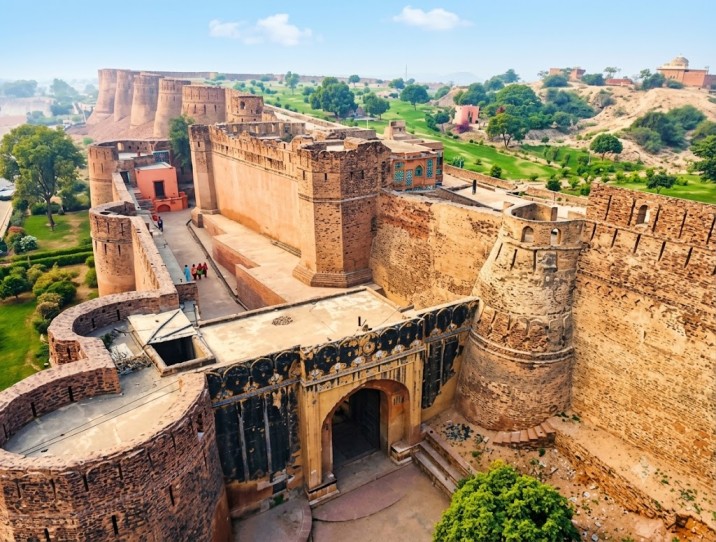
Bhatner Fort rises above the banks of the once-flowing Ghaggar River in Hanumangarh, its massive mud-and-brick ramparts counted among the oldest surviving fortifications in Rajasthan — a stronghold whose defenses famously withstood the forces of Timur in 1398, long before falling to that historic siege.
One of Rajasthan's oldest desert strongholds
Bhatner Fort stands as one of the oldest and most historically significant fortifications in Rajasthan, an ancient desert citadel whose massive mud and brick ramparts have withstood the passage of centuries and the assaults of some of history's most formidable conquerors, earning it a reputation in regional lore as one of the most impregnable strongholds ever built in northern India.
Situated in the town of Hanumangarh, on the banks of the now largely dry Ghaggar River, the fort traces its origins to the second century and is believed to be one of the oldest in the entire state. Its long and eventful history includes a famous and ultimately unsuccessful siege by Timur in 1398 — an episode inseparable from the fort's historical identity and its reputation for formidable defensive strength.
Built largely from sun-dried and burnt mud bricks rather than the dressed stone more commonly associated with Rajasthani forts, Bhatner's construction technique gives it a distinctive architectural character that sets it apart from the more widely known citadels of Jaipur, Jodhpur, and Chittorgarh.
At a Glance
Location: Hanumangarh town, Hanumangarh district, Rajasthan
River: Banks of the Ghaggar River
Material: Sun-dried and burnt mud brick
Character: Lesser-explored heritage site of northern Rajasthan
A fortress defined by a single, defiant siege
The recognition of Bhatner Fort as one of the oldest and most historically resilient fortifications in Rajasthan reflects its unparalleled importance within the lesser-explored heritage landscape of the state's northern desert region — a chapter of Rajasthani history considerably less visited and discussed than the more celebrated Rajput strongholds of the south and west. One of the most compelling reasons the fort is studied and visited is its association with the failed siege by the Central Asian conqueror Timur, whose forces are said to have struggled considerably against the fort's defenses before eventually breaching it, an episode that has lent Bhatner a lasting reputation for defensive strength within regional historical memory.
What defines the site today
The Earthen Ramparts
The massive mud and brick ramparts stand as the most distinctive architectural feature of the site, their considerable thickness and warm earthen tone creating a visual character quite different from the dressed stone fortifications more typically associated with Rajasthan.
Gateways & Surviving Walls
The fort's association with the historic siege by Timur offers a highlight of considerable narrative interest, with surviving walls and gateways standing as physical testament to the defensive engagements that have shaped the fort's reputation across more than six centuries.
Temples Within the Complex
Various temples and structures have developed within and around the fort complex over subsequent centuries of continued use, reflecting the fort's ongoing significance to the local community long after its original defensive purpose diminished.
Activities & best time to visit
Exploring the fort's ramparts, gateways, and surviving internal structures is the primary activity for visitors to Bhatner, offering an opportunity to engage directly with one of the oldest surviving fortifications in Rajasthan and to appreciate its distinctive mud-brick construction technique at close quarters.
Photography of the fort's earthen-toned walls and the surrounding desert landscape of Hanumangarh is a rewarding pursuit for those interested in documenting this lesser-known chapter of Rajasthani heritage architecture.
Best Time to Visit
October to March, when pleasant winter temperatures make extended exploration of the fort and surrounding town considerably more comfortable than during the intense heat of April to June.
Reaching Hanumangarh
Bhatner Fort is situated within Hanumangarh town, accessible directly from the town center by local transport.
Hanumangarh is connected by rail to Bikaner, situated approximately 130 kilometres away, as well as to other major cities across Rajasthan and northern India.
Road connectivity from Sri Ganganagar, Bikaner, and the broader northern Rajasthan region is well established.
A rewarding inclusion for heritage itineraries exploring this less frequently visited corner of the state's fortification history.