Golconda Fort : Where the Echoes of Empire Still Resound
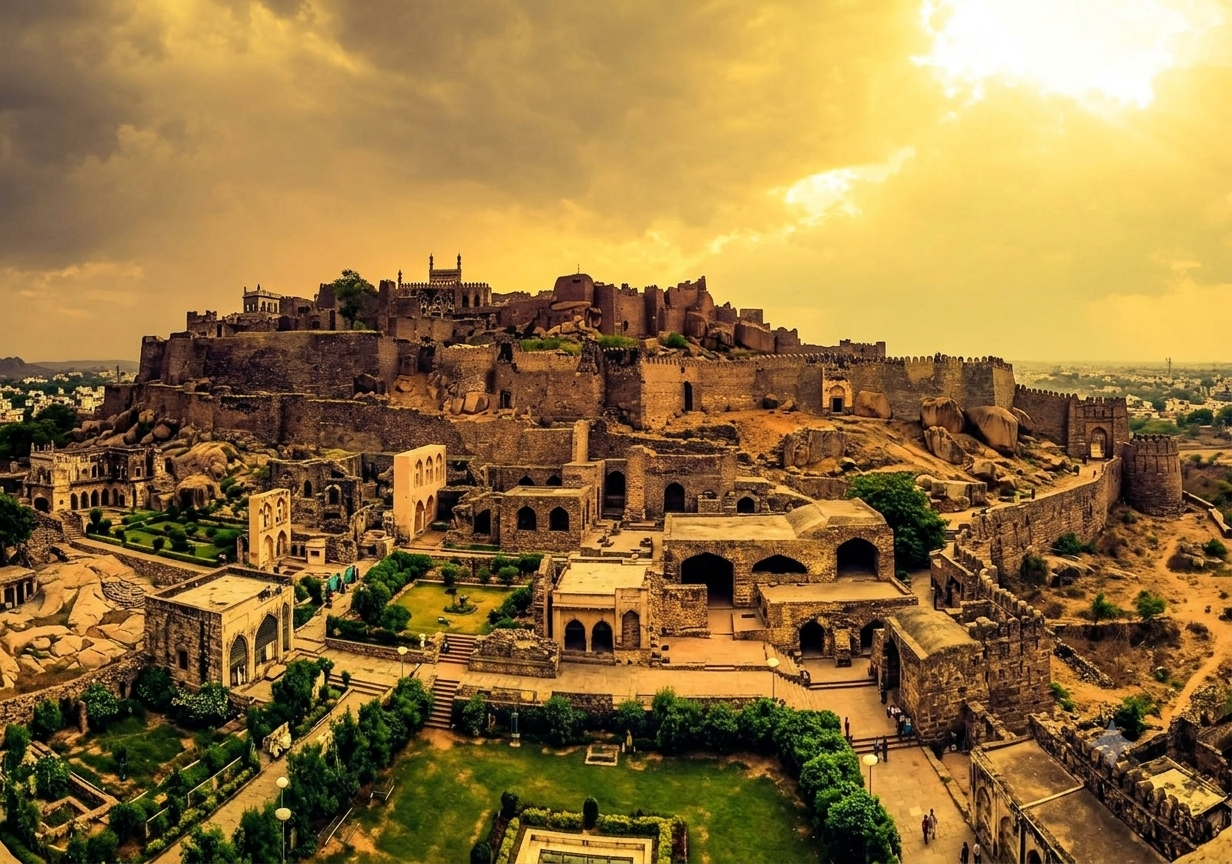
Picture yourself standing atop a granite hill overlooking the bustling city of Hyderabad. Massive stone walls stretch across the landscape, ancient gateways rise with commanding grandeur, and the warm Deccan breeze carries whispers of kings, merchants, and warriors who once shaped the destiny of South India. As the sun casts golden hues across weathered ramparts, the fort seems to awaken with stories from a glorious past. This is Golconda Fort—not merely a historic monument, but a living symbol of power, innovation, and cultural brilliance. Once the capital of a mighty kingdom and the center of the world-famous diamond trade, Golconda Fort remains one of India's most fascinating architectural and historical treasures.
🏰 Golconda Fort, Hyderabad
✨ Where the Echoes of Empire Still Resound
🌄 Introduction
Picture yourself standing atop a granite hill overlooking the bustling city of Hyderabad. Massive stone walls stretch across the landscape, ancient gateways rise with commanding grandeur, and the warm Deccan breeze carries whispers of kings, merchants, and warriors who once shaped the destiny of South India. As the sun casts golden hues across weathered ramparts, the fort seems to awaken with stories from a glorious past. This is Golconda Fort—not merely a historic monument, but a living symbol of power, innovation, and cultural brilliance. Once the capital of a mighty kingdom and the center of the world-famous diamond trade, Golconda Fort remains one of India's most fascinating architectural and historical treasures.
📜 A Legacy Built Through Centuries
The origins of Golconda Fort date back to the 11th century when it was initially constructed as a mud fort under the Kakatiya dynasty. Over the following centuries, it evolved into a formidable stone fortress under the Bahmani rulers and later reached its zenith under the Qutb Shahi dynasty. By the 16th and 17th centuries, Golconda had become one of the wealthiest and most influential kingdoms in India.
The fort's fame extended far beyond the Deccan. It was the heart of the global diamond trade, producing some of the world's most legendary gems, including the Koh-i-Noor, Hope Diamond, and Darya-i-Noor. Merchants from Persia, Arabia, Europe, and Central Asia flocked to Golconda, transforming it into a thriving center of commerce, culture, and diplomacy.
Despite its immense strength, the fort eventually fell to Mughal Emperor Aurangzeb in 1687 after a prolonged siege, marking the end of the Qutb Shahi dynasty. Yet even centuries later, Golconda's grandeur continues to captivate visitors from around the world.
⚙️ An Engineering Marvel Ahead of Its Time
The moment you enter Golconda Fort, you realize this is far more than a military stronghold. Spread across nearly eleven kilometers of fortified walls, the complex demonstrates extraordinary engineering ingenuity.
One of the fort's most famous features is its remarkable acoustic system. A hand clap beneath the entrance dome at Fateh Darwaza can be heard nearly a kilometer away at the Bala Hissar Pavilion located at the summit. This sophisticated communication system once helped guards alert the fort's defenders of approaching visitors or potential threats.
The fort's architecture combines military practicality with artistic elegance. Massive bastions, defensive walls, hidden passages, royal chambers, water supply systems, and strategically designed gateways reveal a level of planning that was centuries ahead of its time. The elevated position of the fort provides natural protection while offering spectacular panoramic views of Hyderabad and the surrounding Deccan landscape.
🏛️ What Awaits Inside
The fort complex unfolds like a journey through history. As visitors ascend through a series of gateways and courtyards, each level reveals a new layer of Golconda's past.
The Bala Hissar, the highest point of the fort, rewards visitors with breathtaking views stretching across Hyderabad. Standing here, it is easy to imagine the rulers who once surveyed their prosperous kingdom from this commanding vantage point.
The royal palaces, audience halls, armories, and barracks showcase the fort's former importance as a political and military center. Although many structures now stand in partial ruin, their scale and craftsmanship continue to inspire awe.
Water management systems, reservoirs, and ingenious hydraulic mechanisms demonstrate how the fort sustained thousands of inhabitants during prolonged sieges. Every corner of Golconda reveals evidence of a civilization that valued innovation as much as strength.
👑 Culture, Trade, and Royal Splendor
Golconda Fort was far more than a defensive fortress. It was the heart of a flourishing kingdom known for its cultural diversity, artistic achievements, and commercial success. The Qutb Shahi rulers patronized literature, architecture, music, and the arts, creating a cosmopolitan society where Persian, Telugu, and Deccani influences blended seamlessly.
The fort's connection to the diamond trade brought immense wealth and international recognition. Traders and travelers from distant lands passed through its gates, contributing to the vibrant cultural atmosphere that defined Golconda's golden age.
Today, the fort remains a proud symbol of Hyderabad's rich heritage and continues to attract historians, architects, photographers, and travelers seeking to understand the region's remarkable past.
📍 Visitor Information
🌤️ Best Time to Visit
The ideal time to explore Golconda Fort is between October and March, when temperatures are pleasant and comfortable for walking through the extensive complex. Early mornings and late afternoons provide the most enjoyable conditions and the best opportunities for photography.
The evening Light and Sound Show is particularly popular, bringing the fort's history to life through narration, music, and dramatic illumination. Visitors should allocate at least three to four hours to explore the site thoroughly.
🚗 How to Reach
Golconda Fort is located approximately 11 kilometers from the center of Hyderabad and is easily accessible by taxi, private vehicle, or app-based transportation services. The nearest airport is Rajiv Gandhi International Airport, while Hyderabad's major railway stations provide convenient rail connectivity from across India.
Its location makes it an easy addition to any Hyderabad sightseeing itinerary.
🗺️ Nearby Places Worth Exploring
Several important attractions lie within easy reach of the fort. The magnificent Charminar, the royal tombs of the Qutb Shahi dynasty, the bustling Laad Bazaar, Hussain Sagar Lake, and the historic old city of Hyderabad all offer deeper insights into the region's heritage and culture.
The nearby Qutb Shahi Tombs are particularly noteworthy, serving as an architectural complement to the fort and preserving the legacy of the dynasty that brought Golconda to its peak.
✨ Why You Simply Must Visit Golconda Fort
Some forts tell stories of battles. Golconda Fort tells the story of an empire. Standing within its mighty walls, you are not merely visiting a monument—you are stepping into a world of royal ambition, global trade, engineering brilliance, and cultural achievement.
For history enthusiasts, Golconda offers a fascinating glimpse into the rise and fall of one of India's greatest kingdoms. For architecture lovers, it showcases remarkable innovation hidden within centuries-old stone. For travelers seeking authentic experiences, the fort provides a powerful connection to Hyderabad's extraordinary past.
Walk through its ancient gateways. Test the famous acoustic marvel. Climb to the summit and gaze across the city below. Let the stones speak of kings, diamonds, and dynasties. Only then will you understand why Golconda Fort remains one of India's most captivating historical landmarks and one of the defining symbols of Hyderabad's enduring legacy.