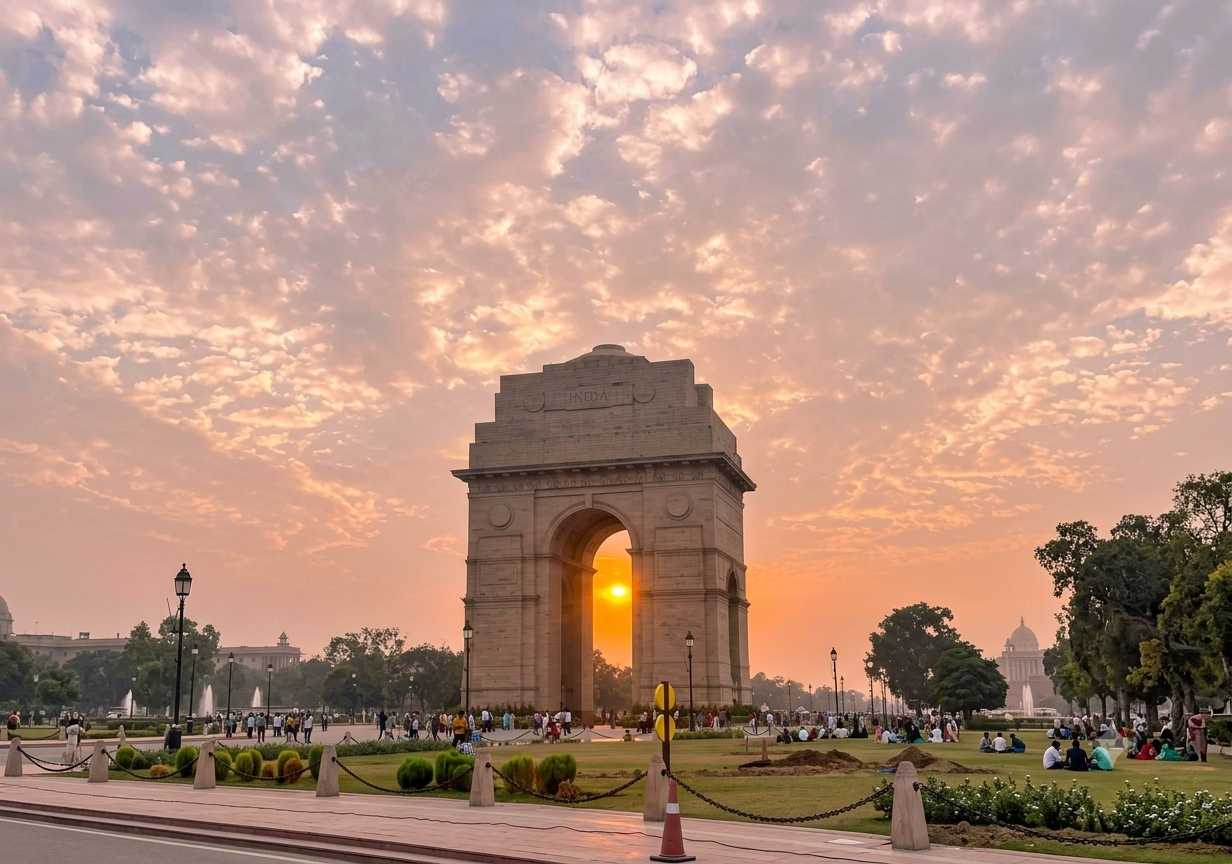
India Gate : Pride Of The Nation
Picture yourself standing beneath a towering archway, the evening sky turning shades of purple and gold behind it, while thousands of people mill about—couples holding hands, families chatting, street vendors selling snacks, the endless hum of Delhi's traffic forming a rhythmic backdrop. The structure above you is impossibly grand yet approachable, massive yet intimate, speaking of sacrifice and pride in a language that transcends words. This is India Gate—not just a monument but the beating heart of New Delhi, a place where history, memory, and everyday life converge in the most democratic way imaginable. Built to honor the Indian soldiers who died in World War I, this sandstone archway has become India's most iconic symbol, standing 42 meters tall on a sprawling roundabout that radiates outward like spokes on a wheel. What makes India Gate truly extraordinary is that unlike most monuments confined to formal ceremonies and reverent silence, India Gate thrives as a living, breathing public space where millions of Indians come to celebrate, mourn, protest, and simply spend time together. Once you stand beneath its arch and feel the energy of this place, you understand why India Gate is more than a memorial—it's a mirror reflecting India's soul
🏛️ India Gate – Where History Stands Defiant and Hope Rises Eternal
Picture yourself standing beneath a towering archway, the evening sky turning shades of purple and gold behind it, while thousands of people mill about—couples holding hands, families chatting, street vendors selling snacks, the endless hum of Delhi's traffic forming a rhythmic backdrop. The structure above you is impossibly grand yet approachable, massive yet intimate, speaking of sacrifice and pride in a language that transcends words. This is India Gate—not just a monument but the beating heart of New Delhi, a place where history, memory, and everyday life converge in the most democratic way imaginable. Built to honor the Indian soldiers who died in World War I, this sandstone archway has become India's most iconic symbol, standing 42 meters tall on a sprawling roundabout that radiates outward like spokes on a wheel. What makes India Gate truly extraordinary is that unlike most monuments confined to formal ceremonies and reverent silence, India Gate thrives as a living, breathing public space where millions of Indians come to celebrate, mourn, protest, and simply spend time together. Once you stand beneath its arch and feel the energy of this place, you understand why India Gate is more than a memorial—it's a mirror reflecting India's soul.
📍 Location
New Delhi, India
📏 Height
42 Meters
🏗️ Inaugurated
1931
🎖️ Purpose
Memorial to Indian Soldiers of World War I
📜 The Monument Born from Tragedy – 1931 and Beyond
India Gate's story begins not with celebration but with sorrow. During World War I, over 90,000 Indian soldiers died fighting for the British Empire. When the war ended, there was a need to honor these fallen soldiers, to ensure their sacrifice wasn't forgotten. In 1931, nearly a decade after the war's conclusion, India Gate—originally called the All-India War Memorial—was inaugurated by the Duke of Connaught.
What's historically significant is that while the monument was built under British colonial rule, it has been completely reclaimed and reinterpreted by Independent India. The inscription on the gate—"To the memory of the 90,000 Indian soldiers who laid down their lives in the Great War 1914-1918"—honors not a colonial empire but Indian sacrifice, Indian courage, and Indian lives. After independence, India Gate became the focal point for nationalist celebration, protest marches, and moments of collective grief. When India won independence, people celebrated beneath this arch. When national tragedies occur, Indians gather here to mourn. This transformation from a British war memorial to India's most democratic public monument is profoundly symbolic.
🏛️ The Architecture That Commands the Skyline
Approaching India Gate, the first impression is of soaring elegance. Designed by architect Edwin Lutyens, a key figure in creating New Delhi's imperial landscape, the monument stands 42 meters tall with a massive archway at its base. The structure is built from red and buff sandstone quarried from Dholpur, a stone that weathers beautifully and glows warmly in sunlight—particularly magical during sunrise and sunset.
The architectural style blends imperial grandeur with classical sensibility. The arch itself is massive—large enough to accommodate traffic flowing through it. The structure is adorned with decorative friezes, carvings, and inscriptions that speak of sacrifice and duty. Four lamp towers frame the arch, their design echoing classical architectural traditions while maintaining a distinctly Indian aesthetic sensibility.
What's remarkable is that Lutyens designed a monument that doesn't dominate but invites. The archway welcomes people beneath it rather than keeping them at distance. The surrounding plaza sprawls across acres, creating space for gatherings, celebrations, and quiet reflection. The architecture acknowledges that monuments serve people—not the other way around.
🌟 A Monument That Thrives on Life
What profoundly distinguishes India Gate from most monuments is that it's not a preserved artifact but an actively lived space. During the day, the plaza buzzes with energy—vendors selling balloons, ice cream, and snacks; musicians playing instruments; street artists creating portraits; families picnicking on the lawns. At night, the crowds shift but never disappear. Young couples come for privacy and romance. Friends gather to chat and celebrate. Political movements use it as a gathering point. On Independence Day and Republic Day, millions converge here to celebrate national pride.
This democratic character is what makes India Gate special. It doesn't segregate or restrict—it welcomes everyone equally. A prime minister and a street child stand beneath the same arch. A wealthy businessman and a laborer rest on the same lawns. This egalitarian spirit, embedded in the monument's open design, embodies India's foundational democratic ideals.
🏙️ The Surrounding Legacy
Radiating outward from India Gate's central archway are some of Delhi's most significant locations. The Rajpath (now renamed Kartavya Path)—a tree-lined avenue stretching from India Gate toward Rashtrapati Bhawan—was envisioned by Lutyens as Delhi's grandest thoroughfare. Lining this road are government buildings, museums, and cultural institutions that represent India's institutional heritage.
The National Stadium hosted the 1982 Asian Games and continues to host national sporting events. The National Museum nearby houses India's most significant art and artifact collections. Rashtrapati Bhawan, the official residence of India's president, stands majestically at the avenue's terminus. The Parliament Building symbolizes democratic governance. These structures, arranged in architectural harmony around India Gate, create a landscape representing India's governmental and cultural center.
🌤️ Best Time to Visit
October to March offers ideal weather—cool mornings and pleasant afternoons make outdoor exploration comfortable. April to May brings intense heat, though evening visits (after 6 PM) are rewarding. Monsoon (June-September) occasionally causes wet conditions but creates dramatic skies and fewer crowds. November-December evenings are particularly magical—cool temperatures and clear skies create perfect conditions.
🚇 How to Get There
India Gate is located in central New Delhi, easily accessible from anywhere in the city. Multiple metro stations serve the area—Central Secretariat, Lok Kalyan Marg, and Patel Chowk are nearest. Taxis, auto-rickshaws, and buses readily serve the location. If arriving from Indira Gandhi International Airport, the drive takes 30-45 minutes depending on traffic.
Plan 1-2 hours for India Gate itself. The surrounding area rewards further exploration—plan 4-5 hours if visiting nearby museums and monuments.
📍 Nearby Places Worth Exploring
Rashtrapati Bhawan offers guided tours showcasing presidential residence grandeur. Parliament House stands as an architectural marvel. National Museum displays India's artistic heritage. Jantar Mantar (200 meters away) showcases astronomical instruments. The old Delhi bazaars provide cultural contrast to this imperial landscape.
🧳 A Few Travel Tips
Wear comfortable shoes—you'll do considerable walking. Carry water and sun protection. The plaza becomes crowded during evenings and weekends; early morning offers tranquility. Photography is permitted everywhere. The monument is beautifully illuminated at night, creating magical evening experiences. Street vendors offer food, but stick to reputable establishments. Guides are available and provide historical context enriching the experience.
❤️ Why You Simply Must Visit India Gate
India Gate represents something rare—a monument that transcends its original purpose to become something universally meaningful. Built as a colonial war memorial, it's been transformed into India's most democratic public space, where all citizens claim equal ownership. It's where sacrifice is remembered, where national pride is celebrated, where ordinary Indians gather to be part of something greater.
Standing beneath its arch, surrounded by millions of voices and stories, you understand that India Gate isn't primarily about architecture or history—it's about the enduring spirit of a people who refused to remain conquered, who transformed a symbol of colonial power into a beacon of independence and democratic pride.
Walk beneath India Gate's soaring arch. Feel the weight of history and the lightness of hope. Understand why this monument remains India's most beloved gathering place.