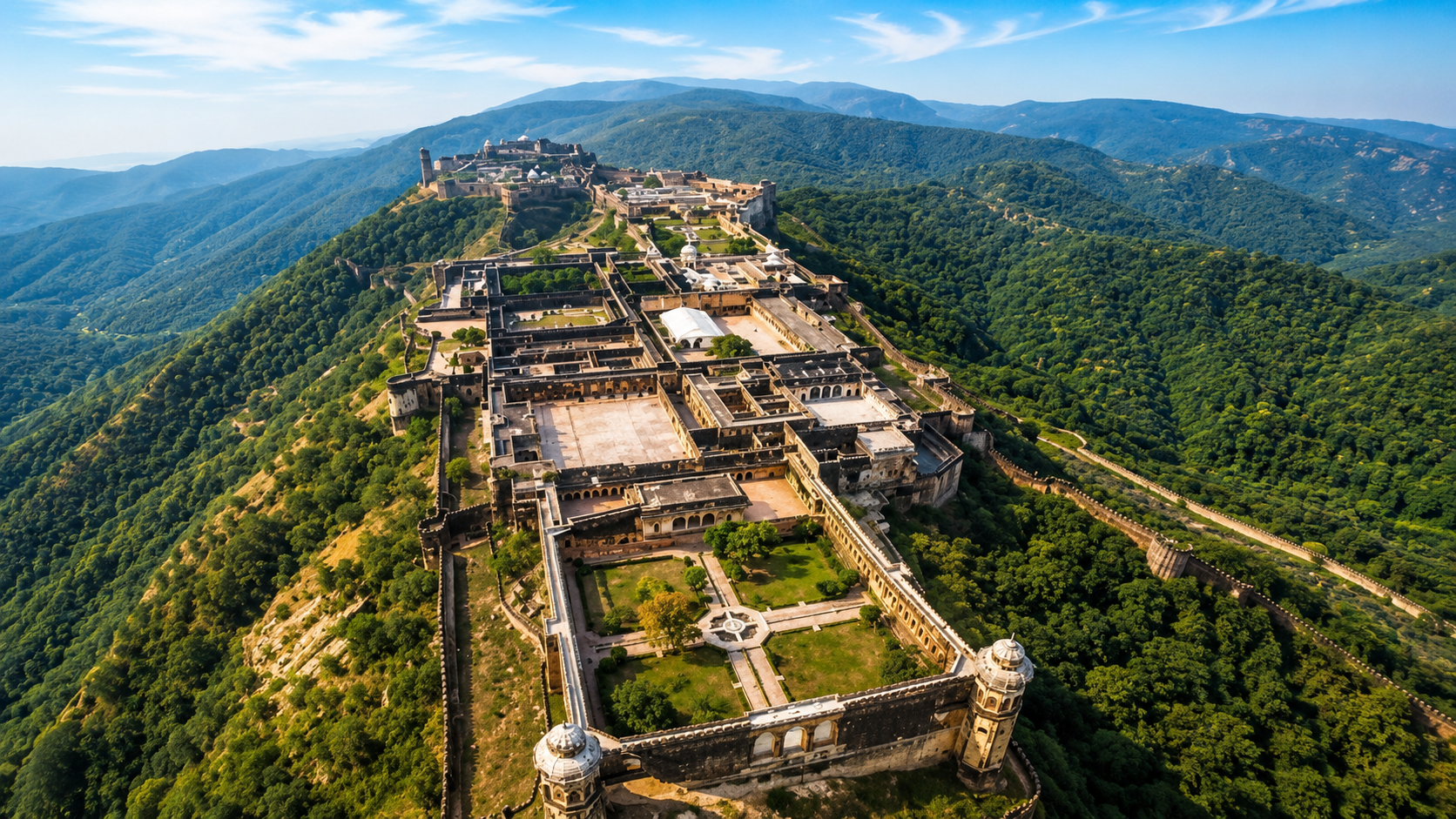
Nahargarh Fort : Where the City Sleeps Below and History Reigns Above
Imagine standing atop a ridge overlooking an entire city bathed in golden twilight, watching millions of lights twinkle to life as darkness falls, while behind you stands a fort so strategically positioned that it seems to guard the very soul of the city below. The wind carries the scent of desert grass mixed with ancient stone, and suddenly you're suspended between earth and sky, between the modern metropolis of Jaipur and centuries of Rajasthani warrior history. This is Nahargarh Fort—a magnificent hilltop fortress that sits like a sentinel above Jaipur, commanding views that stretch across the Pink City and beyond. Built in the 18th century, this fort was originally named Sudarshangarh, but its legendary past earned it the name "Nahargarh," meaning "lion fort" or "fort of the tigers." What makes Nahargarh truly extraordinary is its perfect duality—it's a functioning military fortress with all the tactical sophistication of a medieval stronghold, yet it's become one of Jaipur's most romantic destinations, where thousands of couples come to watch the sunset paint the city in shades of amber and rose. Once you climb these ancient walls and stand at the summit, you understand why this fort has captivated imaginations for nearly 300 years.
🏰 Nahargarh Fort
🌅 Where the City Sleeps Below and History Reigns Above
✨ Introduction
Imagine standing atop a ridge overlooking an entire city bathed in golden twilight, watching millions of lights twinkle to life as darkness falls, while behind you stands a fort so strategically positioned that it seems to guard the very soul of the city below. The wind carries the scent of desert grass mixed with ancient stone, and suddenly you're suspended between earth and sky, between the modern metropolis of Jaipur and centuries of Rajasthani warrior history. This is Nahargarh Fort—a magnificent hilltop fortress that sits like a sentinel above Jaipur, commanding views that stretch across the Pink City and beyond. Built in the 18th century, this fort was originally named Sudarshangarh, but its legendary past earned it the name "Nahargarh," meaning "lion fort" or "fort of the tigers." What makes Nahargarh truly extraordinary is its perfect duality—it's a functioning military fortress with all the tactical sophistication of a medieval stronghold, yet it's become one of Jaipur's most romantic destinations, where thousands of couples come to watch the sunset paint the city in shades of amber and rose. Once you climb these ancient walls and stand at the summit, you understand why this fort has captivated imaginations for nearly 300 years.
📜 The Guardian Fort – 1734 and Its Living Legacy
Nahargarh Fort's story begins in 1734 when Maharaja Sawai Jai Singh II, the visionary founder of Jaipur, constructed this fort as a protective barrier against outside invasions. The fort was initially called Sudarshangarh, but it earned the more fearsome name "Nahargarh"—lion fort—because of a local legend. According to folklore, a wild tiger once roamed these hills, and after taming it, the fort became known as the place where the lion had been captured. Whether myth or history, the name stuck, and it perfectly captured the fort's fierce, protective character.
Unlike many forts built in isolation, Nahargarh was deliberately constructed as an integral part of Jaipur's defense system. Jai Singh II had planned the city with mathematical precision, and Nahargarh was positioned to protect this geometric marvel from northern invasions. The fort's placement was genius—positioned on a ridge overlooking the city, it could spot approaching enemies from vast distances and launch defense mechanisms while remaining hidden from direct frontal assault.
What's remarkable is that Nahargarh never actually saw the kind of brutal siege warfare that defined many Rajasthani forts. Instead, it became a place where rulers retreated during monsoons, where royal hunting expeditions were planned, and where strategic decisions that shaped Jaipur's future were made. This relatively peaceful history allowed the fort to preserve its structures beautifully, making it one of the most intact hill forts near any major Indian city.
🏛️ The Architecture That Commands Respect
Approaching Nahargarh Fort, the first thing that strikes you is its intelligent positioning. The fort sits on a narrow ridge, utilizing the natural topography as its primary defense. The walls are built with pale sandstone that blends seamlessly with the rocky terrain, creating an almost camouflaged appearance. This wasn't accidental—it reflected sophisticated military strategy where visibility and concealment were equally important.
The fort's architecture blends practical military design with aesthetic refinement. Thick bastions protrude at strategic points, allowing defenders to cover all angles of approach. The walls are built with varying heights and widths, adjusting to the terrain while maintaining defensive strength. Gun placements dot the fortifications—silent reminders of the weaponry that once guarded this place.
What makes Nahargarh particularly special is how its architecture acknowledges the surrounding landscape rather than dominating it. Unlike fortress designs that impose themselves aggressively on the environment, Nahargarh seems to grow organically from the ridge, becoming almost part of the natural landscape. This harmony between human construction and nature reflects the sophisticated understanding of Rajasthani builders.
🏰 The Treasures Within These Walls
The Madhavendra Bhawan stands as the fort's most elegant structure—a palace built by Maharaja Sawai Madho Singh in the early 19th century. This two-story structure showcases exquisite architectural details with arched windows and intricate latticed screens. The bhawan features underground passages and chambers designed for royal comfort, and its strategic positioning offers views of the entire fort and city below.
The Fort Walls and Bastions tell stories of defensive innovation. Walking along these walls, you encounter gun emplacements positioned to defend specific approaches, watchtowers from which guards maintained surveillance, and passage systems designed for rapid troop movement. Each element reflects centuries of accumulated military knowledge.
The Central Fort Complex contains various chambers and courtyards where garrison soldiers once lived. The structures reveal how medieval fortifications balanced military functionality with basic human comfort—barracks with ventilation systems, storage areas for weapons and supplies, and ceremonial spaces where rulers held court.
The Underground Passages and Reservoirs are particularly fascinating. Built to withstand desert conditions, these chambers maintained water supplies and provided shelter during extreme weather or siege conditions. The engineering reveals the sophistication of medieval hydraulics.
🌇 A Living Vantage Point
What truly distinguishes Nahargarh is that it's not a ruin or museum piece but a functioning space where history and modernity coexist. The fort welcomes thousands of visitors daily, yet it maintains its integrity as a historical site. Unlike many heritage locations that feel frozen in time, Nahargarh pulses with contemporary life—couples watching sunsets, families picnicking, photographers capturing the city lights below, adventure enthusiasts exploring its passages.
This living presence hasn't diminished the fort's historical significance but enhanced it. The fort remains actively preserved, with regular maintenance ensuring that future generations will experience it as future visitors will—standing atop ancient walls, gazing across a city that Jai Singh II designed over three centuries ago.
📍 Visitor Information
☀️ Best Time to Visit
October to March offers ideal weather—cool mornings and pleasant afternoons make exploration comfortable. April to June brings intense heat, though sunset visits are rewarding when temperatures drop. Monsoon (July-September) transforms the landscape into lush greenery, but afternoon storms can be sudden.
🚗 How to Get There
Nahargarh Fort sits on the outskirts of Jaipur city, just 7 kilometers from the Pink City. It's easily accessible by taxi, auto-rickshaw, or private car from anywhere in Jaipur. The drive takes 15-20 minutes from the city center. For adventurous visitors, hiking trails from the city offer scenic routes, though they're strenuous in summer heat.
Plan 2-3 hours to explore the fort comprehensively. Many visitors combine it with City Palace and Jantar Mantar for a complete Jaipur heritage experience.
🗺️ Nearby Treasures
The Jaipur City Palace (15 km) showcases royal grandeur. Jantar Mantar (14 km) displays astronomical instruments. The Albert Hall Museum (18 km) offers art and history. Govind Dev Ji Temple (12 km) is a significant spiritual site.
💡 A Few Travel Tips
Wear comfortable walking shoes—the terrain is uneven. Carry water and sun protection. Visit during late afternoon for the best light and sunset views. Photography is permitted and encouraged. Respect the fort's historical significance—avoid writing on walls or removing stones. The fort has basic facilities but limited food options; pack snacks.
✨ Why You Simply Must Visit Nahargarh Fort
Nahargarh Fort is more than a historical structure—it's a perspective. Standing atop its walls at sunset, watching Jaipur transform into a tapestry of lights below, you understand that some places are built to protect, some to inspire, and some to remind us that human ambition can create lasting beauty.
This fort doesn't overwhelm you with tragedy or conquest stories. Instead, it offers something rarer—a chance to stand in the footsteps of rulers who shaped a city, to understand the marriage of strategic thinking and architectural vision, to witness how history can coexist peacefully with modernity.
Walk Nahargarh's ancient walls. Watch the city awaken below. Feel the desert breeze carry centuries of stories. Understand why Jaipur, with Nahargarh standing guard above it, remains one of India's most compelling destinations.