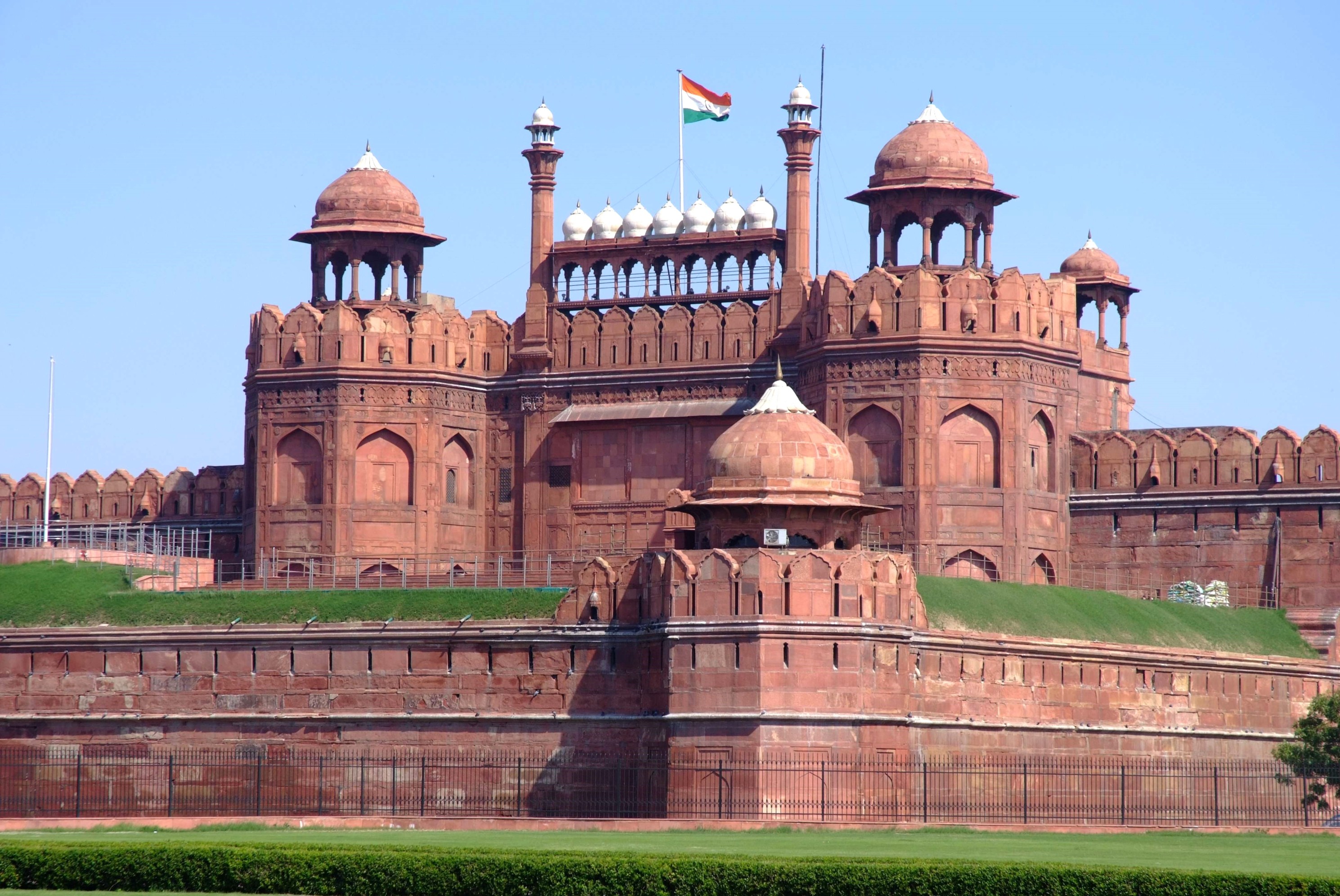
Red fort : The Majestic Heart Of Mughal India
Some buildings are monuments. Others are nations in miniature. The Red Fort — Lal Qila in Hindi — belongs to the second kind. A historic Mughal fort located in the Old Delhi area of Delhi, it served as the main residence of the Mughal emperors for nearly two centuries, and today it carries a meaning that goes well beyond its brick and sandstone. Recognized as a UNESCO World Heritage Site in 2007, the Red Fort remains a potent symbol of India's independence and sovereignty. Every year on 15 August, the Prime Minister of India stands on its ramparts to hoist the national flag — a tradition that has continued without interruption since 1947. To visit the Red Fort is to stand inside a place where empire was built, lost, looted, colonised, and ultimately reclaimed. Few structures anywhere in the world carry that many layers of meaning in the same set of walls.
🏰 Red Fort, Delhi: The Mughal Masterpiece at the Heart of India's Identity
Some buildings are monuments. Others are nations in miniature. The Red Fort — Lal Qila in Hindi — belongs to the second kind. A historic Mughal fort located in the Old Delhi area of Delhi, it served as the main residence of the Mughal emperors for nearly two centuries, and today it carries a meaning that goes well beyond its brick and sandstone. Recognized as a UNESCO World Heritage Site in 2007, the Red Fort remains a potent symbol of India's independence and sovereignty. Every year on 15 August, the Prime Minister of India stands on its ramparts to hoist the national flag — a tradition that has continued without interruption since 1947.
To visit the Red Fort is to stand inside a place where empire was built, lost, looted, colonised, and ultimately reclaimed. Few structures anywhere in the world carry that many layers of meaning in the same set of walls.
👑 The Vision Behind the Fort
The Red Fort was not born of necessity alone — it was born of ambition. Early in his reign, it became clear to Shah Jahan that the Agra Fort was not large enough to accommodate his populous court sessions and festive gatherings, and there was little scope for its expansion. Delhi had been an important city for his predecessors and had been the capital of the Delhi Sultanate, which had dominated the subcontinent before the arrival of the Mughals. The decision was made: Delhi would become his capital, and he would build a palace worthy of the empire he ruled.
Emperor Shah Jahan commissioned the construction of the Red Fort on 12 May 1639, following his decision to shift his capital from Agra to Delhi. Construction began in the sacred Islamic month of Muharram, on 13 May 1638, and it was completed on 6 April 1648. The fort that rose from the banks of the Yamuna River over those nine years became the centrepiece of Shahjahanabad — the new Mughal capital that is today's Old Delhi.
The design of the Red Fort is attributed to the architect Ustad Ahmad Lahori, renowned for his work on the Taj Mahal. That one man gave the world both the Taj Mahal and the Red Fort within a decade is a fact that still astonishes — and explains why both carry such a distinctive quality of refined, confident grandeur.
🏛️ Architecture: Where Four Traditions Meet
🎨 Architectural Synthesis
The Red Fort is not simply a Mughal building. It is the place where Mughal architecture reached its most sophisticated expression — a confident synthesis of traditions that had been evolving since the dynasty's founding in 1526.
The planning of the palace is based on Islamic prototypes, but each pavilion reveals architectural elements typical of Mughal building, reflecting a fusion of Persian, Timurid, and Hindu traditions. The Red Fort's innovative planning and architectural style, including the garden design, strongly influenced later buildings and gardens in Rajasthan, Delhi, Agra, and further afield.
The fort's massive red sandstone walls stand 75 feet (23 metres) high and enclose a complex of palaces and entertainment halls, projecting balconies, baths and indoor canals, geometrical gardens, and an ornate mosque. The walls themselves differ in height depending on which face you approach — they stand at 18 metres on the river side as opposed to the 33-metre high wall on the city side — a practical military distinction that also gives the fort its commanding silhouette from the streets of Chandni Chowk.
The fort features cusped arches and inlaid marble panels drawn from Persian traditions. Jali screens — latticed stone — offer ventilation and visual elegance, while artistic elements such as floral and geometric motifs, pietra dura work, and calligraphic inscriptions adorn the structures.
One of its most poetic engineering features is the Nahr-i-Behisht — the Stream of Paradise. The private apartments consist of a row of pavilions connected by a continuous water channel known as the Nahr-i-Behisht. In an era before air conditioning, this channel cooled the imperial quarters and carried the sound of running water through marble corridors — a detail that reveals how deeply Shah Jahan's architects thought about sensory experience, not just visual impact.
🏰 The Structures Within: A Palace Complex in Full
🚪 Lahori Gate
The Lahori Gate is the main entrance, named for its orientation toward Lahore. It leads into the Chhatta Chowk, a domed shopping area often referred to as the covered bazaar, where silk, jewellery, and other items for the imperial household were sold during the Mughal period. The transition from the chaos of Old Delhi's streets to this vaulted corridor is abrupt and theatrical — exactly as it was designed to be.
🥁 Naubat Khana
Beyond the Chhatta Chowk stands the Naubat Khana (Drum House), where music was performed daily at scheduled times, and it was required of everyone except members of the royalty to dismount during these performances.
⚖️ Diwan-i-Am
The Diwan-i-Am (Hall of Public Audience) is where the emperor met his subjects. It has 60 red sandstone pillars supporting a flat roof — a space designed to be impressive without being exclusive, where anyone with a petition could appear before the emperor and seek justice.
💎 Diwan-i-Khas
The Diwan-i-Khas (Hall of Private Audience) is smaller but far richer. This intimate and richly decorated chamber was where the emperor received courtiers and important state guests, and it once housed the legendary Peacock Throne.
After Nadir Shah's invasion in 1739 carried the throne off to Persia, the walls of the Diwan-i-Khas were left with an inscription that reads: "If there is a paradise on earth, it is this, it is this, it is this" — words that now carry a particular poignancy.
The Rang Mahal (Palace of Colours) housed the emperor's wives and mistresses and was once famous for its mirror mosaics and painted ceilings. The Moti Masjid (Pearl Mosque), added by Shah Jahan's successor Emperor Aurangzeb to the emperor's private quarters, is a small but exquisite structure in pure white marble. The Hammam (Royal Baths) and the Shahi Burj — Shah Jahan's private working tower — complete an ensemble that reveals every dimension of Mughal imperial life, from governance and diplomacy to prayer, leisure, and personal retreat.
📜 History Written in Plunder and Resilience
In 1739, the Persian emperor Nadir Shah decisively defeated the Mughal army and plundered the Red Fort, seizing its treasures including the legendary Peacock Throne. His invasion left the city significantly damaged, and the Mughal Empire was severely weakened.
As later emperors struggled to hold their declining realm together, during the reign of Farrukhsiyar, the silver ceiling of the fort was replaced with copper in order to raise money — probably the beginning of the plunder that would go on for years.
The final blow came with the Indian Rebellion of 1857. Following the rebellion, the British captured the fort, deposed the last Mughal emperor Bahadur Shah Zafar, and demolished many of its marble pavilions and gardens, converting the complex into a military garrison and constructing barracks over once-lush Mughal courtyards.
Priceless objects — including the Koh-i-Noor diamond and the wine cup of Shah Jahan — were removed to Britain, never to return.
And on 15 August 1947, Prime Minister Jawaharlal Nehru addressed the nation from the Red Fort's ramparts, delivering his iconic "Tryst with Destiny" speech to mark India's independence.
In that moment, a Mughal emperor's palace became the birthplace of a republic's annual ritual — one that continues to this day.
✨ Legends, Facts, and What Makes Lal Qila Unique
The Red Fort holds a handful of facts that tend to stop people mid-sentence. The fort's boundary walls are asymmetrical to contain and subsume the older Salimgarh Fort — built by Islam Shah Suri in 1546 — making the complex a layering of two distinct historical eras within a single perimeter.
The fort complex encloses an area of 125 acres in an irregular octagonal shape with twenty-one bastions and six gateways, of which only two remain operational.
One of the fort's most overlooked details is the Orpheus Panel inside the Diwan-i-Am. On the wall behind the emperor's throne is an inlaid panel known as the Orpheus Panel, after the legendary Greek figure, who is depicted here playing the lyre for an entranced congregation of birds and animals.
Scholars believe that the panel, alongside the symbolic significance of the Solomonic throne, represented Shah Jahan's benevolent reign over his subjects. A Greek myth inside a Mughal fort — the Red Fort was always more cosmopolitan than its red walls might suggest.
🎟️ The Visitor Experience
The Red Fort rewards visitors who arrive with patience and curiosity. The complex is large enough that a casual two-hour circuit leaves significant areas unexplored; serious visitors should budget three to four hours or more.
The approach through Chandni Chowk — Old Delhi's ancient market street, lined with spice vendors, jewellers, and food stalls — is itself part of the experience, a sensory immersion that prepares you for the scale of what lies behind the Lahori Gate.
Once inside, the noise of the city drops away, replaced by garden paths, open courtyards, and the cool shade of sandstone colonnades.
🎭 Sound & Light Show
An evening Sound and Light Show brings the fort's history to life after dark, with the ramparts and pavilions dramatically lit while a narrated history of the Mughals unfolds.
🕒 Visiting Hours
The fort is open Tuesday to Sunday, 9:30 AM to 4:30 PM (closed on Mondays).
🌤️ Best Time to Visit
The best time to visit Red Fort is October to March, when Delhi's winter makes outdoor exploration comfortable.
🚇 Nearest Metro
The nearest Delhi Metro station is Chandni Chowk on the Yellow Line, a short walk from the Lahori Gate.
The Archaeological Survey of India (ASI) manages the complex, and entry fees apply separately for Indian and international visitors.
🇮🇳 Why the Red Fort Endures
The Red Fort has been a symbol of power since the reign of Shah Jahan, has witnessed the change in Indian history to British rule, and was the place where Indian independence was first celebrated — and is still celebrated today.
That continuity — from Mughal emperors to colonial administrators to the Prime Ministers of independent India — is what makes the Red Fort unlike almost any other heritage site in the country.
It has not been preserved as a relic of a vanished world; it remains an active stage for the living nation. For domestic travellers, it is a touchstone of national identity. For international visitors, it is both a magnificent architectural achievement and a compressed history of the Indian subcontinent itself.
🏰 Final Reflection
To stand beneath the Lahori Gate is to stand at the intersection of six centuries of power, artistry, loss, and renewal. That, more than any single room or inscription or carving within it, is what makes Lal Qila irreplaceable.