Aihole: Where India's Temple Heritage Began
Imagine standing before a thousand-year-old temple carved from golden sandstone, the late afternoon sun turning its walls into liquid amber, and realising with quiet astonishment that you are standing at the very birthplace of Indian temple architecture. That's Aihole for you — not just a village, but a revelation. Tucked away in the Bagalkot district of northern Karnataka, this extraordinary open-air museum of stone has been shaping the story of India's artistic heritage for over fifteen centuries. Locals call it "Aivalli," and once you walk its ancient lanes, you'll understand why historians, architects, and wanderers keep returning here, as if the stones themselves have something left to say.
🏛️ Aihole, Karnataka – Where India's Architecture Was Born
Imagine standing before a thousand-year-old temple carved from golden sandstone, the late afternoon sun turning its walls into liquid amber, and realising with quiet astonishment that you are standing at the very birthplace of Indian temple architecture. That's Aihole for you — not just a village, but a revelation. Tucked away in the Bagalkot district of northern Karnataka, this extraordinary open-air museum of stone has been shaping the story of India's artistic heritage for over fifteen centuries. Locals call it "Aivalli," and once you walk its ancient lanes, you'll understand why historians, architects, and wanderers keep returning here, as if the stones themselves have something left to say.
📜 A Little Bit of History First
Aihole's story is as layered as the carved reliefs adorning its temple walls. The name is believed to derive from "Ayyavole," a reference to a guild of merchants who once made this settlement thrive. Long before India had a defined temple architecture style, it was here — in this quiet village on the banks of the Malaprabha River — that the earliest experiments began.
Between the 4th and 12th centuries, the Chalukya dynasty ruled this region and chose Aihole as their laboratory. Over 125 temples were built here, each one a slightly different experiment in proportion, structure, and sculpture. Some temples are modest and simple; others are breathtakingly elaborate. Together, they represent a continuous, living archive of architectural evolution — the moment when Indian craftsmen were figuring out, stone by stone, how to build a temple. By the time the Chalukyas moved their capital to Badami and later Pattadakal, the grammar of Indian temple design had been written — and Aihole was where the first draft was composed.
✨ The Attractions That Will Leave You Breathless
🏛️ Durga Temple
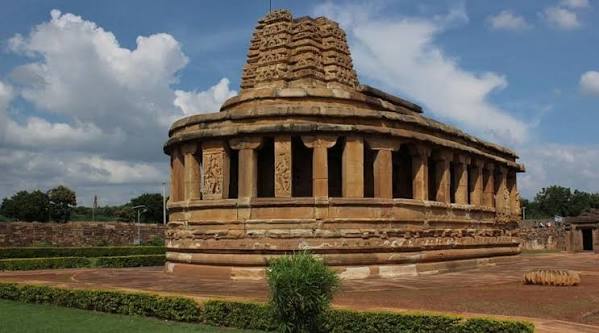
The Durga Temple is the undisputed crown jewel of Aihole. Despite its name, it was never dedicated to Goddess Durga — the name comes from the Kannada word "durg," meaning fort, as the temple once stood near a fortified area. Built in the 6th–7th century, its distinctive apsidal (semicircular) form is unlike anything else in India. The gallery of exquisite sculptures surrounding its outer walls — depicting gods, celestial beings, and mythological scenes — is among the finest Chalukyan art in existence. Standing before it at golden hour, with the sun setting the sandstone ablaze, is nothing short of cinematic.
🕍 Lad Khan Temple & Chalukyan Wonders
A short walk away is the Lad Khan Temple, one of the oldest surviving stone temples in India, believed to date to around the 5th century. Flat-roofed and deceptively simple on the outside, it holds a quiet power that resonates long after you've left. The Hucchimalli Gudi and Hucchappayya Math temples nearby reveal how boldly the Chalukyan craftsmen experimented with towering shikhara styles that would eventually influence temple design across the entire subcontinent.
🪨 Ravanaphadi Cave Temple & Museum
Don't miss the Ravanaphadi Cave Temple, carved directly into a rocky hillside and filled with stunning sculptures of Shiva, Vishnu, and Harihara that retain remarkable detail despite their age. And for context that ties everything together, the Archaeological Museum at the site houses a superb collection of sculptures, inscriptions, and artefacts recovered from the Aihole complex — an essential stop before or after your exploration.
🌾 Culture, People, and Food
Aihole has a warm, unhurried character that is deeply rooted in rural Karnataka. The village moves at its own gentle pace, and locals go about their daily lives surrounded by ancient stone as naturally as if the temples have always simply been there — because, of course, they have. You'll find small chai stalls, friendly conversations in Kannada and Marathi, and an atmosphere entirely free of the commercial bustle that overwhelms more famous heritage sites.
For meals, the surrounding towns of Badami and Pattadakal offer simple, hearty Karnataka cuisine — jowar roti, enne badanekayi (spiced brinjal), and freshly prepared dal that will fuel your exploration. Local eateries serve hot, unpretentious food with genuine hospitality, and a strong filter coffee is never far away.
📌 Visitor Information
🌤️ Best Time to Visit
Aihole is best visited between October and March, when temperatures are cool and the light is perfect for photography and long walks among the temples. The golden winter light between November and February is particularly magical — the sandstone temples seem to glow from within. April to June can be hot but manageable with early morning visits. The monsoon months of July to September bring lush greenery to the landscape and a dramatic, moody atmosphere, though some paths can become muddy.
✈️ By Air
By Air: The nearest airport is Hubli Airport (HBX), approximately 130 km from Aihole, connected to Bengaluru and Mumbai. From Hubli, taxis and local buses reach Aihole via Badami.
🚆 By Rail
By Rail: The nearest railway station is Badami, about 36 km away, on the Gadag–Solapur rail line with connections from Bengaluru and Hyderabad. From Badami station, auto-rickshaws and taxis make the short drive to Aihole.
🛣️ By Road
By Road: Aihole sits roughly 46 km from Badami and 35 km from Pattadakal, and is easily covered by road. Karnataka State Road Transport Corporation buses connect Aihole to Badami and Bagalkot. Most travellers hire a taxi or self-drive to cover the Aihole–Badami–Pattadakal golden triangle in a single day.
📍 Nearby Places Worth Exploring
Aihole is the perfect centrepiece for a wider Chalukyan heritage journey. Badami, just 46 km away, offers spectacular cave temples carved into crimson cliffs above a tranquil lake — a site that simply takes your breath away. Pattadakal, 35 km distant and a UNESCO World Heritage Site, showcases the most refined flowering of Chalukyan temple design. Together, these three sites form one of the most rewarding heritage circuits in all of India.
🎒 A Few Travel Tips Before You Go
Wear comfortable, breathable footwear — you will be walking extensively over uneven stone paths. Carry water and sunscreen, especially for midday visits. Respect the archaeological sites; many structures are fragile and irreplaceable. Hiring a knowledgeable local guide at the entrance significantly deepens the experience. Book accommodation in Badami, which offers a wider range of hotels and guesthouses, and make day trips to Aihole and Pattadakal from there.
❤️ Why You Simply Must Visit Aihole
Some places exist on maps. Aihole exists at the very root of a civilisation's creative awakening. It's the kind of place where you walk slowly, look carefully, and feel the extraordinary weight of human ambition — the ambition of craftsmen who had never built a temple before and yet somehow conjured masterpieces from bare stone. Whether you're a history lover chasing ancient kingdoms, a photographer hunting extraordinary light, an architect drawn to the origins of form, or simply a curious traveller who wants to go somewhere few have thought to look, Aihole will speak to something deep and unhurried inside you.
The carved gods watching from golden walls, the silence broken only by birdsong, the cool shade of a thousand-year-old mandapa, the feeling of standing where India's artistic story truly began — these are the moments you don't simply photograph. You carry them home, changed in some quiet way you might not immediately be able to name.
So lace up your walking shoes, leave the tourist trail behind, and let Aihole do what it has always done best — remind you that the most astonishing things are often hiding in plain sight, waiting patiently in stone.