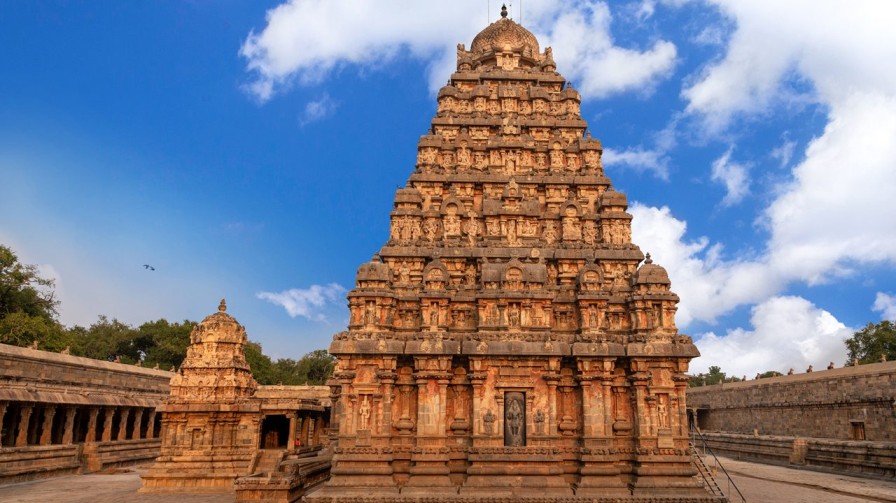
Airavateshwar Temple
Imagine standing before walls so intricately carved that every inch seems to breathe — gods and dancers frozen mid-motion, celestial musicians playing silently for eternity, horses that look as though they might gallop away at any moment. That& Airavatesvara Temple for you — not just a place of worship, but a masterpiece of human devotion carved in stone. Tucked quietly in the small town of Darasuram, near Kumbakonam in Tamil Nadu, this magnificent 12th-century Chola temple has been astonishing visitors for nearly nine centuries.
🏛️ Airavatesvara Temple, Darasuram – Where Stone Speaks in Whispers
Imagine standing before walls so intricately carved that every inch seems to breathe — gods and dancers frozen mid-motion, celestial musicians playing silently for eternity, horses that look as though they might gallop away at any moment. That's Airavatesvara Temple for you — not just a place of worship, but a masterpiece of human devotion carved in stone. Tucked quietly in the small town of Darasuram, near Kumbakonam in Tamil Nadu, this magnificent 12th-century Chola temple has been astonishing visitors for nearly nine centuries. A UNESCO World Heritage Site, it is one of the greatest achievements of Dravidian architecture — and yet, it remains blissfully unhurried, intimate, and deeply moving in ways that larger, more famous temples sometimes cannot match.
📜 A Little Bit of History First
Airavatesvara Temple was built by the great Chola king Raja Raja Chola II in the 12th century CE, during a period when Tamil temple architecture had reached its most refined and breathtaking peak. The temple is named after Airavata — the divine white elephant of Lord Indra, king of the gods — who is said to have worshipped the presiding deity, Lord Shiva, at this very spot, seeking relief after being cursed by a sage. Even the sacred tank here is believed to have healing properties; Airavata bathed in its waters to regain his celestial white colour. Legend and stone intertwine here so seamlessly that it becomes impossible to tell where history ends and myth begins.
The temple is part of the celebrated Great Living Chola Temples group, recognised by UNESCO alongside the Brihadeeswarar Temple at Thanjavur and the Gangaikonda Cholapuram Temple — three monuments that together represent the absolute pinnacle of Chola artistry and vision.
✨ The Temple That Will Leave You Breathless
🏛️ Architectural Splendour
What sets Airavatesvara apart from other great temples is its extraordinary attention to detail and its sense of intimate perfection. While the Brihadeeswarar at Thanjavur overwhelms with sheer scale and grandeur, Airavatesvara captivates with its precision and poetry.
The mandapam (pillared hall) at the entrance is shaped like a giant chariot, complete with ornamental stone wheels and horses — a concept so theatrical and imaginative that it still stops visitors in their tracks. This chariot motif was a beloved device of Chola architects, turning sacred space into mythological spectacle.
The carvings that cover every surface are simply without equal. Panels depict scenes from Hindu mythology, images of Shiva in his many forms, celestial nymphs, warriors, musicians, and animals rendered with a naturalism and energy that feels almost impossible for stone. Look closely and you'll find a staircase whose steps are said to produce musical notes when struck — the famous musical steps, a detail so playful and human that it makes the Chola builders feel suddenly, warmly present across the centuries.
🕉️ Culture, Mythology, and Meaning
Airavatesvara Temple is not merely an architectural wonder — it is a living document of Chola civilisation, belief, and artistic ambition. The temple's iconographic programme is extraordinarily rich, covering the 63 Nayanmars (Tamil Shaivite saints), episodes from the Puranas, and devotional narratives that generations of Tamil pilgrims have known and loved.
The presiding deity is Lord Dharmaraj (Shiva), and the temple is also associated with Yama, the god of death, who is said to have been cured of a burning curse by bathing in the temple tank. This connection to transformation — from suffering to relief, from curse to grace — gives the temple a profoundly human emotional resonance that transcends religion.
For visitors with an eye for art, the sculptural details reward slow, patient looking. Every pillar, every doorway, every cornice has something new to reveal — a smiling face, an acrobat, a pair of lovers, a devotee lost in prayer.
🌤️ Best Time to Visit
🍃 November–February
Darasuram is a year-round destination, but the cooler months from November to February are the most comfortable for exploring the temple at leisure.
☀️ March–May
The Tamil Nadu summer (March–May) can be intensely hot, so early morning visits are recommended if you're travelling in warmer months.
🌧️ June–September
The monsoon (June–September) brings lush greenery to the surrounding landscape, making the ancient stone look even more dramatic against the deep greens of the season.
🚗 How to Get There
✈️ By Air
By Air: The nearest airport is Tiruchirappalli International Airport (TRZ), approximately 60 km from Darasuram. It is connected to Chennai, Bengaluru, Mumbai, and several international destinations. From the airport, taxis are readily available to Darasuram or Kumbakonam.
🚆 By Rail
By Rail: The closest railway station is Kumbakonam Railway Station, just 4 km from the temple. Kumbakonam is well connected to Chennai, Thanjavur, Trichy, and other major Tamil Nadu cities. From the station, autos and taxis reach the temple in minutes.
🛣️ By Road
By Road: Darasuram sits on the highway between Kumbakonam and Thanjavur, making it extremely easy to reach by road. Tamil Nadu State Transport buses run regularly between Kumbakonam and Darasuram, and the drive from Thanjavur takes less than 40 minutes.
📍 Nearby Places Worth Exploring
Airavatesvara Temple is perfectly placed for a magnificent Chola heritage circuit. Thanjavur and its towering Brihadeeswarar Temple are just 35 km away — a must-visit on any itinerary. Gangaikonda Cholapuram, the third great Chola temple, lies about 70 km north. The temple town of Kumbakonam itself is home to dozens of beautiful temples and is famous for its sacred Mahamaham tank. Swamimalai, home to traditional Chola-era bronze casting artisans still practising ancient techniques, is a short drive away and offers a remarkable living connection to the same artistic tradition that built Airavatesvara.
❤️ Why You Simply Must Visit Airavatesvara Temple
Some monuments announce themselves with size and spectacle. Airavatesvara speaks quietly — and that is precisely what makes it unforgettable. It rewards those who slow down, who lean in, who let their eyes travel unhurriedly across a carved panel until a goddess smiles back at them from across nine centuries.
Whether you are a lover of history, a devotee on pilgrimage, a photographer chasing extraordinary light on ancient stone, or simply a curious traveller looking for an experience that goes deeper than a photograph — Airavatesvara Temple will give you something you didn't know you were searching for.