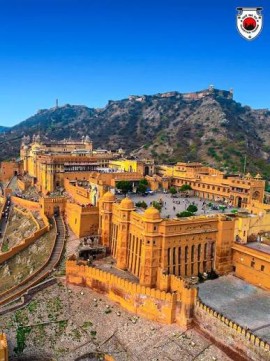
Amber Fort : The Crown Jewel of Rajasthan
There are forts in India that impress, and then there is Amber Fort — a place that genuinely overwhelms. Perched on a rugged ridge of the Aravalli Hills, approximately 11 kilometres north of Jaipur in Rajasthan, Amber Fort (also spelled Amer Fort) commands its surroundings with the quiet authority of something built not just for defence, but for posterity. Its pale yellow and pink sandstone walls, reflected in the still waters of Maota Lake below, create one of the most iconic images in all of Indian heritage tourism. A UNESCO World Heritage Site since 2013 — included as part of the Hill Forts of Rajasthan — Amber Fort is far more than a military structure. It is a palace complex, a work of art, and a living archive of Rajput and Mughal history woven together in breathtaking harmony.
🏰 Amber Fort: Rajasthan's Hilltop Palace Where Every Stone Tells a Royal Story
There are forts in India that impress, and then there is Amber Fort — a place that genuinely overwhelms. Perched on a rugged ridge of the Aravalli Hills, approximately 11 kilometres north of Jaipur in Rajasthan, Amber Fort (also spelled Amer Fort) commands its surroundings with the quiet authority of something built not just for defence, but for posterity. Its pale yellow and pink sandstone walls, reflected in the still waters of Maota Lake below, create one of the most iconic images in all of Indian heritage tourism. A UNESCO World Heritage Site since 2013 — included as part of the Hill Forts of Rajasthan — Amber Fort is far more than a military structure. It is a palace complex, a work of art, and a living archive of Rajput and Mughal history woven together in breathtaking harmony.
📍 Location and Approach: Drama Before You Even Arrive
The journey to Amber Fort is itself part of the experience. The winding road up the hill offers gradually expanding views of the fort's layered ramparts rising against the sky, the glittering surface of Maota Lake in the valley, and the dense network of walls and watchtowers that stretch across the surrounding ridgeline. The approach has been made this way for centuries — designed to impress visiting dignitaries and remind approaching armies of exactly what they were up against. It still works.
📜 History and Origins: From Meena Tribe to Rajput Glory
The site of Amber has been inhabited and fortified for well over a thousand years. The original settlement is believed to have been controlled by the Meena tribe before the Kachchwaha Rajputs, led by Raja Alan Singh, wrested control in the 11th century CE. The Kachchwahas made Amber their capital and ruled from here for several centuries, establishing it as an important centre of Rajput power in the region.
The fort as it stands today, however, owes its most significant construction to Raja Man Singh I, a trusted general and close ally of the Mughal Emperor Akbar. Construction of the main palace complex began around 1592 CE under his patronage, and successive rulers continued expanding and refining it over the next 150 years. Mirza Raja Jai Singh and Sawai Jai Singh II — the latter of whom eventually founded Jaipur in 1727 and shifted the capital there — made particularly important contributions to the fort's architecture and interior decoration.
The relationship between the Kachchwaha rulers and the Mughal Empire was one of pragmatic alliance rather than submission. Raja Man Singh I served as a Navratna — one of the nine jewels — in Akbar's court, and this partnership brought considerable wealth and cultural exchange to Amber. The result is an architectural language that is neither purely Rajput nor purely Mughal, but a sophisticated and beautiful fusion of both traditions.
🏛️ Architecture: The Art of Two Worlds Meeting
Amber Fort's architecture is its greatest achievement. The complex is organised across four main courtyards, each with a distinct character and function, connected by a series of staircases, corridors, and grand gateways that manage to feel both monumental and intimate simultaneously.
The entrance to the main palace is through the Suraj Pol (Sun Gate), opening into the large Jaleb Chowk — the first courtyard, once used for military assemblies and public gatherings. From here, a broad staircase ascends to the Sila Devi Temple, dedicated to the goddess Sheela Mata, whose idol Raja Man Singh is said to have brought from Bengal following a military victory. The temple remains an active place of worship and draws enormous crowds, particularly during the Navratri festival.
The second courtyard contains the Diwan-i-Aam (Hall of Public Audience) — a colonnaded hall where the Maharaja would address his subjects and receive petitions, its double-rowed columns lending it a stately rhythm. The third courtyard is the private royal precinct, housing the most celebrated spaces in the fort: the Ganesh Pol, the Sheesh Mahal, the Jai Mandir, and the Sukh Niwas.
The Ganesh Pol (Ganesh Gate) is perhaps the most photographed gateway in all of Rajasthan — a riot of colour, mosaic, and fresco work that serves as the threshold between the public areas of the fort and the royal private quarters. Every surface is painted or inlaid with floral patterns, geometric designs, and figures from Hindu mythology, executed with a precision and vibrancy that centuries have barely dimmed.
Behind it lies the Sheesh Mahal (Palace of Mirrors) — a room whose walls and ceiling are entirely encrusted with tiny convex mirrors of coloured glass, arranged in elaborate geometric patterns. When a single candle is lit inside this room, the mirrors catch and multiply the flame until the entire space glitters like a sky full of stars. It is one of the most extraordinary interior spaces in Indian architecture and consistently leaves visitors speechless.
The Sukh Niwas (Hall of Pleasure) demonstrates a different kind of ingenuity: it was cooled by a system of water channels running through its marble walls — an ancient form of air conditioning that kept the royal apartments comfortable even in Rajasthan's fierce summer heat.
🎨 The Sheesh Mahal and Artistic Legacy
The artistic sophistication of Amber Fort extends well beyond the Sheesh Mahal. Throughout the complex, walls are decorated with frescoes depicting scenes from Hindu epics, battle narratives, hunting expeditions, and royal court life. The craftsmanship reflects a tradition of painting and decorative arts that flourished under Kachchwaha patronage and laid the groundwork for what became known as the Jaipur school of miniature painting.
The use of materials is equally striking. Local Dhaulpur sandstone, white marble from Makrana (the same quarries that supplied stone for the Taj Mahal), semi-precious stones inlaid in pietra dura style, and hand-painted lime plaster combine to create a palette that shifts in mood and atmosphere depending on the quality of light. At sunrise, the fort glows warm gold. In the midday sun, the marble courtyards shine with an almost clinical brightness. At dusk, the whole complex turns a deep, burnished amber — a colour that seems to have given the fort its name.
🛡️ Legends and Notable Facts
Amber Fort carries its share of compelling legends. One of the most enduring concerns a network of secret underground passages said to connect the fort to the nearby Jaigarh Fort, which sits on the ridge directly above. This tunnel — part of which can still be accessed by visitors — was reportedly used as an escape route for the royal family in times of emergency, and also as a means of moving troops and supplies unseen.
Jaigarh Fort is also the site of one of the largest cannons on wheels in the world — the Jaivana cannon, cast in 1720 and never fired in actual battle. The relationship between Amber and Jaigarh is inseparable; the two forts functioned as a single defensive system, and walking between them along the ancient walls remains one of Jaipur's most rewarding heritage experiences.
Another remarkable fact: Amber Fort was reportedly the inspiration for Rudyard Kipling's fictional city of Amber in Kim, though this connection remains a matter of literary discussion rather than documented record.
🌅 Visitor Experience: Timeless and Thoroughly Rewarding
Amber Fort is open daily from early morning until late evening, and it offers something different at almost every hour. Morning visits are ideal for photography and relative quiet before the crowds arrive. The evening light and sound show, projected onto the fort's exterior walls and narrating its history in dramatic fashion, is a popular and genuinely atmospheric experience.
The elephant ride up the ramp to the fort's main entrance — once the traditional royal approach — remains a well-known feature of the Amber experience, though increasing animal welfare concerns have led many travellers to opt instead for jeeps or the pleasant walk up the cobbled path. The ongoing debate around this practice reflects a broader and healthy conversation about responsible tourism at heritage sites.
Inside the fort, guided tours are available and well worth taking — the layers of history here are dense enough that even a good guidebook struggles to do them justice in the way a knowledgeable guide can. The museum within the complex houses a collection of artefacts, weaponry, and royal costumes that add further context to the spaces you walk through.
The best time to visit is between October and March, when Jaipur's climate is at its most hospitable. The fort is especially magical during the festive season — Diwali lights reflected in Maota Lake below the fort walls create a visual that lingers long in memory.
🌍 Heritage Tourism and International Appeal
Amber Fort is consistently ranked among the top heritage destinations in India and draws millions of visitors annually, a mix of domestic pilgrims, history enthusiasts, honeymooners, school groups, and international tourists who include it as a centrepiece of the Rajasthan Golden Triangle circuit alongside Jaipur and Agra.
Its appeal crosses cultural boundaries effortlessly. For Indian visitors, it is a source of immense pride and historical connection. For international travellers, it offers an encounter with a tradition of palatial architecture that has no real equivalent anywhere else in the world — neither the European castle nor the East Asian palace quite prepares you for the scale, colour, and conceptual ambition of Amber.
What makes Amber Fort truly enduring, though, is not any single room or gateway or view — it is the sense that the whole complex was built by people who believed deeply that beauty and power were not opposites, but partners. That philosophy, embedded in every carved panel and mirrored ceiling, is what visitors carry home with them long after the photographs have been sorted and the journey is over.