Badami Cave: Wonder Carved In Stone
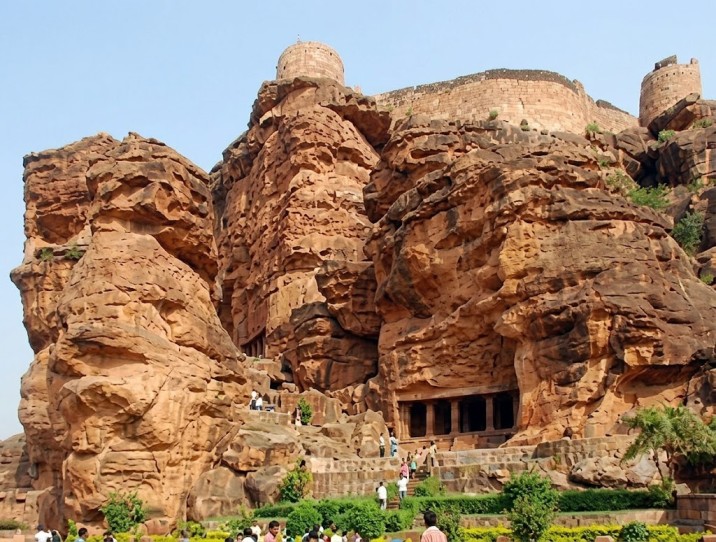
Imagine standing at the edge of a rust-red gorge, the golden sandstone cliffs glowing like embers in the afternoon sun, ancient carvings gazing down at you from alcoves carved a thousand and a half years ago. That&Badami for you — not just a historical site, but a conversation with time itself. Tucked into a dramatic ravine in northern Karnataka, this small, unhurried town sits cradled between two rocky hills, with an emerald lake shimmering at its heart. The Badami Cave Temples, hewn directly into the face of a sandstone cliff, are among the finest examples of early Indian rock-cut architecture ever created — and yet, remarkably, Badami remains one of the country& best-kept secrets.
🏛️ Badami Caves, Karnataka – Where Stone Tells the Story of Eternity
Imagine standing at the edge of a rust-red gorge, the golden sandstone cliffs glowing like embers in the afternoon sun, ancient carvings gazing down at you from alcoves carved a thousand and a half years ago. That's Badami for you — not just a historical site, but a conversation with time itself. Tucked into a dramatic ravine in northern Karnataka, this small, unhurried town sits cradled between two rocky hills, with an emerald lake shimmering at its heart. The Badami Cave Temples, hewn directly into the face of a sandstone cliff, are among the finest examples of early Indian rock-cut architecture ever created — and yet, remarkably, Badami remains one of the country's best-kept secrets.
📜 A Little Bit of History First
Badami's story stretches back to the 6th century CE, when it served as the proud capital of the Chalukya dynasty — one of the most powerful empires of early medieval India. The town was known then as Vatapi, and under the reign of the Chalukya king Pulakesi I and his successors, it flourished into a centre of art, religion, and political power. The cave temples were commissioned during this golden age, carved out of the soft Badami sandstone between the 6th and 8th centuries, and dedicated to the three great traditions of ancient India — Hinduism, Jainism, and Buddhism.
What makes Badami extraordinary is not just the age of its monuments, but the ambition behind them. These weren't temples built stone by stone — they were sculpted out of living rock, chiselled from the mountainside with breathtaking precision, as if the craftsmen were simply revealing what had always been there.
🪨 The Caves That Will Leave You Breathless
🕉️ Cave 1
Cave 1 is dedicated to Lord Shiva and is the oldest of the group. Step inside and you are greeted immediately by one of ancient India's most magnificent sculptures — an 18-armed dancing Shiva, known as Nataraja, depicted in a pose of cosmic rhythm. Every arm, every detail is carved with extraordinary finesse. The ceiling bears intricate geometric patterns that feel almost impossibly precise for their era.
🌟 Cave 2
Cave 2, dedicated to Lord Vishnu, celebrates the deity in his many divine avatars. The sculpted panels here tell stories — Vishnu as the cosmic boar Varaha, as the dwarf Vamana, as the preserver of all creation — each image rich with symbolism and executed with remarkable artistic confidence.
🏛️ Cave 3
Cave 3 is the largest and most spectacular of them all, also dedicated to Vishnu. It bears an inscription dating to 578 CE, making it one of the oldest dated monuments in Karnataka. The pillared verandah looks out over the Agastya Lake below like a royal balcony, and the scale of the sculptures inside — particularly the enormous reclining Vishnu — is genuinely awe-inspiring. Stand here at the right hour and the view over the lake and the surrounding hills is simply unforgettable.
☸️ Cave 4
Cave 4, dedicated to the Jain Tirthankaras, is quieter in mood — serene, meditative, its carvings more restrained but no less beautiful. It is a reminder that Badami was not a place of a single faith, but a meeting point of spiritual traditions.
🌄 Culture, People, and the Spirit of the Place
Badami has a warm, unhurried character that feels entirely its own. The town is small enough to explore on foot, and the locals carry a quiet pride in their extraordinary surroundings — as well they should. You'll find a town that hasn't been swallowed by mass tourism, where a chai stall near the base of the cliff feels more authentic than anywhere else you've been, and where an elderly man might casually point you toward a carving that most visitors walk straight past.
Beyond the caves, the Agastya Lake at the foot of the cliff reflects the sandstone hills in shades of ochre and amber — especially beautiful at dusk, when the entire gorge turns gold. The Bhutanatha Temple complex, standing half in the water at the lake's edge, looks as though it has grown organically from the landscape itself.
Don't leave without exploring the Badami Archaeological Museum, which houses sculptures and artefacts recovered from the surrounding region, and the hilltop North Fort, which rewards the climb with sweeping views over the town, the lake, and the plains beyond.
🗓️ Best Time to Visit
The best time to visit Badami is October to March, when the weather is cool and pleasant and the light is gentle and golden — perfect for both exploration and photography. Summer (April–June) can be intensely hot, as the sandstone cliffs absorb and radiate heat fiercely. Monsoon brings a moody, dramatic beauty to the gorge, though humidity can be high.
🚗 How to Get There
✈️ By Air
By Air: The nearest airport is Hubli Airport, approximately 105 km from Badami, with connections to Bengaluru and Mumbai. Belgaum Airport is also an option, around 160 km away.
🚆 By Rail
By Rail: Badami has its own railway station on the Gadag–Solapur line, connected to Hubli, Bengaluru, and Hyderabad. The station is about 5 km from the cave site.
🛣️ By Road
By Road: Badami is well-connected by road to Hubli (105 km), Hospet (140 km), and Bengaluru (500 km). KSRTC buses operate regular services, and the drive through the Deccan landscape is quietly beautiful.
🏺 Nearby Places Worth Exploring
Badami sits at the heart of a remarkable triangle of Chalukya heritage. Just 22 km away, Aihole — often called the cradle of Indian temple architecture — has over a hundred ancient temples scattered across a small village. Pattadakal, 27 km from Badami and a UNESCO World Heritage Site, is home to an extraordinary group of 8th-century temples that represent the peak of Chalukya craftsmanship. Together, these three sites form one of the most significant and undervisited heritage circuits in India.
🎒 A Few Travel Tips Before You Go
Wear comfortable shoes with grip — the steps up to the caves are steep and can be slippery.
Carry water and sunscreen, as the exposed sandstone reflects considerable heat even in cooler months.
Visit early morning to beat the midday sun and catch the softest light on the carvings.
Hire a local guide — the stories behind the sculptures transform the experience entirely.
❤️ Why You Simply Must Visit Badami
Some destinations impress you. Badami does something rarer — it moves you. There is something profoundly humbling about standing inside a cave carved fifteen centuries ago, looking out through ancient pillars at a lake that has reflected these same hills for just as long.
The artistry is extraordinary, but it is the quietness of Badami that stays with you — the sense that you have found something real, something that the world hasn't yet discovered how to crowd or commercialise.
Whether you're a history lover, an architecture enthusiast, a photographer chasing extraordinary light, or simply a traveller in search of something genuinely off the beaten path — Badami will give you more than you came for.