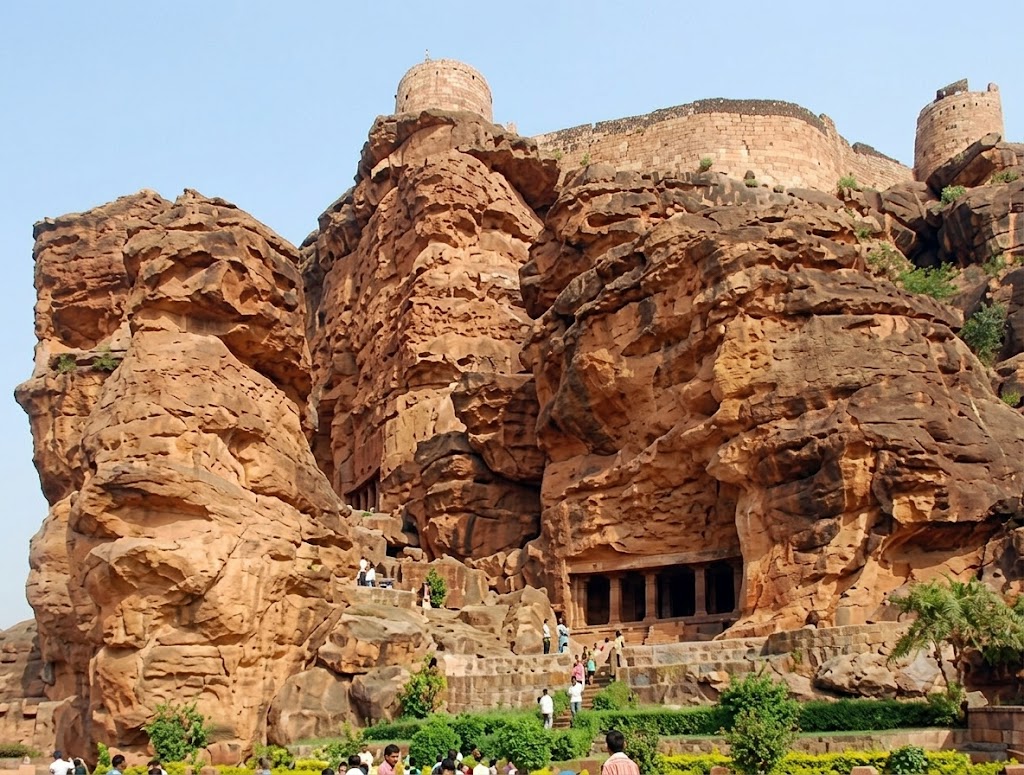
Badami caves : A Marvel Of Ancient Rock-Cut Architecture
Imagine standing at the foot of a rust-red sandstone cliff, the warm Karnataka sun casting long shadows across centuries-old carvings, and the silence around you broken only by birdsong and the distant shimmer of a lake. That's Badami for you — a place that doesn't just show you history, it makes you feel it. Tucked in the Bagalkot district of northern Karnataka, Badami (once known as Vatapi) is one of India's most underrated archaeological treasures. While the crowds rush to Hampi or Mysore, those in the know quietly make their way to this magical little town where four extraordinary rock-cut cave temples cling to the side of a golden-red cliff, watching over a placid green lake below. If you love history, art, spirituality, or just want a jaw-dropping destination that hasn't been overrun by tourist buses, Badami deserves a top spot on your travel list.
🏛️ Badami Caves: Where Ancient Stories Are Carved in Stone
Imagine standing at the foot of a rust-red sandstone cliff, the warm Karnataka sun casting long shadows across centuries-old carvings, and the silence around you broken only by birdsong and the distant shimmer of a lake. That's Badami for you — a place that doesn't just show you history, it makes you feel it.
Tucked in the Bagalkot district of northern Karnataka, Badami (once known as Vatapi) is one of India's most underrated archaeological treasures. While the crowds rush to Hampi or Mysore, those in the know quietly make their way to this magical little town where four extraordinary rock-cut cave temples cling to the side of a golden-red cliff, watching over a placid green lake below. If you love history, art, spirituality, or just want a jaw-dropping destination that hasn't been overrun by tourist buses, Badami deserves a top spot on your travel list.
📜 A City Carved from Cliff — The History Behind the Magic
Badami was the proud capital of the early Chalukya dynasty from around the 6th to 8th centuries CE. These were ambitious rulers with a taste for art and architecture, and they left behind a legacy that has outlived empires, invasions, and centuries of time.
The cave temples were commissioned between 543 and 598 CE, primarily under kings Pulakesi I and Kirtivarman I. What makes them remarkable isn't just their age — it's the extraordinary skill of the craftsmen who chiseled these shrines directly into the rock face. No bricks, no mortar, just human hands, iron tools, and an unshakeable artistic vision. Three of the four caves are Hindu (dedicated to Shiva and Vishnu), and one is Jain — a beautiful reflection of the religious inclusivity that defined the Chalukya era.
The town itself holds a mythological resonance too. Ancient texts associate Vatapi with the demon Vatapi, slain by the sage Agastya — a story still whispered in local folklore.
🪨 The Cave Temples — A Closer Look at the Masterpieces
🕉️ Cave 1 — Shiva's Domain
The first cave is dedicated to Lord Shiva and greets you with an 18-armed Nataraja (dancing Shiva) carved in extraordinary detail. Every limb tells a story. Look closely at the ceiling — it's adorned with intricate carvings of couples and geometric patterns that would make any modern designer envious.
🌌 Cave 2 — Vishnu's Realm
Smaller but equally stunning, Cave 2 is dedicated to Vishnu in his Trivikrama avatar. The carvings here depict the god's three cosmic strides across the universe — a visual mythology lesson you won't forget.
👑 Cave 3 — The Grandest of Them All
This is the jewel of Badami. Dedicated to Vishnu, it contains a famous image of Vishnu seated on the serpent Ananta, flanked by attendants. An inscription here dates to 578 CE, making it one of the oldest Kannada inscriptions ever found. The scale, detail, and artistry here are breathtaking — many visitors spend 30–40 minutes in this cave alone.
☸️ Cave 4 — A Jain Sanctuary
Perched highest on the cliff, this cave celebrates Jain Tirthankaras in serene, elegant carvings that carry a quieter spiritual energy compared to the exuberant Hindu caves below.
Beyond the caves, the Agastya Lake (Bhutanatha Lake) at the base reflects the cliffs in its still green waters, creating that quintessential Badami postcard view. The Bhutanatha temples along the lakeside date back to the 7th–11th centuries and are equally worth exploring. For panoramic views, the North Fort atop the cliff offers sweeping vistas of the town and surrounding countryside.
🍛 Local Culture and Cuisine
Badami is a town where time moves a little slower, and the locals welcome visitors with quiet warmth. The surrounding region is part of Karnataka's heartland, and the culture reflects a beautiful blend of devotion, craft, and community.
Don't miss trying the local food. Karnataka's North district has its own flavour palette — heartier, spicier, and deeply satisfying. Look for jolada rotti (sorghum flatbread) served with enne badnekai (spiced brinjal curry), shenga chutney (peanut chutney), and the ever-comforting bisi bele bath. Local dhabas around the bus stand and market area serve generous, honest meals at pocket-friendly prices. Street-side vendors near the cave entrance sell sugarcane juice and local snacks — perfect for recharging between explorations.
🌤️ Best Time to Visit
The ideal window to visit Badami is October to February, when the weather is cool, the skies are clear, and the golden sandstone glows brilliantly in the winter sun. Temperatures during this period range from 15°C to 28°C — perfect for walking, exploring, and photography.
Avoid peak summer (April–June) when temperatures can soar above 40°C. The monsoon season (July–September) brings dramatic skies and lush greenery, and the lake fills beautifully, but some paths near the cliffs can get slippery.
🚆 How to Reach Badami
✈️ By Air
The nearest airport is Hubli Airport (HBX), approximately 100 km away, with regular flights connecting to Bengaluru, Mumbai, and Hyderabad. From Hubli, you can hire a cab or take a bus to Badami in about 2–2.5 hours.
🚉 By Rail
Badami has its own railway station on the Hubli–Solapur line, with direct or connecting trains from Bengaluru, Hubli, Gadag, and Bijapur (Vijayapura). The station is just 5 km from the town centre, with auto-rickshaws and local taxis readily available.
🛣️ By Road
Badami is well-connected by road. Regular KSRTC buses run from Bengaluru (about 9–10 hours), Hubli (2.5 hours), Bijapur (3 hours), and Hospet (3 hours). If you're driving, NH 67 passes close by, and the roads through the Deccan plateau are scenic and manageable.
📍 Nearby Places Worth Exploring
🏺 Aihole (45 km)
Often called the "cradle of Indian temple architecture," Aihole has over 120 temples spread across a quiet village. It's where Indian temple design was essentially invented and experimented with.
🌏 Pattadakal (22 km)
A UNESCO World Heritage Site with ten stunning temples representing both Nagara and Dravidian architectural styles. Absolutely unmissable.
🏰 Bijapur / Vijayapura (130 km)
Home to the Gol Gumbaz, one of the world's largest domes and a masterpiece of Adil Shahi architecture.
🎒 Travel Tips to Keep in Mind
• Start early — The caves open at 6 AM, and mornings offer the best light for photography and cooler temperatures for climbing.
• Wear comfortable footwear — There's a fair bit of stair-climbing to reach the upper caves.
• Carry water and sunscreen — The sandstone reflects heat intensely during the day.
• Hire a local guide — Available at the entrance for reasonable rates, they bring the carvings to life with stories and context you won't find in any guidebook.
• Entry fee — ₹40 for Indian nationals, ₹600 for foreign tourists (subject to ASI updates). Camera fees may apply.
• Photography — Allowed inside the caves but use natural light wherever possible — the carvings deserve to be seen in their truest form.
✨ Why You Should Go to Badami
Here's the honest truth: Badami doesn't try to impress you. It doesn't need to. The caves have been standing for nearly 1,500 years, quietly doing what they've always done — stopping people in their tracks, making them look up, and reminding them that human creativity has always reached for the extraordinary.
This is a destination that rewards the curious. Every carving has a story. Every step up the cliff reveals a new perspective. And when you sit at the edge of the lake at dusk, watching the pink sky mirror itself in the still water while the ancient temples stand sentinel on the shore, you'll understand why some places stay with you long after you've come home.
Badami isn't just a stop on a Karnataka itinerary. It's a reason to travel.