Bhimbetka: The World's Oldest Storybook in Stone
Imagine standing before a cave wall painted tens of thousands of years ago — not a replica, not a museum exhibit, but the real thing — the actual handprint of a hunter, the vivid red outline of a bison, the swirling dance of ancient figures frozen in time. That is what awaits you at Bhimbetka Rock Shelters, one of the most extraordinary archaeological sites on Earth. Tucked into the forested Vindhya hills of Madhya Pradesh, about 45 kilometres south of Bhopal, Bhimbetka is not merely a tourist spot — it is a conversation with humanity's oldest ancestors, told in ochre, white, and green across the walls of ancient stone.
🏞️ Bhimbetka Rock Shelters, Madhya Pradesh – Where Stone Speaks and Time Stands Still
Imagine standing before a cave wall painted tens of thousands of years ago — not a replica, not a museum exhibit, but the real thing — the actual handprint of a hunter, the vivid red outline of a bison, the swirling dance of ancient figures frozen in time. That is what awaits you at Bhimbetka Rock Shelters, one of the most extraordinary archaeological sites on Earth. Tucked into the forested Vindhya hills of Madhya Pradesh, about 45 kilometres south of Bhopal, Bhimbetka is not merely a tourist spot — it is a conversation with humanity's oldest ancestors, told in ochre, white, and green across the walls of ancient stone.
📜 A Story Written in Stone: The History
The name Bhimbetka derives from "Bhima Baithaka" — meaning "the sitting place of Bhima", referencing the mighty Pandava hero from the Mahabharata. Local legend long held that these caves were where the Pandavas rested during their years of exile, and you can almost feel that mythic weight in the air.
But the true history reaches far deeper. Dr. Vishnu Shridhar Wakankar, a celebrated Indian archaeologist, rediscovered the site in 1957 while travelling by train. Something about the rock formations outside the window caught his scholarly eye, and what he found when he explored them changed history. The caves contain paintings dating back over 30,000 years, with evidence of human habitation stretching back an almost incomprehensible 100,000 years — making it one of the oldest known human settlements in South Asia.
In 2003, UNESCO declared Bhimbetka a World Heritage Site, recognising it as a treasure not just of India, but of all humankind. Today, the site covers over 10 square kilometres and includes more than 700 rock shelters, of which around 400 contain paintings — a gallery so vast and ancient it humbles even the most seasoned traveller.
🎨 What You Will See: The Paintings and Rock Shelters
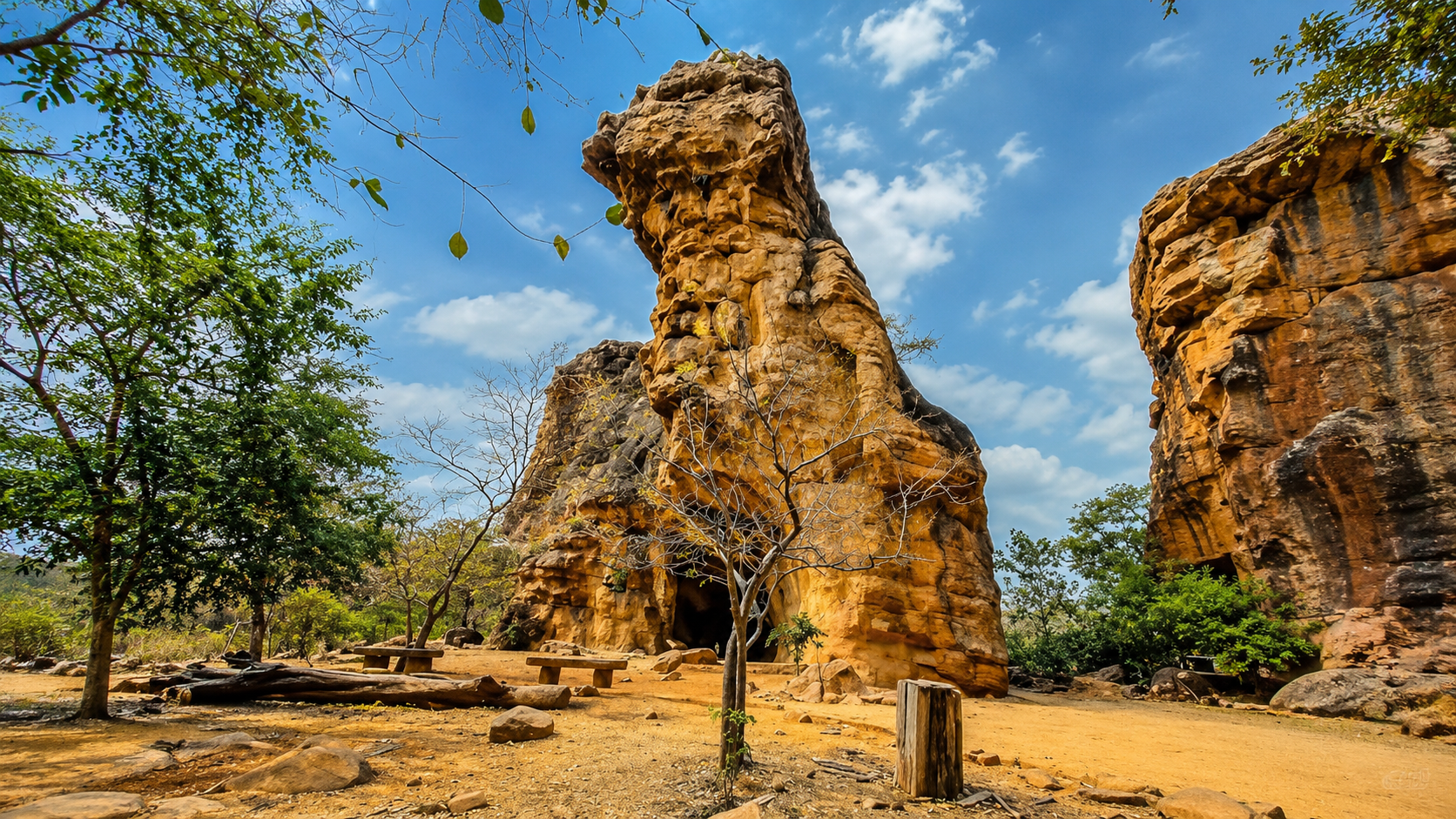
Walking through Bhimbetka feels surreal. The massive sandstone outcrops rise like natural cathedrals from the forest floor, their overhanging roofs providing shelter just as they did for Stone Age families huddled against the wind. Inside these natural chambers, the walls come alive with art.
The paintings span multiple prehistoric periods, and the range is astonishing. You will find bison, elephants, tigers, rhinoceroses, and wild boar — rendered with such confidence and energy that the animals seem ready to leap off the rock. There are hunting scenes with archers and spearmen, communal dances, rituals, battles, and even early geometric patterns. Some paintings are layered one over another, created across different eras by different hands — a living palimpsest of human experience.
The most famous among the shelters is called the "Zoo Rock", which showcases an incredible variety of animals. Another standout is the "Auditorium Cave" — a massive shelter with a rock that may have been used as a percussion instrument, suggesting our ancestors had a sense of rhythm and ceremony long before written history.
🌿 Culture, People, and the Living Forest
Bhimbetka is not just about the past. The surrounding Ratapani Wildlife Sanctuary envelops the site in lush forest, home to leopards, deer, wild boar, and a spectacular variety of birds. The drive through the jungle to reach the shelters is itself an experience — sunlight filtering through dense sal and teak trees, the forest alive with birdsong.
Local tribal communities, including the Gond and Korku people, have lived in these forests for generations. Their folk art and oral traditions carry echoes of the same visual language seen on the cave walls — a remarkable continuity of human creativity across millennia. Visiting Bhimbetka is, in this sense, a deeply humbling reminder that culture does not simply end; it transforms and endures.
📅 Best Time to Visit
The ideal time to visit Bhimbetka is from October to March, when the weather in Madhya Pradesh is cool and pleasant — perfect for exploring the rocky terrain on foot. Summers (April–June) can be intensely hot, though early morning visits are manageable. The monsoon season (July–September) turns the surrounding forest a magnificent green, and the misty forest atmosphere adds a certain magic to the experience, though some trails can become slippery.
✈️🚆🛣️ How to Get There
By Air: The nearest airport is Raja Bhoj Airport, Bhopal, approximately 45 kilometres away, well-connected to Delhi, Mumbai, Hyderabad, and other major cities. From Bhopal, taxis take about an hour to reach the site.
By Rail: Bhopal Junction is one of central India's major railway hubs, with excellent connections across the country. From Bhopal, hire a cab or take a bus towards Hoshangabad — Bhimbetka lies just off this route.
By Road: Bhimbetka is about 45 km from Bhopal on the NH-46 (Bhopal–Hoshangabad highway). State buses run to the area, though hiring a taxi gives you the flexibility to explore the site at your own pace.
📍 Nearby Places Worth Exploring
Sanchi Stupa, a UNESCO World Heritage Site and one of Buddhism's greatest monuments, is just 50 km away. Bhojpur Temple, an unfinished 11th-century Shiva temple with a magnificent lingam, is a 25 km drive. Bhopal itself offers the Taj-ul-Masajid, one of Asia's largest mosques, and the excellent Madhya Pradesh Tribal Museum, which provides beautiful context for the tribal cultures connected to Bhimbetka's heritage.
🧳 A Few Travel Tips Before You Go
Wear comfortable walking shoes — the paths between shelters involve uneven rocky terrain. Carry water and sunscreen, as the site is open-air with limited shade. A licensed ASI guide is strongly recommended; without one, you risk missing the most significant paintings and their stories. Photography is permitted inside the shelters, so bring your camera — but do so with reverence. The entry fee is modest and goes towards site maintenance.
✨ Why Bhimbetka Will Stay With You Forever
There are places you visit, and there are places that visit you long after you've left. Bhimbetka belongs firmly in the second category. Standing inside those ancient shelters, looking at a hand outlined in red ochre by someone who lived thirty thousand years ago, something profound shifts inside you. The distances of history collapse. You realise with quiet certainty that the human desire to create, to mark one's presence, to say "I was here, I saw beauty, I felt something" — that desire is not modern. It is the most ancient thing about us.
Bhimbetka is not a ruin. It is not a monument. It is a mirror — reflecting back to us who we have always been. Pack your curiosity, come with reverence, and let these timeless hills of Madhya Pradesh do what they have always done: remind you that the human story is far older, far richer, and far more beautiful than you ever imagined.