Discover the Crown Jewel of North Bengal
Tucked away in the northeastern corner of West Bengal, the Cooch Behar Palace rises from the plains of the Dooars like a vision transplanted from Victorian Europe. Known officially as the Victor Jubilee Palace, this extraordinary structure has stood for well over a century as one of India's most distinctive royal monuments — a place where Italian Renaissance grandeur meets the proud heritage of the Koch dynasty. For travelers drawn to heritage tourism, architectural history, or simply the romance of a bygone royal era, Cooch Behar Palace is a destination unlike any other in eastern India
👑 The Koch Dynasty and the Origins of a Palace
The story of Cooch Behar Palace cannot be told without first understanding the land it rules over. The region now known as Cooch Behar has ancient roots stretching back to the Kamrup kingdom of the 11th and 12th centuries, when the Pala-Sena rulers held sway over this fertile territory. The Koch dynasty rose to prominence in the 16th century, carving out a powerful principality that maintained its distinct identity through Mughal invasions, British colonialism, and centuries of political flux.
It was Maharaja Nripendra Narayan — a forward-thinking ruler educated in England and deeply engaged with the Bengal Renaissance — who commissioned the palace that stands today. Completed in 1887, the year coinciding with Queen Victoria's Golden Jubilee (hence the "Victor Jubilee" name), the palace was not merely a royal residence. It was a deliberate statement: proof that Cooch Behar's rulers were cosmopolitan, modern, and equal in ambition to the great imperial powers of the age. Under Nripendra Narayan's enlightened governance, the kingdom also saw sweeping reforms in education, public works, and justice — and the palace served as the administrative nerve center for all of it.
🏛️ Architecture: Where Renaissance Europe Meets Royal Bengal
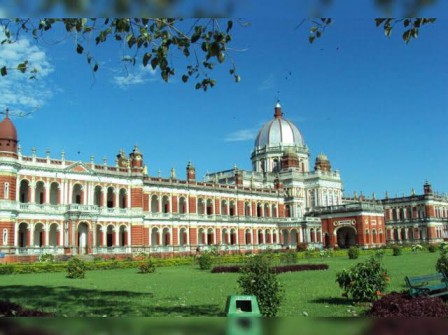
The most immediately striking thing about Cooch Behar Palace is how thoroughly European it looks — and how intentionally so. Designed by British architect F.W. Stevens, the same visionary behind Mumbai's iconic Chhatrapati Shivaji Maharaj Terminus, the palace draws direct inspiration from Buckingham Palace in London while realizing it in the vocabulary of Italian Renaissance architecture.
The numbers alone convey its scale. The brick-built structure sprawls across 51,000 square feet, measuring roughly 390 feet in length and 296 feet in width, raised on a basement 1.5 metres high. Its central dome soars 124 feet from the ground, sheathed in gleaming silver and ringed by Corinthian columns in a configuration reminiscent of St. Peter's Basilica in Rome. The frontal facade presents a rhythmic sequence of arches resting on alternating narrow and broad piers — a classical European arrangement that creates both visual drama and elegant proportion.
Inside, the palace once housed over 50 rooms, including the celebrated Durbar Hall — a twelve-sided, dodecagonal chamber that served as the royal court of audience — alongside drawing rooms, a dining hall, a billiard room, a library, bedrooms, a ladies' gallery, and the Toshakhana (treasury). The original three-storey structure suffered partial damage in the devastating 1897 Assam earthquake, and what visitors see today is the restored, two-storey version that emerged afterward. Despite this, the palace retains its commanding presence and architectural coherence.
🖼️ The Museum: Treasures of a Forgotten Kingdom
A significant portion of the palace has been converted into a public museum, now maintained by the Archaeological Survey of India (ASI), which has declared it a Monument of National Importance. The galleries within offer an intimate window into the life and times of the Cooch Behar royal family.
Visitors can explore collections of oil paintings, sepia-tinted royal photographs, terracotta figurines, clay models, sandstone and laterite sculptures, decorative chandeliers, arrows, and ceremonial objects that once populated the palace's now-silent halls. A dedicated tribal gallery brings to life the everyday customs and material culture of the region's indigenous communities — a thoughtful reminder that the palace's story is inseparable from the land and people around it.
📜 Royal Connections and Historical Milestones
In 1901, Viceroy Lord Curzon paid a visit — an event that underlined Cooch Behar's strategic importance within the British Raj. Decades later, following Indian independence, Maharaja Jagaddipendra Narayan — Nripendra Narayan's grandson — signed the Instrument of Accession in 1949, peacefully merging the princely state of Cooch Behar into the Indian Union and transforming the royal seat into a public heritage monument.
The palace also holds a charming footnote in modern history: Maharani Gayatri Devi, widely celebrated as one of the most beautiful women in the world and later a celebrated politician, was born within these walls before leaving Cooch Behar for the Pink City of Jaipur upon her marriage. Her life story adds a layer of glamour and personal narrative to the palace that continues to captivate visitors.
🌿 The Visitor Experience: Stepping Into Another Era
Arriving at Cooch Behar Palace, the first impression is of unexpected serenity. The palace sits amid well-maintained landscaped gardens — wide lawns, manicured hedges, and open pathways that invite a slow, contemplative stroll. The grandeur of the exterior, with its sweeping colonnade and silver dome catching the light, makes it immediately clear why photographers and architecture enthusiasts travel specifically to see it.
Inside the museum, the pace naturally slows further. Each gallery presents artifacts with the kind of quiet authority that only genuine antiquity can command. Guided tours are available and highly recommended: a knowledgeable guide fills the corridors with the kind of anecdotes and historical context that transform a sightseeing visit into an immersive experience.
The best time to visit Cooch Behar Palace is between October and March, when the weather across North Bengal is cool and clear, making outdoor exploration genuinely pleasant. Early mornings and late afternoons are ideal — the light is softer, the crowds thinner, and the atmosphere around the palace gardens particularly tranquil.
🚆 Getting There and Practical Information
🚉 Rail Connectivity
The New Cooch Behar railway station, about 6 km from the town center, lies on the Barauni–Guwahati line and receives trains from Kolkata, Delhi, Guwahati, and other major cities.
🚕 Local Transport
Auto-rickshaws and taxis connect the station to the palace easily.
🚌 Road Connectivity
State and private buses also link Cooch Behar to key towns across West Bengal, Assam, and Bihar.
🎟️ Visitor Information
The palace museum charges a modest entry fee and remains closed on certain days of the week, so it is worth confirming timings before visiting.
⭐ Why Cooch Behar Palace Belongs on Every Heritage Traveler's Map
At a time when heritage tourism in India is growing rapidly, Cooch Behar Palace stands out not just for its architectural distinction but for the layered, complex story it tells. It speaks of a Koch king who looked to London for inspiration without abandoning his roots. It speaks of a region that absorbed European ideas during the Bengal Renaissance and fashioned something entirely its own. And it speaks, perhaps most powerfully, of how local communities, archaeologists, and tourism bodies are working together to ensure that this remarkable building endures for the generations who haven't yet discovered it.
Whether you come as a history enthusiast, an architecture admirer, a photographer chasing the perfect frame, or simply a curious traveler seeking something off the well-worn tourist trail, Cooch Behar Palace offers a genuinely rare experience — the feeling of stepping into a world that is gone, but not quite forgotten.