Gingee Fort - The Troy Of The East
Imagine standing at the base of three colossal hills, each crowned with ancient ramparts that seem to grow naturally from the rock itself, as though the earth simply decided one day to build a fortress. That's Gingee Fort for you — not just a monument, but a myth made of stone. Tucked away in the Villupuram district of Tamil Nadu, this extraordinary hill fortress has been called the "Troy of the East" by the Marathas and remains one of the most underrated wonders in all of India. Once you see it rising against a blazing Tamil sky, you'll wonder how the rest of the world hasn't been talking about it louder.
🏰 Gingee Fort, Tamil Nadu – Where the Gods Chose to Build Their Throne
Imagine standing at the base of three colossal hills, each crowned with ancient ramparts that seem to grow naturally from the rock itself, as though the earth simply decided one day to build a fortress. That's Gingee Fort for you — not just a monument, but a myth made of stone. Tucked away in the Villupuram district of Tamil Nadu, this extraordinary hill fortress has been called the "Troy of the East" by the Marathas and remains one of the most underrated wonders in all of India. Once you see it rising against a blazing Tamil sky, you'll wonder how the rest of the world hasn't been talking about it louder.
📜 A Little Bit of History First
Gingee's story stretches back over a thousand years, layered with the ambitions of some of India's most powerful dynasties. The fort was originally built by the Chola kings around the 9th century, but it was the Vijayanagara rulers in the 13th and 14th centuries who transformed it into the formidable military complex it is today. After them came the Marathas under Shivaji, who captured it and declared it one of the strongest forts he had ever seen — high praise from a man who knew a thing or two about fortresses.
The Mughals besieged it. The Bijapur Sultans held it. The French and the British both fought over it during the colonial era. And through every conquest, every siege, every change of flag, Gingee Fort stood firm. That endurance is written into every stone, every crumbling battlement, every steep stairway carved into living rock. To walk its paths is to walk through the entire sweep of South Indian history in a single afternoon.
🌄 The Attractions That Will Leave You Breathless
The fort spreads across three hills — Rajagiri, Krishnagiri, and Chakkilidurg — each connected by massive granite walls that run for nearly 13 kilometres. The sheer scale of the place takes a moment to absorb.
Rajagiri, the tallest of the three at about 160 metres, is the crown jewel. The climb to the top is steep and rewarding, with the fortress walls hugging the hillside at impossible angles. From the summit, the views stretch endlessly across the Tamil plains — golden, flat, and shimmering — while the wind carries the silence of centuries.
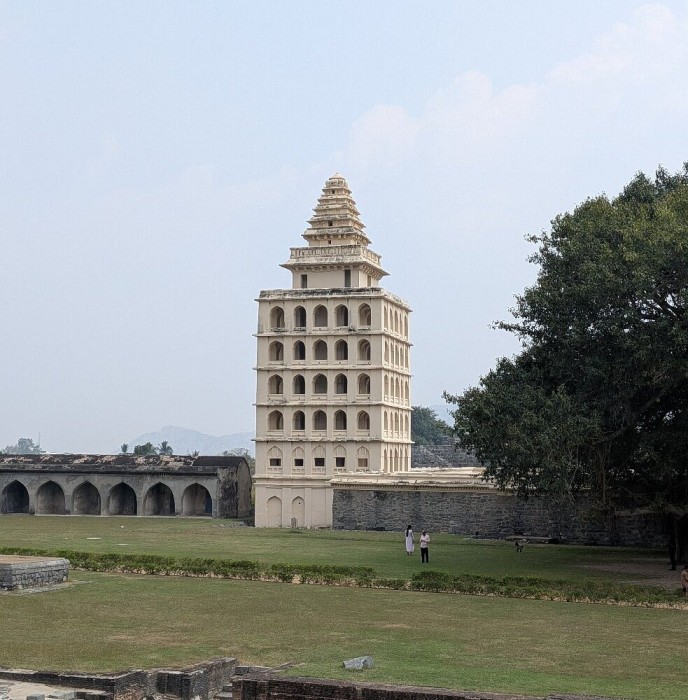
At the heart of the complex lies the Kalyana Mahal, a seven-storeyed wedding tower of extraordinary elegance, rising 27 metres with a pyramidal top that has defied time remarkably well. Standing beside it, you can almost hear the celebrations of a royal wedding echoing off its walls.
The Venkataramana Temple, a beautifully carved Dravidian shrine within the fort, is still active today — a reminder that for all its military history, Gingee was also a place of devotion and daily life. Nearby, the audience hall, the granaries, and the elephant tank paint a vivid picture of a self-sufficient city built for kings who planned to never surrender.
🎭 Culture, People, and the Soul of the Place
Gingee sits in the heart of rural Tamil Nadu, and the region around it carries a quiet, unhurried warmth. The local community has lived in the shadow of these hills for generations, and you'll find small temples, colourful festivals, and roadside stalls selling fresh coconuts and sugarcane juice that make the journey as enjoyable as the destination.
The fort is considered sacred by local communities, and the temples within its walls are visited by pilgrims as much as tourists. There's a beautiful coexistence here between history and living culture — ancient stones surrounded by the sound of temple bells and village life carrying on as it always has.
For food, head into the nearby town of Gingee or the larger hub of Tindivanam for authentic Tamil meals — steaming rice with sambar and rasam, crispy dosas, and strong filter coffee that will fuel your climb. Simple, honest, and deeply satisfying.
🗓️ Best Time to Visit
The ideal time to visit Gingee Fort is between October and March, when the weather is cooler and the skies are clear — perfect for climbing and photography. Avoid the peak summer months of April to June if you can, as the exposed granite hillsides absorb heat intensely and the climb becomes genuinely challenging. The post-monsoon season from October onwards brings a freshness to the landscape, with the surrounding plains turning green and the air carrying the scent of red earth after rain.
🚗 How to Get There
✈️ By Air
The nearest airport is Chennai International Airport, approximately 160 km away. From Chennai, the drive to Gingee takes around 3 hours via the NH532.
🚆 By Rail
The closest railway station is Tindivanam, about 30 km from Gingee, well connected to Chennai, Villupuram, and Pondicherry. Taxis and local buses cover the remaining distance easily.
🛣️ By Road
Gingee is well connected by road. Regular buses run from Chennai, Pondicherry (about 70 km away), and Villupuram (about 37 km away). The drive through Tamil Nadu's flat, open countryside is straightforward and pleasant.
📍 Nearby Places Worth Exploring
The region around Gingee rewards those who linger. Pondicherry, with its French colonial streets, vibrant café culture, and serene Auroville community, is barely 70 km away and makes a perfect complement to Gingee's rugged history. Villupuram offers onward connections deeper into Tamil Nadu. The ancient temple town of Tiruvannamalai, home to the sacred Arunachaleswarar Temple, is about 90 km away and is one of Tamil Nadu's most spiritually significant destinations.