Gwalior Fort: The Guardian of a Thousand Years
🏰 Gwalior Fort, Madhya Pradesh – Where Stone Walls Remember Everything
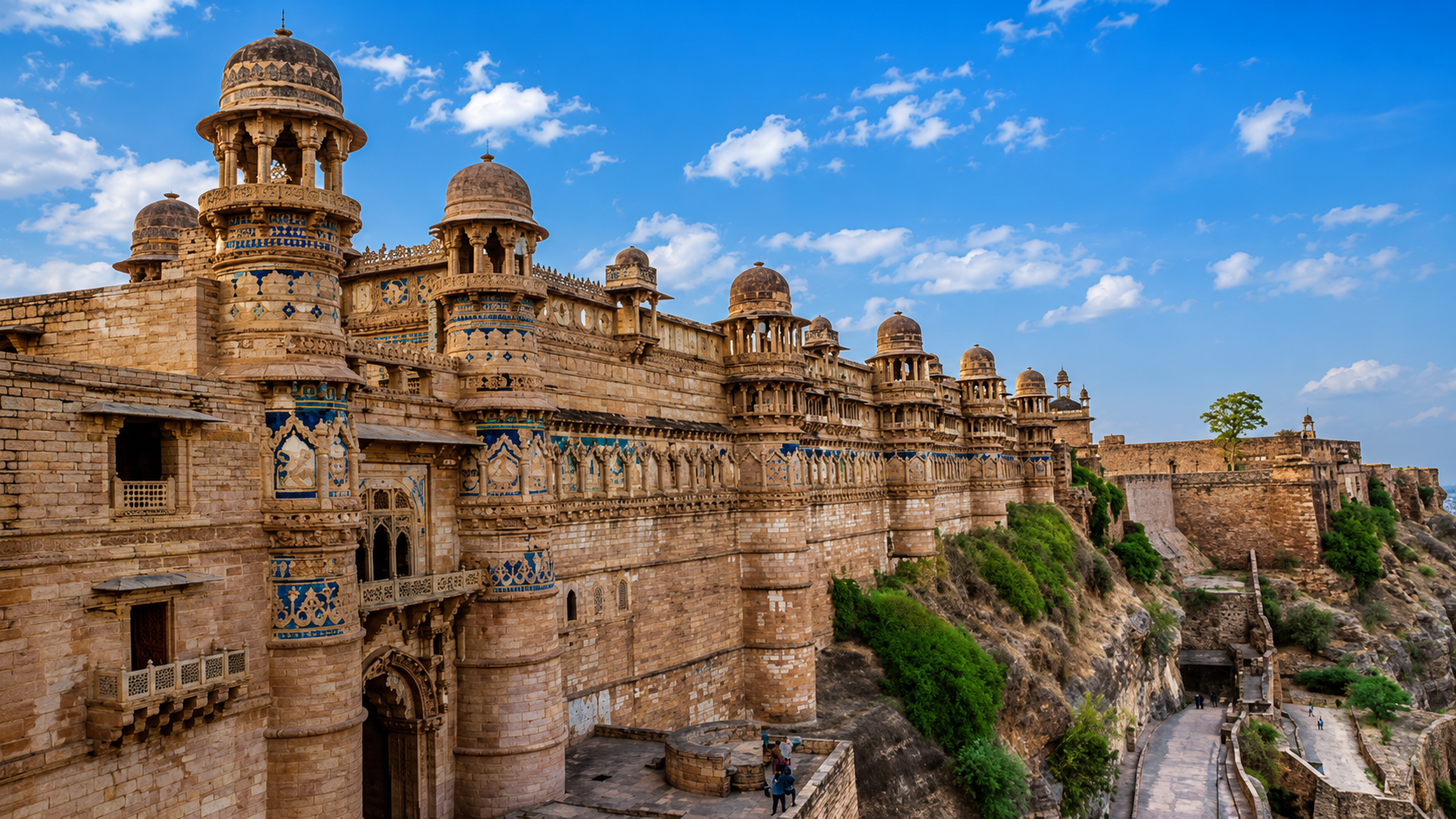
Imagine standing on the edge of a sandstone cliff, a thousand years of history rising beneath your feet, the city of Gwalior spreading out below you like a painting left to dry in the afternoon sun. The wind carries the faint echo of battles long past, of emperors and poets, of music and devotion. That's Gwalior Fort for you — not just a monument, but a mood. Perched nearly 100 metres above the city on a flat-topped rocky hill in Madhya Pradesh, this magnificent fortress has been called the Gibraltar of India, and the moment you lay eyes on it, you understand exactly why.
📜 A Little Bit of History First
Gwalior Fort's story begins somewhere in the 8th century — though legends push it even further back. One popular tale credits a local chieftain named Suraj Sen, who was cured of leprosy by the sage Gwalipa on this very hill. In gratitude, the sage gave him the name "Pal" and blessed him with the hilltop, saying his dynasty would endure as long as the name was kept. And so, a fortress was born.
Over the centuries, the fort changed hands repeatedly — the Tomars, the Lodhis, the Mughals, the Marathas, and finally the British each left their mark on its walls. It was the Tomar kings, particularly Raja Man Singh Tomar in the 15th century, who gave the fort its most glorious architectural chapter, building the jewel-like Man Mandir Palace that still dazzles visitors today. Mughal emperor Babur, upon seeing it, reportedly called it "the pearl among the fortresses of India." High praise from a man who had seen a few.
✨ The Attractions That Will Leave You Breathless
Man Mandir Palace is the undisputed crown of the fort complex. Its facade is adorned with brilliant turquoise and yellow tilework — geometric patterns of ducks, elephants, and crocodiles dancing across the stone in a way that feels almost impossibly vivid for something built over 500 years ago. Step inside and you enter a world of underground chambers, jali screens, and royal halls that whisper of court life and quiet intrigues.
Just a short walk away stands Teli Ka Mandir, an 8th-century temple that rises to a striking 30 metres — the tallest structure within the fort. Its architecture is a fascinating fusion of North and South Indian styles, a reminder that Gwalior has always been a crossroads of cultures.
The Sas Bahu Temples — literally "mother-in-law and daughter-in-law temples" — are a pair of intricately carved 11th-century shrines whose columns and ceilings are covered in such fine detail that you could spend an hour simply staring at one wall.
On your way up, don't miss the rock-cut Jain sculptures carved directly into the cliff face — serene, towering figures of Jain tirthankaras that seem to emerge from the stone itself. They're unexpected, extraordinary, and completely unforgettable.
And as evening falls, stay for the sound-and-light show, when the fort's ancient walls come alive with colour and narration, telling the entire sweep of Gwalior's history in one spellbinding performance.
🎭 Culture, People, and the City Below
Gwalior is a city of many layers, and the fort is only one of them. At the base of the hill lies the old city, a maze of bustling lanes, fragrant street food stalls, and the magnificent Jai Vilas Palace, home to the Scindia royal family and one of the most opulent palace museums in India — complete with the world's largest crystal chandeliers and a model train that once served whisky to dinner guests.
The city has a deep connection to classical music. It is the birthplace of Tansen, one of the nine gems of Akbar's court and a towering figure in Hindustani music. Every year, the Tansen Music Festival draws classical musicians and ragas lovers from across the country to perform in the shadow of his tomb.
For food, don't leave without trying Gwalior's street snacks — kachori, jalebi, and the local poha are morning staples that taste best eaten standing at a roadside stall with the fort looming in the distance.
🗓️ Best Time to Visit
Gwalior is a year-round destination, but October to March is the sweet spot — the weather is cool and pleasant, the skies are clear, and the fort photographs beautifully in the soft winter light. Summers (April–June) can be intensely hot on the exposed hilltop, so early morning visits are essential. The Tansen Music Festival, held in November or December, is a wonderful reason to time your trip just right.
🚗 How to Get There
✈️ By Air
Gwalior has its own airport, Rajmata Vijayaraje Scindia Air Terminal, well-connected to Delhi, Mumbai, and other major cities.
🚆 By Rail
Gwalior Railway Station sits on the busy Delhi–Mumbai and Delhi–Chennai rail corridors, making it easily accessible from most major cities. The fort is visible from the train — your first glimpse as you pull into the station is genuinely spectacular.
🛣️ By Road
Gwalior is well-connected by national highway. It sits roughly 320 km from Delhi and 120 km from Agra, making it a natural addition to the Golden Triangle circuit.
📍 Nearby Places Worth Exploring
Gwalior pairs beautifully with Orchha — a medieval town of temples and cenotaphs about 120 km away that feels entirely frozen in time. Khajuraho, famous for its intricately carved temples, is about 280 km further. Together, these three form one of Madhya Pradesh's most rewarding heritage circuits. Agra and the Taj Mahal are just two hours away, making Gwalior an ideal extension to any Golden Triangle itinerary.
⭐ Why You Simply Must Visit Gwalior Fort
Some places carry the weight of history lightly. Gwalior Fort carries it magnificently. It is the kind of place where you find yourself standing very still in the middle of a 500-year-old courtyard, suddenly aware that you are inside a story far larger than yourself. The carved stone, the tilework shining in the sun, the view over a city that has grown and changed while the fort has stood unchanged above it — all of it adds up to something that is genuinely difficult to leave behind.
Whether you are a history lover, a photographer chasing perfect light, a traveller building your first India itinerary, or someone simply looking for a place that feels real and rare — Gwalior Fort will meet you exactly where you are.
So look up, walk through the gate, and let a thousand years begin to tell you their story