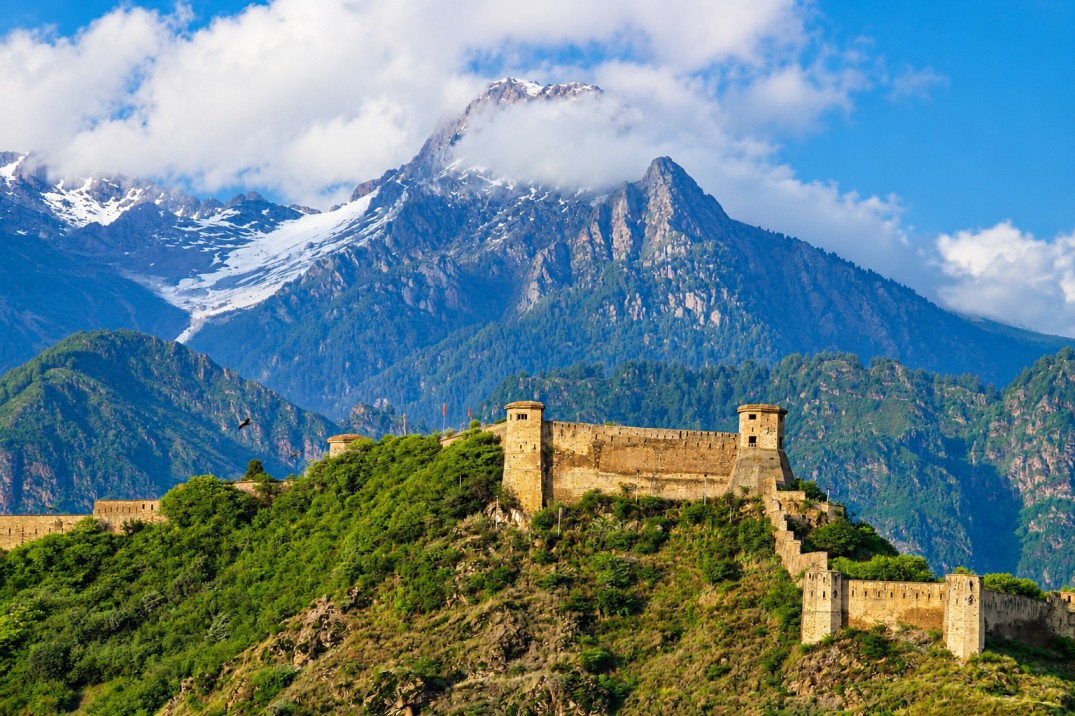
Hari Barbat Fort : Where History Meets Himalayas
There are places in the world where history, mythology, and faith occupy the same ground so completely that it becomes impossible to separate them. Hari Parbat Fort in Srinagar is one such place. Rising from the crest of a hill on the western edge of the Dal Lake basin, this centuries-old fortification overlooks the entire city of Srinagar like a quiet, immovable guardian. It has watched empires come and go — Mughal, Afghan, Sikh, and British — and it remains today as one of Kashmir& most layered and spiritually significant landmarks, drawing historians, pilgrims, and travellers with equal pull.
🏰 Hari Parbat Fort: Kashmir's Sacred Hill
✨ Where History and Faith Converge
There are places in the world where history, mythology, and faith occupy the same ground so completely that it becomes impossible to separate them. Hari Parbat Fort in Srinagar is one such place. Rising from the crest of a hill on the western edge of the Dal Lake basin, this centuries-old fortification overlooks the entire city of Srinagar like a quiet, immovable guardian. It has watched empires come and go — Mughal, Afghan, Sikh, and British — and it remains today as one of Kashmir's most layered and spiritually significant landmarks, drawing historians, pilgrims, and travellers with equal pull.
Also known as Koh-i-Maran (Hill of Serpents in Persian) and sometimes called the Durrani Fort, Hari Parbat is far more than a military structure. It is a hill that holds temples, shrines, and gurdwaras on its slopes, each sacred to a different faith — a living expression of Kashmir's deeply pluralistic heritage.
📍 Location: A Hill That Defines a City's Skyline
Hari Parbat lies to the west of Dal Lake in Srinagar, in the Union Territory of Jammu & Kashmir. The hill rises sharply from the surrounding neighbourhoods, and the fort's long stone walls trace its ridgeline with a commanding authority that is visible from much of the city. The fort is about 5 kilometres from the city centre and can easily be accessed by tourists and locals.
Two routes approach the hill: via Rainawari through the Kathi Darwaza Gate, and via Hawal through the Sangin Darwaza Gate. Both approaches pass through the older quarters of Srinagar, where traditional wooden architecture, narrow lanes, and the occasional chinar tree make the journey to the fort an experience in itself. From the hilltop, the view across Dal Lake toward the Zabarwan mountain range is one of the most rewarding panoramas in the entire Kashmir Valley.
🕉️ The Legend of the Hill: A Goddess, a Demon, and a Pebble
Before there was a fort here, there was a myth — and in Hari Parbat's case, the myth is magnificent. According to Hindu mythology, the area was inhabited by an asura named Jalodbhava who was terrorising the valley. The people prayed to Goddess Parvati for help. She took the form of a bird and dropped a pebble on the demon's head. The pebble grew larger and larger until it crushed him. Hari Parbat is revered as that pebble.
The name Kangra can be traced to an ancient story. Parvati is worshipped here under the name Sharika, and her temple occupies the middle part of the western slope of the hill, where she is depicted as having 18 arms and sitting in the Shri Chakra formation. This ancient legend explains why Hari Parbat is considered sacred by Kashmiri Pandits, for whom the Sharika Devi temple is among the most important religious sites in the valley. The hill itself is, in their belief, the physical body of the goddess — the very ground made divine.
📜 History: From Akbar's Ambition to Afghan Fortification
The recorded history of Hari Parbat as a fortified site begins with the Mughals. The first fortifications on the site were constructed by the Mughal emperor Akbar in 1590, who built an outer wall for the fort as part of his plans for a new capital at the site of modern-day Srinagar. The project, however, was never completed.
Akbar's grand vision for a capital city called Nagar Nagor at this location remained unrealised, but the outer enclosure wall he constructed — stretching for several kilometres around the hill — remained as a defining feature of the landscape, and the gate he built, Kathi Darwaza, still stands.
The fort as it exists today was built much later. The present fort was built in 1808 under the reign of the Governor of Kashmir Province of the Durrani Empire, Atta Mohammed Khan — an Afghan commander who significantly strengthened and expanded the hilltop fortifications during a period of Afghan dominance over Kashmir. It is from this Afghan-era construction that the fort takes its alternate name, the Durrani Fort.
In the early 1800s, the Sikh Empire took over the fort, and later in 1846, the British claimed the fort from the Sikhs following the First Anglo-Sikh War — the same conflict that ended Sikh rule across much of northern India. Each of these successive powers left its mark on the structure and the hill, adding gates, modifications, and names while the older layers beneath remained largely intact.
🏛️ Architecture: Afghan Strength with Kashmiri Soul
Hari Parbat Fort has an exceptional Afghan architectural appearance, with high-ceilinged walls and rich stucco carving. The fortification is not ornate in the way of a Mughal palace — it was built to be formidable, not decorative. But within that martial aesthetic, there is considerable craft.
The fortification features thick stone walls, sturdy bastions, and watchtowers strategically positioned to provide panoramic views of the surrounding landscape, including Srinagar and Dal Lake. These architectural elements served both defensive and surveillance purposes.
Visitors can access the fort through the Kathi Darwaza, the main entrance, which bears Persian inscriptions that reflect the fort's historical and cultural value. These inscriptions — carved in elegant calligraphy — are a reminder that the fort stood at the crossroads of Persian, Central Asian, and Kashmiri cultural traditions.
The fort still stands impressively with old apartments and tall pillars, and although much of its interior has weathered over the centuries, the scale of the complex and its commanding position over the city convey a powerful sense of what it once was. It is maintained by the Archaeological Survey of India (ASI).
🙏 A Hill of Many Faiths: The Spiritual Landscape of Hari Parbat
🛕 Sharika Devi Temple
Perched on the western slope of the hill, the Sharika Devi Temple is dedicated to Goddess Jagadamba Sharika Bhagwati, regarded as the presiding deity of Srinagar.
☪️ Makhdoom Sahib Shrine
The southern side of Hari Parbat features Makhdoom Sahib, the shrine of Hamza Makhdoom, a 16th-century Kashmiri Sufi saint known locally as Hazrat Sultan and Sultan-ul-Arifeen.
🕌 Shah Badakhshi Mosque
Just below the Hari Parbat Fort, there is a mosque dedicated to Shah Badakhshi, a 17th-century Qadiri Sufi saint.
☬ Gurdwara Chatti Patshahi
Gurdwara Guru Nanak Dev is a place where Guru Nanak sat and had discourse with people in the early 16th century.
🏞️ The View and the Flag
From the top of Hari Parbat, the view is extraordinary in every direction: Dal Lake shimmers to the east, the Zabarwan hills rise beyond it, and the dense rooftops of old Srinagar spread below like a textured carpet. The Badamwari garden — famous during spring for its almond blossoms — is visible on the hillside.
The Indian government on 15 August 2021 hoisted a 100-foot-tall Indian flag on the top of the fort, a gesture of national significance that has since become a landmark in its own right, visible from across the city and from the lakes below.
🧭 Visiting Hari Parbat: What to Know
⏰ Timings
9:30 AM to 4:30 PM (Monday); 9:30 AM to 5:30 PM (Tuesday to Saturday); closed on Sundays.
🎟️ Entry Fee
₹50 per person.
📍 Access
The fort is accessible by road from Srinagar city.
🌸 Best Time
March to May and September to October.
⭐ Why Hari Parbat Fort Matters
In a city as historically layered as Srinagar, Hari Parbat Fort occupies a unique position. It is not the grandest fort in India by scale, nor the most elaborately decorated. But it carries something rarer: a sense of lived history across faiths and centuries, compressed into a single hill.
For the heritage traveller, it offers the chance to walk through Mughal outer walls, stand inside an Afghan-era fort, visit a Sufi shrine, pray at a Hindu temple, and pay respects at a Sikh gurdwara — all within an hour's exploration. For anyone seeking to understand Kashmir's soul beyond its landscapes, Hari Parbat is one of the most honest and moving places the valley has to offer.
📌 Essential Information
📍 Location
Koh-i-Maran Hill, Srinagar, Jammu & Kashmir
🏛️ Managed By
Archaeological Survey of India
✈️ Nearest Airport
Sheikh ul-Alam International Airport, Srinagar (14 km)
🌿 Best Season
March – May and September – October