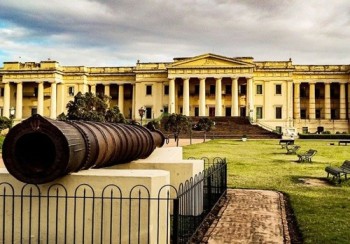
Hazarduari Palace: Discover the Secrets Behind 1,000 Doors
Picture a grand white palace rising beside the gentle bends of the Bhagirathi River, its endless corridors hiding secret passages and trick doorways meant to confuse intruders centuries ago. That's Hazarduari for you — not just a monument, but a riddle wrapped in marble. Located in Murshidabad, West Bengal, the name itself translates to "Palace of a Thousand Doors," and while it doesn't quite have a thousand, it comes wonderfully close, with 900 real doors and 100 false ones designed purely to bewilder anyone with ill intent.
🏛️ Hazarduari Palace, West Bengal – The Palace of a Thousand Doors
Picture a grand white palace rising beside the gentle bends of the Bhagirathi River, its endless corridors hiding secret passages and trick doorways meant to confuse intruders centuries ago. That's Hazarduari for you — not just a monument, but a riddle wrapped in marble. Located in Murshidabad, West Bengal, the name itself translates to "Palace of a Thousand Doors," and while it doesn't quite have a thousand, it comes wonderfully close, with 900 real doors and 100 false ones designed purely to bewilder anyone with ill intent.
📜 A Little Bit of History First
Murshidabad was once the capital of Bengal, a city of immense wealth and political intrigue during the reign of the Nawabs. Hazarduari Palace was built between 1829 and 1837 by Nawab Nazim Humayun Jah, the last independent Nawab of Bengal, and it was designed by Duncan MacLeod, a British architect, in the grand European Renaissance style.
The palace served as the official residence of the Nawabs of Bengal and later became a key administrative center under British colonial influence. Its construction marked a fascinating period of cultural fusion, where Mughal-era nobility adopted distinctly Western architectural sensibilities, resulting in a structure that feels almost transplanted from a European capital onto the banks of a Bengali river.
✨ The Attractions That Will Leave You Breathless
The palace itself is a sight to behold — a three-storied structure stretching across acres of manicured lawns, its façade lined with towering Corinthian columns. Today, it functions as a museum, and stepping inside feels like walking through a time capsule of Nawabi grandeur.
The Darbar Hall houses a massive chandelier gifted by Queen Victoria, said to be one of the largest in India, along with ornate thrones, royal portraits, and an armory containing swords, muskets, and cannons once used by the Nawabs.
Just opposite the palace stands the Imambara, a sprawling congregation hall used during Muharram processions, rebuilt in the 19th century after fire destroyed the original structure. Nearby, the Bacchawali Tope, a massive cannon believed to have been used in historic battles, sits as a quiet reminder of the region's turbulent past.
A short distance away, Kathgola Palace, a beautifully preserved Jain merchant's mansion with lush gardens, offers a contrasting glimpse into Murshidabad's mercantile history.
History enthusiasts shouldn't miss the Clock Tower, standing tall near the palace grounds, or the Nizamat Imambara's intricately decorated interiors. For those willing to venture slightly further, Katra Mosque, built by Murshid Quli Khan himself and believed to contain his grave beneath its steps, adds a layer of spiritual depth to the visit.
🎭 Culture, People, and Food
Murshidabad carries a rich blend of Mughal, Nawabi, and Bengali influences, visible in everything from its architecture to its everyday rhythms. The local population is warm and proud of their historical legacy, often eager to share stories passed down through generations about the Nawabs and their court intrigues.
Food here reflects this layered heritage beautifully. Murshidabad is renowned for its Murshidabadi mishti (sweets), particularly the famous chhena poda and silk-soft sandesh varieties unique to the region. The town is also historically tied to silk production, and you'll find local eateries serving Bengali classics like fish curry, luchi, and aromatic biryani influenced by Awadhi-style cooking brought by the Nawabs themselves.
🌤️ Best Time to Visit
The ideal time to visit Hazarduari Palace is between October and March, when the weather is pleasantly cool and comfortable for exploring the extensive palace grounds and nearby monuments. Summers, from April to June, can get quite hot and humid, making outdoor sightseeing tiring. Monsoon months bring lush greenery to the riverside but can also disrupt travel plans with heavy rainfall.
🚗 How to Get There
✈️ By Air
The nearest airport is Kolkata's Netaji Subhas Chandra Bose International Airport, roughly 200 km away. From Kolkata, taxis and buses connect travelers to Murshidabad.
🚆 By Rail
Berhampore Court Railway Station is the closest major station, about 11 km from the palace, with regular connections to Kolkata and other major cities in West Bengal.
🛣️ By Road
Murshidabad is well-connected by state highways, with regular bus services from Kolkata and Berhampore. The drive offers scenic views of rural Bengal, dotted with rivers, paddy fields, and small riverside villages.
📍 Nearby Places Worth Exploring
Beyond Hazarduari, Murshidabad town itself is dotted with historical gems — the Moti Jheel (Pearl Lake), Jahan Kosha cannon, and Wasef Manzil Palace are all worth a visit. Plassey, the historic battlefield where the British East India Company's victory changed the course of Indian history, lies about 50 km away and makes for a compelling day trip for history lovers.
🧳 A Few Travel Tips Before You Go
Wear comfortable footwear, as exploring the palace and surrounding monuments involves considerable walking. Photography inside certain sections of the museum may be restricted, so check rules at the entrance. Hiring a local guide is highly recommended, as the palace's history is rich with stories that aren't always captured on information plaques. Visit early in the day to avoid crowds, especially during winter weekends.
❤️ Why You Simply Must Visit Hazarduari Palace
Some monuments are admired from a distance. Hazarduari demands to be walked through, door by door, story by story. It's a place where Bengal's Nawabi past lingers in every chandelier and cannon, where European architecture meets Mughal memory on the banks of a quiet river.
Whether you're a history enthusiast, an architecture lover, or simply someone seeking a slower, story-rich journey through Bengal, Hazarduari Palace offers a window into a world of intrigue, grandeur, and a thousand doors waiting to be opened.