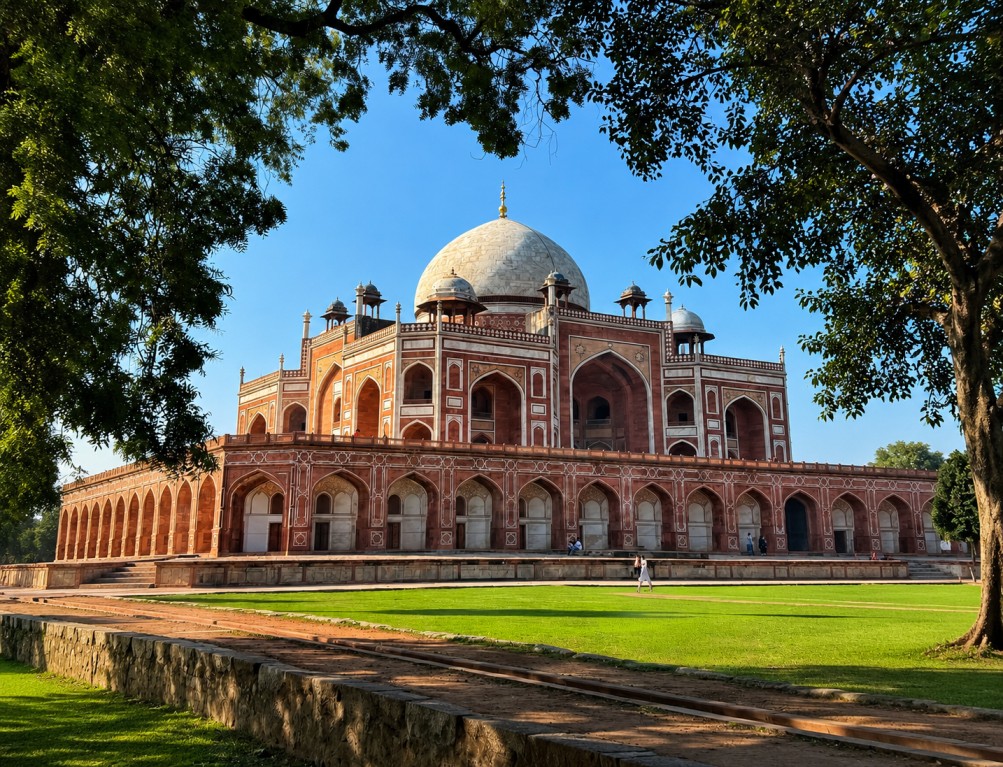
Humayun’s Tomb: A UNESCO Heritage Jewel of Delhi
Long before the Taj Mahal rose above the banks of the Yamuna in Agra, another building was quietly rewriting the language of Mughal architecture in Delhi. Humayun's Tomb, standing with serene authority in the Nizamuddin area of the capital, is the monument that started it all — the first fully realized garden tomb in the Indian subcontinent, the structure that introduced the Persian charbagh layout to Indian soil, and the architectural ancestor of nearly every great Mughal building that followed it. To visit Humayun's Tomb is to stand at the very origin point of an architectural tradition that would eventually produce one of the seven wonders of the world. And yet the tomb itself, with its extraordinary double dome, its red sandstone and white marble geometry, and its great walled garden filled with fountains and cypress trees, is magnificent enough to deserve attention entirely on its own terms.
📍 Location
Nizamuddin area, Delhi
🏺 Heritage Status
UNESCO World Heritage Site
🏗️ Construction Period
1565 – 1572
👑 Built For
Emperor Humayun by Haji Begum
Humayun's Tomb: The Garden of Eternity That Inspired the Taj Mahal
Long before the Taj Mahal rose above the banks of the Yamuna in Agra, another building was quietly rewriting the language of Mughal architecture in Delhi. Humayun's Tomb, standing with serene authority in the Nizamuddin area of the capital, is the monument that started it all — the first fully realized garden tomb in the Indian subcontinent, the structure that introduced the Persian charbagh layout to Indian soil, and the architectural ancestor of nearly every great Mughal building that followed it. To visit Humayun's Tomb is to stand at the very origin point of an architectural tradition that would eventually produce one of the seven wonders of the world. And yet the tomb itself, with its extraordinary double dome, its red sandstone and white marble geometry, and its great walled garden filled with fountains and cypress trees, is magnificent enough to deserve attention entirely on its own terms.
👑 The Emperor Who Came Back
The story of Humayun's Tomb begins with the story of Humayun himself — one of the more humanly compelling figures in Mughal history.
The second Mughal emperor, son of the dynasty's founder Babur, Humayun was a man of genuine intellectual gifts: an astronomer, a poet, a lover of books and philosophy.
He was also, by many accounts, a spectacularly unlucky ruler.
After inheriting a still-fragile empire from his father in 1530, he spent the next fifteen years being systematically outmaneuvered by the Afghan king Sher Shah Suri, eventually losing his throne entirely and spending more than a decade in exile — mostly in Persia at the court of Shah Tahmasp, where he encountered the full flowering of Safavid Persian culture, architecture, and garden design.
When Humayun finally recaptured Delhi in 1555 with Persian military support, he brought back more than an army. He brought back a visual vocabulary — the formal garden, the elevated tomb platform, the double dome — that would transform Indian architecture permanently.
He died the following year in an accidental fall from his library steps, barely a year after his triumphant return.
🏗️ Built by a Grieving Wife, Finished by a Great Son
Construction of Humayun's Tomb began in 1565, approximately nine years after the emperor's death, under the direction of Haji Begum — also known as Bega Begum — who reportedly oversaw the project with passionate personal involvement, even living near the construction site during the building period.
The architect was Mirak Mirza Ghiyath, a Persian master brought from Iran specifically for this commission, and the building he created was unlike anything previously seen in the subcontinent.
The tomb was completed around 1572, during the reign of Akbar, and the total cost of construction was reportedly one and a half crore rupees — an almost incomprehensible sum for the period, financed by Haji Begum from her personal treasury.
🌿 Architecture That Changed Everything
The charbagh — literally "four gardens" — is a formal Persian garden layout divided by water channels into four quadrants.
The physical experience of approaching Humayun's Tomb follows a deliberate sequence that the architects designed to maximize emotional and visual impact.
You enter through one of two imposing gateways — the southern Bu Halima gateway or the western Arab Serai gateway — and cross through walled enclosures before reaching the main charbagh garden.
The tomb structure itself sits on a high platform of red sandstone approximately 7 metres tall.
The building rises to a total height of 47 metres.
The double dome — an outer dome that maintains its exterior profile independently of the inner dome that defines the interior space — was the first of its kind in India.
The materials are themselves a statement — red sandstone for the main body of the building, white and black marble for the inlay detailing, and the delicate jaali screens of pierced marble that filter light into the interior chambers in shifting, lacelike patterns.
⚱️ A City of the Dead That Lives
One of the most remarkable aspects of Humayun's Tomb complex is the sheer density of historical significance concentrated within its walls.
The main tomb chamber contains the cenotaph of Humayun himself, but the platform below and the surrounding structures contain the remains of over 150 Mughal royals.
Among those interred here are Dara Shikoh and Hamida Banu Begum.
The complex also contains the tomb of Isa Khan Niyazi, a powerful Afghan noble who served the Suri dynasty.
The complex further includes the Nila Gumbad and the Arab Serai.
⚔️ The 1857 Connection
Humayun's Tomb carries one final historical significance that resonates with particular intensity in Indian memory.
In September 1857, as British forces moved to suppress the great uprising that had swept northern India, the last Mughal emperor Bahadur Shah Zafar took refuge in the tomb complex with members of his family.
It was here that the British officer William Hodson located and captured him.
Two of his sons and a grandson were shot by Hodson at the gateway.
Bahadur Shah Zafar was subsequently tried and exiled to Rangoon.
💡 Interesting Facts
UNESCO inscribed Humayun's Tomb as a World Heritage Site in 1993.
The Aga Khan Trust for Culture undertook an extensive restoration of the complex beginning in the early 2000s.
The restoration work revealed that the original garden contained over 2,500 species of plants.
🤔 Did You Know?
The dome of Humayun's Tomb was used as a model by the architects of the Taj Mahal nearly a century later.
To visit both buildings in the same trip is to see, in concrete architectural terms, how a great tradition evolves and perfects itself across generations.
🚶 The Visitor Experience
The tomb is open from sunrise to sunset every day of the year except during maintenance closures.
The morning hours offer the best combination of soft light and manageable crowds.
The interior of the tomb is cool and dim even in summer.
Allow at minimum two hours for a thorough visit.
Audio guides are available at the entrance and provide genuinely useful historical context.
🗺️ Tourism Significance and How to Reach
Humayun's Tomb receives approximately two to three million visitors annually and forms a key node in Delhi's heritage tourism circuit.
The nearest Delhi Metro station is JLN Stadium on the Violet Line.
The Hazrat Nizamuddin railway station is also within walking distance.
🍂 Best Time to Visit
October through March offers the most comfortable visiting conditions in every respect.
The Delhi winter brings clear skies, moderate temperatures, and the long golden light that makes the red sandstone most beautiful.
Summer visits require early morning timing to avoid the worst heat.
The monsoon months of July and August bring lush greenery to the gardens and dramatic clouded skies that make for spectacular photography.
✨ Conclusion
Humayun's Tomb stands as proof that the very first attempt at something can sometimes achieve a perfection that all subsequent attempts merely approach.
Built by a grieving wife for a twice-exiled emperor, designed by a Persian master working in unfamiliar red Indian sandstone, it gave Indian architecture a new grammar — the garden, the platform, the double dome, the geometric symmetry — that would define the visual culture of an entire dynasty for two more centuries.
To walk through its gateway, down the long central path between the water channels, toward that extraordinary red and white building rising against the Delhi sky, is to walk toward something that genuinely changed the world. And that is not a claim that many buildings, in all of human history, can honestly make.