Jag Mandir : The Island Palace Of Udaipur
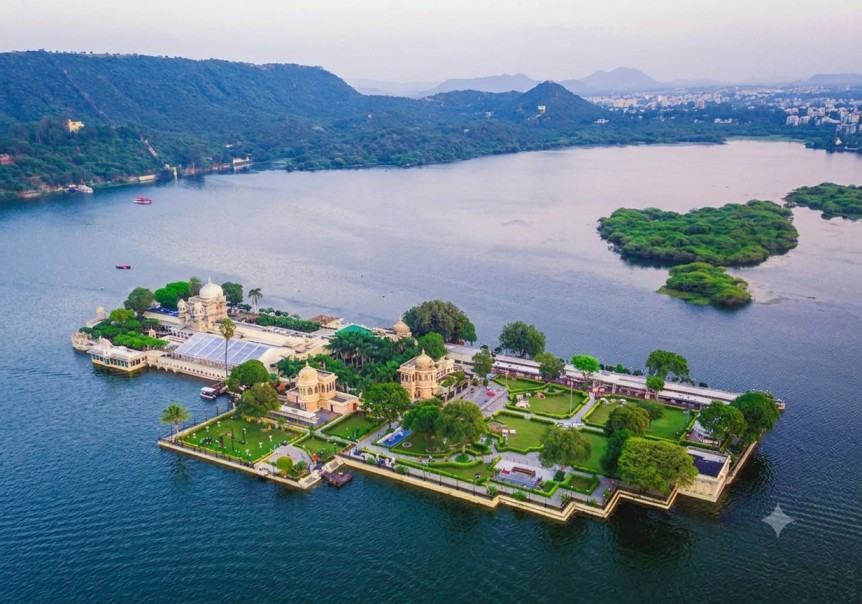
the sun beginning its slow descent over Lake Pichola, the water turning gold, and rising from the middle of it all, a marble palace that seems to float between the sky and its own reflection. That's the magic of Jag Mandir — not just a monument, but a moment frozen in time. Tucked away on a small island in Udaipur, this lake palace has been quietly stealing hearts for nearly four centuries, often standing in the shadow of its more famous twin, the Taj Lake Palace, yet holding stories rich enough to rival any Mughal legend
🏝️ Jag Mandir, Udaipur – The Island Palace That Floats on Dreams
Picture this: the sun beginning its slow descent over Lake Pichola, the water turning gold, and rising from the middle of it all, a marble palace that seems to float between the sky and its own reflection. That's the magic of Jag Mandir — not just a monument, but a moment frozen in time. Tucked away on a small island in Udaipur, this lake palace has been quietly stealing hearts for nearly four centuries, often standing in the shadow of its more famous twin, the Taj Lake Palace, yet holding stories rich enough to rival any Mughal legend.
📜 A Little Bit of History First
Jag Mandir's story unfolds across three generations of Mewar royalty. Maharana Amar Singh first laid its foundation in the early 1600s, but it was Maharana Karan Singh who truly began building the island palace around 1620. The man who gave it its soul, however, was Maharana Jagat Singh I, who completed the palace between 1628 and 1652 and lent it his own name.
Here's where history gets cinematic: in the 1620s, a young Mughal prince named Khurram, rebelling against his father Emperor Jahangir, found himself with nowhere to turn. Maharana Karan Singh opened the doors of Jag Mandir to him, offering shelter during his most uncertain days. That prince would later become Emperor Shah Jahan — the man behind the Taj Mahal. Local legend whispers that the marble domes and intricate stonework of Jag Mandir left such an impression on him that echoes of it can be seen in his later masterpiece, though historians still debate just how much truth lies in that romantic theory.
✨ The Attractions That Will Leave You Breathless
The Gol Mahal is the heart of Jag Mandir — a grand domed structure held up by elegant pillars, opening out to sweeping views of Lake Pichola and the city beyond. Step out onto its terraces at golden hour, and you'll understand why this spot has inspired poets and painters alike.
The Bara Pathar ka Mahal, or Palace of Stones, is a quiet marvel of engineering — built from massive stone slabs on a tiny island, it's a reminder of just how determined the Mewar builders were to create beauty even with nature's constraints.
But if there's one image that defines Jag Mandir, it's the row of stone elephants standing guard along the steps that rise from the water. Carved with striking detail, they greet every visitor arriving by boat, as if welcoming you into a forgotten royal court.
Wander further and you'll find peaceful courtyards and gardens, dotted with fountains and shaded corners — the kind of spaces where Mewar royals once retreated from the heat and noise of daily court life. The black-and-white marble inlay work throughout the palace adds a quiet richness that rewards anyone who slows down to really look.
🎭 Culture, People, and Experience
Jag Mandir today carries a gentler, more intimate energy than the bustling City Palace on the mainland. There are no crowds rushing past — just the lap of lake water against stone steps and the occasional call of birds skimming the surface. The palace now houses a charming restaurant and lounge, where you can sip a drink as the lake stretches out before you, the Aravalli hills fading into the distance.
It's no surprise that Jag Mandir has become one of India's most romantic wedding venues, drawing couples from across the world who want their vows exchanged somewhere that feels almost mythical.
📅 Best Time to Visit
Late afternoon into early evening is when Jag Mandir truly comes alive. As the sun dips lower, the white marble glows amber, and the still waters of Pichola mirror the entire palace. The cooler months, October to March, are the most pleasant time to explore Udaipur, with comfortable weather for boat rides and walks along the lake.
🚤 How to Get There
🛶 By Boat
Jag Mandir can only be reached by boat, departing from the City Palace jetty in Udaipur. The ride takes about 15-20 minutes, gliding past the Taj Lake Palace, with the city's domes and havelis rising on one side and the Aravalli hills framing the other. Many boat packages include a stop near Jag Niwas for photos, though that palace remains reserved exclusively for hotel guests.
📍 Nearby Places Worth Exploring
While you're in Udaipur, the City Palace complex is a must, towering over the lake with its own labyrinth of courtyards and museums. Saheliyon ki Bari, a garden built for royal attendants, offers a calmer contrast. For panoramic views of the entire lake, Monsoon Palace on a nearby hilltop is well worth the drive, especially at sunset.
🎒 A Few Travel Tips Before You Go
Carry a hat or scarf for the boat ride, as the open water can get sunny even in cooler months. If you're hoping to dine at the restaurant, it's worth checking timings in advance, since access depends on boat schedules. And if photography is your thing, the steps with the stone elephants are best shot early in your visit, before the evening light shifts.
🌟 Why You Simply Must Visit Jag Mandir
Some palaces are built to impress. Jag Mandir was built to offer refuge, to host emperors-in-waiting, and to give the Mewar royals a place to simply breathe. Today, it offers visitors that same gift — a slice of stillness in the middle of a lake, away from the noise of the world. Whether you're tracing the footsteps of Shah Jahan, marveling at centuries-old stonework, or just watching the sun set over Pichola from a boat, Jag Mandir has a way of making you pause.
And in a city full of palaces, sometimes it's the quieter one — floating gently on the water — that stays with you the longest.