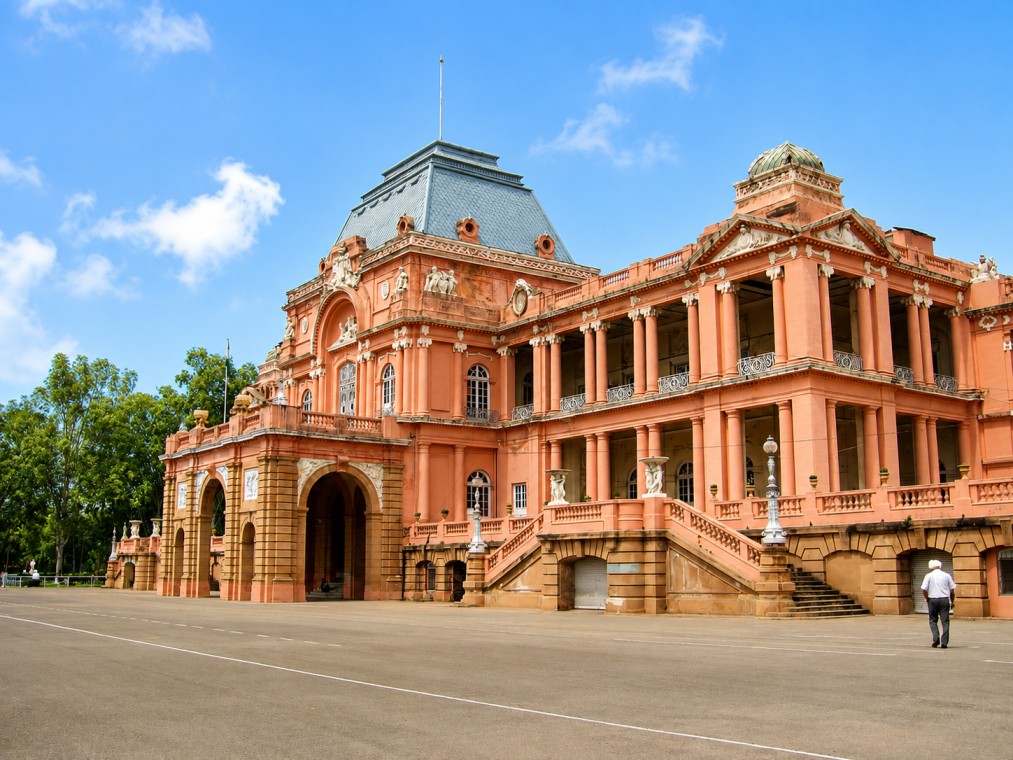
Jagjit Palace - The Royal Gem Of Elegance
In the fertile plains of Punjab, where history runs as deep as the rivers that gave the land its name, stands a palace that speaks of a era when the princely states of northern India produced architecture of quiet elegance and remarkable ambition. Jagjit Palace in Kapurthala, Punjab, is one of those heritage treasures that rewards the traveller willing to venture beyond the well-worn tourist circuits — a royal residence of genuine historical significance, architectural distinction, and cultural depth that has not yet received the international attention it richly deserves.
In the fertile plains of Punjab, where history runs as deep as the rivers that gave the land its name, stands a palace that speaks of a era when the princely states of northern India produced architecture of quiet elegance and remarkable ambition. Jagjit Palace in Kapurthala, Punjab, is one of those heritage treasures that rewards the traveller willing to venture beyond the well-worn tourist circuits — a royal residence of genuine historical significance, architectural distinction, and cultural depth that has not yet received the international attention it richly deserves.
Kapurthala, located approximately 20 kilometres west of Jalandhar in Punjab, was the seat of the Ahluwalia dynasty, a Sikh royal family whose influence and sophistication placed them among the most progressive princely rulers of colonial-era India. The palace they built here — and the broader architectural landscape of Kapurthala that surrounds it — represents a remarkable chapter in the story of how Indian royalty navigated the cultural crosscurrents of the late 19th and early 20th centuries, absorbing European influences without abandoning their own identity, and producing in the process a built heritage that is genuinely unlike anything else in northern India.
📍 Location
Kapurthala, Punjab
👑 Dynasty
Ahluwalia Dynasty
🏛️ Identity
Paris of Punjab
📜 History and Origins: The Ahluwalia Dynasty and Kapurthala's Royal Legacy
The Ahluwalia Misl — one of the twelve Sikh confederacies that emerged in the 18th century during the decline of Mughal power — established control over the Kapurthala region under Jassa Singh Ahluwalia, one of the most celebrated figures in Sikh military history. Jassa Singh was a commander of extraordinary ability who played a central role in the consolidation of Sikh political power in Punjab, and the dynasty he led continued to rule Kapurthala through the Sikh period and into the era of British paramountcy.
The state of Kapurthala formally entered into a relationship with the British East India Company in the early 19th century and remained a loyal princely state through the remainder of the colonial period. This political stability, combined with the personal sophistication and ambition of successive rulers, allowed Kapurthala to develop into one of Punjab's most culturally distinctive princely states — nicknamed, with considerable justification, the "Paris of Punjab" for its French-influenced architecture and cosmopolitan atmosphere.
The figure most responsible for this reputation — and most closely associated with Jagjit Palace — is Maharaja Jagatjit Singh, who ruled Kapurthala from 1877 to 1949 and was among the most remarkable Indian princes of the colonial era. Educated in Europe and deeply influenced by French culture, Jagatjit Singh was a prolific traveller, an author, a sportsman, and a patron of architecture who left an indelible physical mark on his capital. He spoke French fluently, maintained close relationships with European aristocracy, and approached the development of Kapurthala with the vision of a ruler who understood that architecture is the most lasting form of political and cultural expression.
🏛️ Jagjit Palace: Architecture at the Crossroads of Cultures
Jagjit Palace — the primary royal residence of the Kapurthala rulers — is a building of considerable architectural ambition that reflects the distinctive cultural vision of the Ahluwalia dynasty. The palace draws on multiple architectural traditions, blending Mughal elements — arched galleries, intricate jali screens, ornamental domes — with European classical influences in a synthesis that feels less like cultural confusion and more like deliberate cosmopolitan confidence.
The palace complex is set within extensive grounds that originally included formal gardens, fountains, and landscaped walks designed to create a setting worthy of a royal residence that aspired to international standards. The building's facade presents a carefully composed arrangement of arches, columns, and decorative elements that creates a visual rhythm both stately and welcoming.
The interiors of Jagjit Palace reflect the same eclecticism — rooms furnished with European furniture and decorative objects alongside traditional Indian craftsmanship, ceilings painted with floral and geometric motifs that draw on both Punjabi and European decorative traditions, and spaces designed for the kind of formal entertaining that Maharaja Jagatjit Singh conducted with visiting dignitaries, European nobles, and fellow Indian princes.
It is worth noting that Kapurthala's most internationally famous building — the Moorish Mosque built by Jagatjit Singh in 1930 and modelled on the great mosque of Marrakech — and the extraordinary Elysee Palace (modelled on the French presidential palace) are part of the broader architectural legacy of which Jagjit Palace forms the royal residential centrepiece. Together, these buildings make Kapurthala one of the most architecturally diverse small cities in India, a living museum of one extraordinary ruler's engagement with world architecture.
🎭 Cultural Significance and Royal Life
Jagjit Palace was not merely a residence — it was the centre of a court culture that Maharaja Jagatjit Singh cultivated with considerable deliberateness. He was a prolific writer, publishing accounts of his extensive travels across Europe, America, Japan, China, and the Middle East in a series of books that reveal a mind of genuine curiosity and observational intelligence. He brought back not just objects and architectural ideas from his travels but a broader cultural orientation that shaped how his court functioned and how his state presented itself to the world.
The palace hosted a remarkable range of guests over the decades of Jagatjit Singh's long reign — British viceroys and governors, European royalty, Indian nationalist leaders, and international celebrities of the early 20th century. This cosmopolitan traffic made Jagjit Palace a genuine crossroads of the colonial world, a place where the complex negotiations between Indian tradition and European modernity were conducted not in political chambers but in drawing rooms, over formal dinners, and in the gardens of a Punjab palace far from the usual centres of imperial power.
Jagatjit Singh's personal life was itself a subject of considerable public fascination. His relationship with a Spanish dancer named Anita Delgado, whom he met in Madrid in 1906 and married in 1908, making her Maharani Prem Kaur of Kapurthala, became one of the celebrated romantic stories of the Edwardian era. Anita Delgado's memoir of her life at the Kapurthala court — published decades later — provides a vivid and sometimes startling window into the world that revolved around Jagjit Palace in the early 20th century.
🎨 Notable Structures and Artistic Features
The architectural and decorative programme of Jagjit Palace reflects several distinct artistic traditions working in productive combination. The Mughal-influenced elements — particularly the jali screens that filter light into interior spaces and the ornamental arches of the principal facades — connect the palace to the broader North Indian architectural heritage that Kapurthala's rulers inherited through centuries of cultural exchange.
The European classical elements — columns, cornices, formal symmetrical compositions, and the general organisation of the principal facade — reflect Jagatjit Singh's direct experience of European palace architecture, particularly French chateaux and Italian villas, which he encountered during his numerous European tours.
The gardens and grounds of the palace complex, though changed significantly since the height of the Kapurthala court, still retain something of their original formal character — the spatial relationships between building and landscape that are fundamental to the palace's intended experience as a royal residence.
The decorative arts within the palace — furniture, textiles, paintings, and ceremonial objects accumulated through decades of royal patronage and international travel — represent a collection of considerable historical interest, though access to interior spaces depends on the current use of the building.
✨ Legends, Interesting Facts, and Unique Characteristics
Kapurthala's designation as the "Paris of Punjab" is not merely promotional — it reflects the genuine architectural ambition of Maharaja Jagatjit Singh, who not only built French-influenced structures but actually employed French architects for some of his most ambitious projects, including the Elysee Palace, which was designed by French architect M. Marcel and completed in 1908.
The story of Anita Delgado — the Spanish dancer who became Maharani of Kapurthala — remains one of the most compelling personal narratives connected to Jagjit Palace. She arrived in Kapurthala speaking no Hindi and knowing little of Indian customs, learned the languages of the court, observed purdah protocols, and eventually published her memoir The Maharani of Kapurthala (originally in Spanish as Memorias de una princesa), which became a celebrated document of cross-cultural royal life in the colonial era.
One of the most remarkable facts about Kapurthala's architectural heritage is its sheer stylistic diversity within a small area. Within a few kilometres, you can encounter a French palace, a Moorish mosque, a Sikh gurudwara, and a royal residence that blends Mughal and European elements — a concentration of architectural eclecticism that reflects one ruler's genuine engagement with world culture rather than mere imitation.
🚶 Visitor Experience: Discovering Punjab's Architectural Secret
Visiting Jagjit Palace and the broader architectural heritage of Kapurthala is an experience that rewards the independently minded traveller who is willing to venture slightly off the standard Punjab tourism circuit. Kapurthala is well connected by road and rail to Jalandhar, Amritsar, and Chandigarh, making it accessible as a day trip or an overnight stop on a broader Punjab itinerary.
The town itself is compact enough to explore on foot or by cycle rickshaw, and the concentration of architectural landmarks — the palace, the Moorish Mosque, the Elysee Palace, the Gurudwara Bibeksar, and several other heritage structures — makes for a genuinely enriching half-day or full-day architectural tour.
The atmosphere of Kapurthala is that of a small Punjab town that carries its royal heritage with a certain quiet dignity — not aggressively promoted, not yet overwhelmed by tourism infrastructure, but accessible to those who make the effort and genuinely rewarding to those who know what they are looking at.
The best time to visit is between October and March, when Punjab's climate is at its most pleasant — cool mornings, clear skies, and the golden light of the winter sun that makes heritage photography particularly rewarding. The wheat harvest season in spring transforms the surrounding countryside into a vivid green and gold landscape that adds to the pleasure of a visit to this part of Punjab.
🌍 Heritage Tourism and the Case for Kapurthala
Jagjit Palace and the architectural heritage of Kapurthala represent exactly the kind of heritage destination that India's tourism landscape needs more of — significant, accessible, historically rich, and not yet overwhelmed by the infrastructure and crowds that can diminish the experience at more famous sites.
For domestic tourists from Punjab and the broader north Indian region, Kapurthala offers a fascinating chapter of Sikh and princely history that complements the more widely known heritage of Amritsar's Golden Temple and the Partition Museum in Amritsar. For international travellers, particularly those with an interest in the architecture of colonial India or the complex cultural negotiations of the princely state era, Kapurthala is a genuine discovery — a place where the story of how Indian royalty engaged with the wider world is written in stone, brick, and the graceful arches of a palace that deserves far more attention than it currently receives.
In the end, Jagjit Palace is a reminder that the heritage of Punjab is far richer and more architecturally diverse than the standard tourist narrative suggests — that beyond the gurdwaras and the fields and the well-worn monuments of Partition history, there are palaces, mosques, and royal complexes that tell equally compelling stories about who the people of this region were, what they aspired to, and how magnificently, at their best, they built.