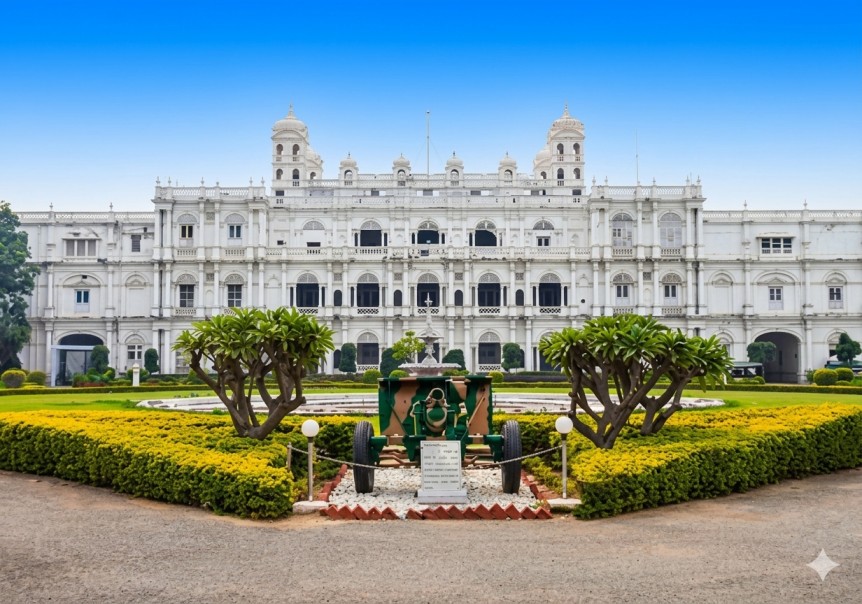
Jai Villas Palace - A Legacy Of Royal Grandaur
Step through the gates of Jai Vilas Palace and you're stepping into a world where chandeliers weigh more than elephants, where European grandeur meets Maratha pride, and where the Scindia dynasty once lived a life so opulent it still leaves visitors speechless. Located in the heart of Gwalior, Madhya Pradesh, this isn't just a palace — it's a glittering time capsule of royal extravagance that continues to dazzle everyone who walks through its halls.
👑 Jai Vilas Palace, Gwalior – Where Royalty Still Lingers in Gold and Crystal
Step through the gates of Jai Vilas Palace and you're stepping into a world where chandeliers weigh more than elephants, where European grandeur meets Maratha pride, and where the Scindia dynasty once lived a life so opulent it still leaves visitors speechless. Located in the heart of Gwalior, Madhya Pradesh, this isn't just a palace — it's a glittering time capsule of royal extravagance that continues to dazzle everyone who walks through its halls.
📜 A Little Bit of History First
Jai Vilas Palace was built in 1874 by Maharaja Jayajirao Scindia, the ruler of the princely state of Gwalior, to host the visiting Prince of Wales, Edward VII. The Maharaja wanted a palace that would rival the finest European royal residences, and he didn't hold back. He commissioned Lieutenant Colonel Sir Michael Filose, an architect of Italian descent, to design a structure blending Tuscan, Italian-Doric, and Corinthian architectural styles — a striking departure from the traditional Indian palace design of the era.
The result was a palace so grand that it set the gold standard for princely opulence in 19th-century India. The Scindia royal family still resides in a portion of the palace today, while another wing has been transformed into a museum, allowing visitors a rare glimpse into a lifestyle once reserved for maharajas and their honored guests.
✨ The Attractions That Will Leave You Breathless
The Darbar Hall is, without question, the palace's crowning glory. This is where the two largest hand-cut Belgian crystal chandeliers in the world hang from the ceiling, each weighing over three tonnes. Legend has it that before installing them, ten elephants were hoisted onto the roof to test whether the structure could bear the weight — a story that captures just how seriously the Maharaja took his ambitions.
The Durbar Hall's carpet is equally legendary, woven from pure silk and so vast that it remains one of the largest carpets in Asia. Walking across it feels like stepping onto a cloud stitched with centuries of craftsmanship.
The palace museum houses an extraordinary collection of artifacts, including the Maharaja's personal silver model train, which was once used to serve after-dinner drinks and cigars to guests seated around the dining table, gliding along a miniature track built into the table itself. It remains one of the most talked-about curiosities in the museum.
Visitors can also explore vintage cars, weaponry from the Mughal and Maratha eras, rare paintings, and the personal artifacts of the Scindia family, all displayed across more than 35 rooms open to the public. The sheer scale of the European furniture, gilded mirrors, and ornate ceilings throughout the palace makes every room feel like a chapter from a different era of Indian royal history.
🎭 Culture, People, and Food
Gwalior carries a rich cultural identity shaped by Rajput valor, Maratha governance, and Mughal influence, and the Jai Vilas Palace sits at the intersection of all three legacies. The city's musical heritage is equally significant, being the birthplace of the Gwalior Gharana, one of the oldest schools of Hindustani classical music.
When it comes to food, Gwalior is a paradise for those with a sweet tooth and a love for rich, hearty flavors. Don't miss the city's famous bedai with aloo sabzi, a popular breakfast combo, or the indulgent Gwalior ka kachori. For something sweet, try the local gajak, made from sesame seeds and jaggery, especially popular during winter months.
📅 Best Time to Visit
The ideal time to visit Jai Vilas Palace is between October and March, when Gwalior's weather is pleasant and comfortable for sightseeing. Summers (April to June) can get extremely hot, often exceeding 40°C, making early morning visits advisable if traveling during this period.
🚗 How to Get There
✈️ By Air
Gwalior has its own airport, Gwalior Airport (GWL), with regular domestic flights connecting it to Delhi and other major cities.
🚆 By Rail
Gwalior Railway Station is a major junction on the Delhi–Chennai and Delhi–Mumbai routes, making it easily accessible from most parts of the country.
🛣️ By Road
Gwalior is well connected via National Highways to Delhi (approximately 320 km), Agra (about 120 km), and Jhansi. State and private buses run frequently, and the drive along the highway is smooth and scenic.
📍 Nearby Places Worth Exploring
While in Gwalior, don't miss the magnificent Gwalior Fort, perched on a hill and visible from much of the city. The Sas-Bahu Temples, Teli ka Mandir, and Gujari Mahal are all within easy reach. For history lovers, Agra, home to the Taj Mahal, is just a couple of hours away, making Gwalior a wonderful addition to a North Indian heritage circuit.
🎒 A Few Travel Tips Before You Go
Plan at least two to three hours for the museum section alone, as the sheer number of artifacts deserves unhurried exploration. Photography may be restricted in certain sections, so check at the entrance. Comfortable walking shoes are a must, given the scale of the palace.
🌟 Why You Simply Must Visit Jai Vilas Palace
Some palaces are admired for their architecture. Jai Vilas Palace is admired for its audacity — the sheer scale of ambition behind every chandelier, every silver train track, every gilded ceiling. It's a place where history doesn't just sit quietly in glass cases; it shimmers, gleams, and tells stories of a Maharaja who dreamed without limits.
So when you find yourself in the heart of Madhya Pradesh, let Jai Vilas Palace remind you what royal grandeur truly looked like — gold-trimmed, crystal-lit, and utterly unforgettable.