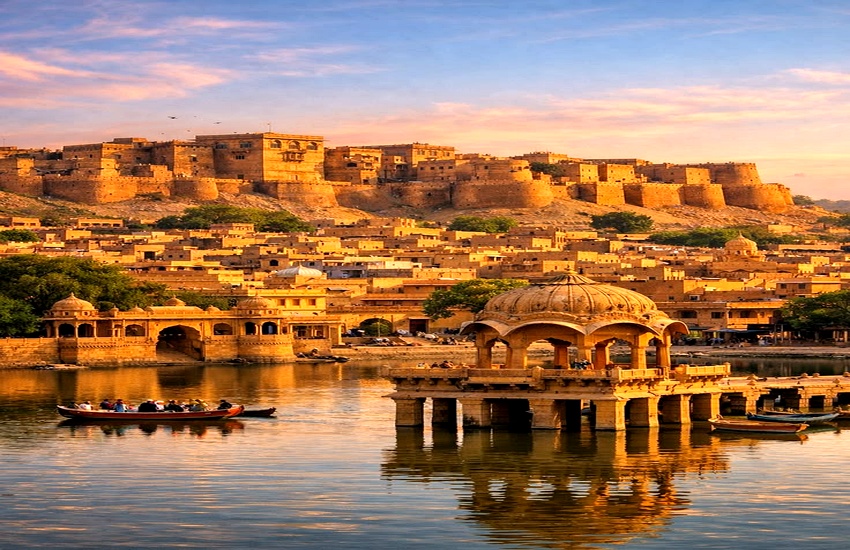
Jaisalmer Fort: A UNESCO Heritage Treasure in the Desert
Most forts in India are empty. You walk through grand gateways, past crumbling palaces and dry courtyards, reading plaques that tell you what used to happen here, and you try to imagine the life that once filled these walls. Jaisalmer Fort asks nothing of your imagination. It is still alive — still breathing, still inhabited, still humming with the sounds of daily life in a way that no other fort in Rajasthan, perhaps in all of India, can claim. Nearly three thousand people live inside its walls today. Families have called it home for generations. Shops sell spices and silver. Children run through medieval lanes. Temples ring with bells in the early morning. And all of this happens inside a fortress that is over 850 years old, rising from the Thar Desert like a sandcastle built by the gods and left standing as proof that some things are simply too beautiful to abandon.
Jaisalmer Fort, Rajasthan: The Golden Fortress That Rises from the Desert Like a Dream
An Introduction — A Fort That Is Still Alive
Most forts in India are empty. You walk through grand gateways, past crumbling palaces and dry courtyards, reading plaques that tell you what used to happen here, and you try to imagine the life that once filled these walls. Jaisalmer Fort asks nothing of your imagination. It is still alive — still breathing, still inhabited, still humming with the sounds of daily life in a way that no other fort in Rajasthan, perhaps in all of India, can claim.
Nearly three thousand people live inside its walls today. Families have called it home for generations. Shops sell spices and silver. Children run through medieval lanes. Temples ring with bells in the early morning. And all of this happens inside a fortress that is over 850 years old, rising from the Thar Desert like a sandcastle built by the gods and left standing as proof that some things are simply too beautiful to abandon.
Jaisalmer Fort — locally and lovingly called Sonar Quila, the Golden Fort — sits on Trikuta Hill in the heart of Jaisalmer city in western Rajasthan. Built from golden yellow sandstone that glows amber in the afternoon sun and turns a deep, burnished gold at sunset, it is one of the largest fully preserved medieval forts in the world and a UNESCO World Heritage Site that earns every word of its reputation.
When the desert light hits those walls in the hour before evening, the fort does not look like a human construction at all. It looks like something the desert itself pushed up from the earth — ancient, organic, and completely inevitable.
History and Interesting Facts
Jaisalmer Fort was founded in 1156 CE by Rawal Jaisal, a Rajput ruler of the Bhati clan, who chose the strategic flat-topped hill of Trikuta as the site for his new capital.
The Bhati Rajputs were warriors and traders, and their fort controlled one of the most important caravan routes of medieval India — the Silk Road trade corridor that connected Central Asia to the subcontinent, carrying silk, spices, gems, and gold across the Thar Desert.
The wealth generated by this trade financed the extraordinary architecture you see within the fort today — the elaborate palaces, the intricately carved Jain temples, the ornate havelis, and the merchant mansions whose stone filigree work is so delicate it seems impossible that human hands carved it from rock.
Over the centuries, Jaisalmer Fort withstood multiple sieges and invasions, including attacks by the Delhi Sultanate and the Mughal Empire. The Bhati Rajputs defended it with fierce determination, and the fort became as much a symbol of Rajput pride and identity as it was a military installation.
The tradition of Jauhar — the practice of self-immolation by Rajput women to avoid capture during military defeats — is said to have been performed within these walls on at least two occasions, lending the fort a weight of history that goes beyond its stone and mortar.
One of the most remarkable facts about Jaisalmer Fort is that it has never been fully abandoned. While most Indian forts became museums or ruins after independence, Sonar Quila remained a living settlement, its population continuing unbroken from medieval times to the present day.
This continuity is what makes it genuinely unique — the streets inside the fort are not a recreation or a restoration. They are the actual streets where people have walked for nine centuries, worn smooth by millions of footsteps across hundreds of generations.
The fort encompasses a perimeter of nearly one and a half kilometres, has 99 bastions along its walls — 92 of which were built between 1633 and 1647 — and rises approximately 76 metres above the surrounding plain.
It is not just big. It is the kind of big that takes your breath away when you see it for the first time from the road approaching the city, shimmering in the desert heat like a mirage that refuses to disappear.
What to Do at Jaisalmer Fort
The single most important thing you can do at Jaisalmer Fort is simply walk — slowly, without a fixed agenda, allowing the medieval lanes to lead you where they will.
The fort has four main gateways — Ganesh Pol, Akha Pol, Suraj Pol, and Hawa Pol — and entering through any of them deposits you into a world that operates at a pace and on a scale that feels entirely removed from the twenty-first century.
The main square, Dussehra Chowk, is the beating heart of the fort — a wide open courtyard flanked by the Royal Palace on one side and surrounded by shops, tea stalls, and local residents going about their day.
Sit here for an hour with a cup of chai and watch the fort live around you. It is one of the finest pieces of free entertainment that Rajasthan offers.
Royal Palace — Raj Mahal
The Royal Palace — Raj Mahal — is an essential stop and offers one of the most spectacular views in all of Rajasthan from its upper terraces.
The palace was built and added to by successive Bhati rulers over many centuries, and the result is a layered, organic structure of extraordinary architectural complexity.
Carved balconies, latticed windows, painted chambers, and narrow staircases connect different eras of construction in a way that feels like walking through time rather than through a building.
The museum within the palace gives context to the fort's history and the lives of the rulers who shaped it.
Jain Temples
The Jain Temples inside the fort are perhaps the most breathtaking architectural achievement in Jaisalmer and consistently astonish visitors who expect the palaces to be the main attraction.
There are seven interconnected temples built between the twelfth and fifteenth centuries, dedicated to various Jain tirthankaras, and the level of stone carving within them is almost incomprehensibly fine.
Ceilings of solid sandstone are carved into flowers and geometric patterns of such intricacy that they appear to have been made from lace rather than rock.
Columns are wrapped in layers of figurative carving — celestial musicians, dancers, elephants, and deities — rendered with a liveliness and detail that makes you want to stand in front of each one for far longer than any tour schedule allows.
The temples are still active places of worship and are among the finest examples of Jain temple architecture anywhere in India.
Sunset Views and Residential Lanes
Walking the fort's outer walls at sunset is an experience that justifies an entire journey to Jaisalmer by itself.
As the sun drops toward the Thar Desert horizon and the golden sandstone walls begin to glow with an internal warmth that seems to come from within the stone rather than from the sky above, the fort transforms into something that looks less like architecture and more like a natural phenomenon.
The view from the bastions — over the desert city below, the sand dunes shimmering in the far distance, and the vast open sky turning amber and rose — is the kind of view that stays in your memory for the rest of your life.
The narrow lanes of the residential quarters inside the fort are another world entirely.
Here, away from the main tourist trail, cats sleep in doorways, old men sit on stone steps in the afternoon sun, women carry water and children call to each other from window to window across streets so narrow that two people walking side by side barely fit.
These streets smell of woodsmoke and spices and the particular warm dustiness of old sandstone, and wandering through them without a map or a plan is one of the most humanly rich experiences that any heritage destination in India can offer.
Local Culture and Cuisine — Tasting Rajasthan in the Desert
The culture of Jaisalmer is the culture of the desert — shaped by scarcity, defined by resilience, and made beautiful by a human refusal to let harsh conditions flatten the joy of living.
The Rajasthani folk traditions of music, dance, and craft are alive in Jaisalmer in a way that feels genuine rather than performed for tourist consumption.
In the evenings near the fort and in the old city below, you will often hear the haunting strings of a Rajasthani sarangi or the deep percussion of a dhol drifting from a rooftop restaurant or an open courtyard.
Kalbeliya dancers, whose serpentine movements and black skirts are recognised worldwide, still perform in Jaisalmer with the kind of unselfconscious skill that comes from generations of practice rather than years of tourism training.
Must-Try Dishes
- Dal Baati Churma
- Ker Sangri
- Laal Maas
- Pyaaz Kachori
- Lassi
- Mirchi Bada
- Masala Chai brewed with camel milk
- Ghevar
- Mawa Kachori
Best Time to Visit
The best time to visit Jaisalmer Fort and the city of Jaisalmer is from October to March.
The desert winters are mild and pleasant during the day — temperatures typically range between twelve and twenty-five degrees Celsius — and the evenings are cool and clear, perfect for rooftop dinners under an open sky full of desert stars.
The famous Jaisalmer Desert Festival, usually held in February, brings the city to life with folk performances, camel races, turban-tying competitions, and an atmosphere of celebration that draws visitors from across the world.
How to Reach Jaisalmer Fort
By Air
The nearest airport is Jaisalmer Airport, which has seen improved connectivity in recent years with flights from Delhi, Mumbai, and Jaipur operated by IndiGo and Air India.
By Rail
Jaisalmer Railway Station is the most popular and romantic way to arrive — and the overnight train from Jaipur or Jodhpur is a genuinely wonderful experience.
By Road
By road, Jaisalmer is 575 kilometres from Jaipur and approximately 285 kilometres from Jodhpur.
Travel Tips
- Carry sufficient cash.
- Drink plenty of water throughout the day.
- Wear light, breathable clothing in layers.
- Bargain respectfully at the markets around the fort.
- Be cautious of touts near the fort entrance.
- Visit the Jain Temples in the morning.
- Spend at least one evening watching the sunset from the fort.
Nearby Places to Explore
- Sam Sand Dunes
- Khuri Sand Dunes
- Patwon Ki Haveli
- Salim Singh Ki Haveli
- Nathmal Ki Haveli
- Gadisar Lake
- Kuldhara
Why You Should Visit Jaisalmer Fort
Jaisalmer Fort is not just one of the finest heritage sites in India — it is one of the finest heritage sites in the world, and it offers something that almost no other ancient monument on earth can claim: the experience of a living medieval city.
When you walk through its gates, you are not entering a museum. You are entering a place where life has continued unbroken for nine centuries, where the stones beneath your feet have been worn smooth by generations of human movement, where the temples are still lit with oil lamps and the lanes still smell of cooking fires and the calls of children.
The fort will give you history and architecture and beauty and food and craft and culture and stories.
But what it will give you most powerfully, if you walk slowly and pay attention and let the place work on you at its own pace, is a sense of the extraordinary continuity of human life.
Come to Jaisalmer Fort once and you will spend years thinking about going back. That is the nature of the golden fortress. It does not let you go easily, and it is not supposed to.