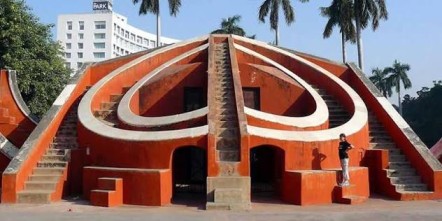
Jantar-Mantar : The Ancient Science Of Time & Stars
There are monuments built to house kings, monuments built to honour gods, and then there is Jantar Mantar — built to measure the universe itself. Located in the heart of Jaipur, Rajasthan, the Jantar Mantar is one of the most extraordinary scientific complexes ever constructed, a collection of massive stone and marble astronomical instruments that could track celestial movements, predict eclipses, calculate time, and determine the positions of stars with a precision that astonished European scientists when they first encountered it. A UNESCO World Heritage Site since 2010, Jantar Mantar is not a palace, not a temple, and not a fort — it is an observatory, and arguably the finest pre-telescopic astronomical observatory ever built anywhere in the world.
🔭 Jantar Mantar: Where Architecture Becomes Astronomy
There are monuments built to house kings, monuments built to honour gods, and then there is Jantar Mantar — built to measure the universe itself. Located in the heart of Jaipur, Rajasthan, the Jantar Mantar is one of the most extraordinary scientific complexes ever constructed, a collection of massive stone and marble astronomical instruments that could track celestial movements, predict eclipses, calculate time, and determine the positions of stars with a precision that astonished European scientists when they first encountered it. A UNESCO World Heritage Site since 2010, Jantar Mantar is not a palace, not a temple, and not a fort — it is an observatory, and arguably the finest pre-telescopic astronomical observatory ever built anywhere in the world.
📍 Location and First Impressions: Science in the Open Air
The Jaipur Jantar Mantar sits adjacent to the City Palace in the old walled city, easily accessible and yet somehow unexpected — a landscape of giant geometric forms rising from the ground like sculptures designed by a mathematician with a poet's sense of drama. Triangular ramps soar at precise angles toward the sky. Circular dials are embedded in the earth. Enormous arcs of marble curve upward, their surfaces marked with calibrations so fine they can register fractions of a second. To walk among these instruments without knowing what they are is to experience a genuinely surreal landscape. To understand what they do is to experience something close to wonder.
Jantar Mantar means, roughly, "calculating instrument" — derived from the Sanskrit yantra mantra, meaning instrument of calculation or formula. The name is functional rather than poetic, which is entirely appropriate for a place where function was elevated to an art form.
👑 History and Origins: The Vision of Sawai Jai Singh II
The Jantar Mantar was built under the extraordinary patronage of Maharaja Sawai Jai Singh II of Jaipur, one of the most remarkable ruler-scholars in Indian history. Born in 1688, Jai Singh II was not merely a political leader — he was a deeply learned astronomer, mathematician, and urban planner who founded Jaipur itself in 1727, designing it on a grid plan that remains one of the most sophisticated examples of pre-modern urban planning in South Asia.
Jai Singh II was deeply concerned about the accuracy of the astronomical tables then in use for calculating religious calendars, astrological charts, and navigational data. Both Indian and Islamic astronomical traditions had accumulated significant errors over centuries of hand-copying and imprecise instrumentation. He determined to correct these errors through direct, systematic observation — and to do that, he needed instruments of unprecedented scale and precision.
Between approximately 1724 and 1735, Jai Singh II constructed five Jantar Mantar observatories across northern India — at Jaipur, Delhi, Varanasi, Ujjain, and Mathura. The Jaipur observatory is the largest, the best preserved, and the most comprehensive of the five. The Delhi Jantar Mantar, built slightly earlier in 1724, is also well preserved, but Jaipur's is the one that fully realises Jai Singh's astronomical ambitions.
Before building these observatories, Jai Singh II studied European astronomical methods, corresponded with Jesuit scholars in Goa and Portugal, and carefully studied the work of Ulugh Beg, the 15th-century Timurid astronomer-king of Samarkand whose observatory had set a standard Jai Singh II was determined to surpass. He sent ambassadors to European courts to collect the latest scientific texts, and he mastered both Sanskrit and Arabic astronomical traditions. The result was an observatory that synthesised the best of multiple scientific traditions into something entirely original.
🛰️ The Instruments: Giants Built for Precision
⏳ Samrat Yantra
The centrepiece of the complex is the Samrat Yantra — the Supreme Instrument — a massive right-angled triangular gnomon whose hypotenuse points precisely toward the North Pole, parallel to Earth's axis of rotation. Standing nearly 27 metres tall, its shadow moves across two large quadrant arcs, allowing the local time to be read to an accuracy of two seconds.
🌌 Jai Prakash Yantra
Two hemispherical bowls sunk into the ground and lined with precise calibrations, the Jai Prakash Yantra was Jai Singh's own invention — a concave marble hemisphere that acts as a map of the inverted sky.
♈ Rashivalaya Yantra
A collection of twelve instruments, each corresponding to one of the twelve signs of the zodiac, the Rashivalaya Yantra allowed astronomers to measure the celestial latitude and longitude of stars.
🧭 Ram Yantra & Digamsha Yantra
The Ram Yantra consists of two large cylindrical structures open to the sky, while the Digamsha Yantra is used to calculate the azimuth of celestial objects and determine sunrise and sunset timings.
🎨 Artistic and Architectural Character: Beauty as a Byproduct of Function
What strikes many visitors about Jantar Mantar is that its instruments are not merely functional — they are beautiful. The clean geometric forms, the smooth curves of marble against the sky, the interplay of shadow and light across calibrated surfaces — all of it produces an aesthetic experience that feels surprisingly contemporary. Several modern architects and artists, including Le Corbusier (who designed the nearby city of Chandigarh), have cited Jantar Mantar as an influence and visited the complex specifically for inspiration.
The construction uses lime plaster, local stone, marble, and brick, chosen for their dimensional stability across temperature changes — an important practical consideration for instruments that must remain accurate through Rajasthan's extreme seasonal variations. The instruments were periodically recalibrated and maintained throughout Jai Singh's reign, reflecting an ongoing commitment to scientific accuracy rather than mere monumental display.
✨ Unique Facts and Fascinating Details
Jantar Mantar produced a revised set of astronomical tables — the Zij Muhammad Shahi — that Jai Singh II dedicated to the Mughal Emperor Muhammad Shah. These tables corrected significant errors in existing calendrical calculations and were used for decades in religious and navigational contexts across the subcontinent.
European astronomers who visited or learned of the observatory in the 18th century were reportedly surprised and impressed that an Indian ruler had built instruments of such sophistication and scale — a reaction that said as much about European assumptions as it did about Jai Singh's achievement.
The Jaipur Jantar Mantar is also unusual among ancient scientific sites in that its instruments are still functional. The Samrat Yantra still tells accurate local time, and during the summer solstice, large crowds gather to watch its shadow reach its northernmost point — an annual event that connects modern visitors directly to the observations Jai Singh's astronomers were making nearly three centuries ago.
🚶 Visitor Experience: Contemplative, Curious, and Rewarding
Jantar Mantar is open daily from sunrise to sunset, and the experience it offers is genuinely unlike any other heritage site in India. It rewards slow, curious visitors — those willing to read the explanatory panels, engage with a guide, and stand quietly beside an instrument trying to understand what it measures and how. Those who rush through miss the point entirely.
The complex is compact enough to explore thoroughly in two to three hours, and the nearby City Palace and Hawa Mahal make for a natural full-day heritage circuit within Jaipur's old city. The atmosphere inside is relatively calm compared to the bustle of the surrounding streets — the scale of the instruments creates a sense of seriousness and purpose that visitors seem to absorb instinctively.
The best time to visit is between October and March, when the sky is clear and the weather pleasant. Sunrise visits are particularly atmospheric, and the Samrat Yantra is at its most impressive on days when the sun is strong enough to cast a sharp, readable shadow across the quadrant arcs.
🌍 Heritage Tourism and Enduring Significance
Jantar Mantar attracts a remarkably diverse audience — astronomy enthusiasts, architecture students, historians, school groups, and international tourists who place it firmly among Jaipur's essential experiences. Its UNESCO designation has raised its international profile considerably, and it increasingly features on the itineraries of scientifically and culturally curious travellers who might previously have limited their Jaipur visit to the Amber Fort and the City Palace.
What makes Jantar Mantar truly irreplaceable is the idea it embodies: that the pursuit of knowledge is itself a form of greatness. Jai Singh II did not build these instruments to glorify himself or to intimidate his neighbours. He built them because he wanted to understand the sky more accurately than anyone had before. In an era of royal patronage mostly directed toward palaces and tombs, that impulse was genuinely radical — and the instruments it produced remain, nearly three centuries later, among the most compelling achievements in the history of science.
To stand inside Jantar Mantar and look up at the soaring triangle of the Samrat Yantra against a blue Rajasthan sky is to understand that curiosity, given enough stone and enough skill, can become architecture.