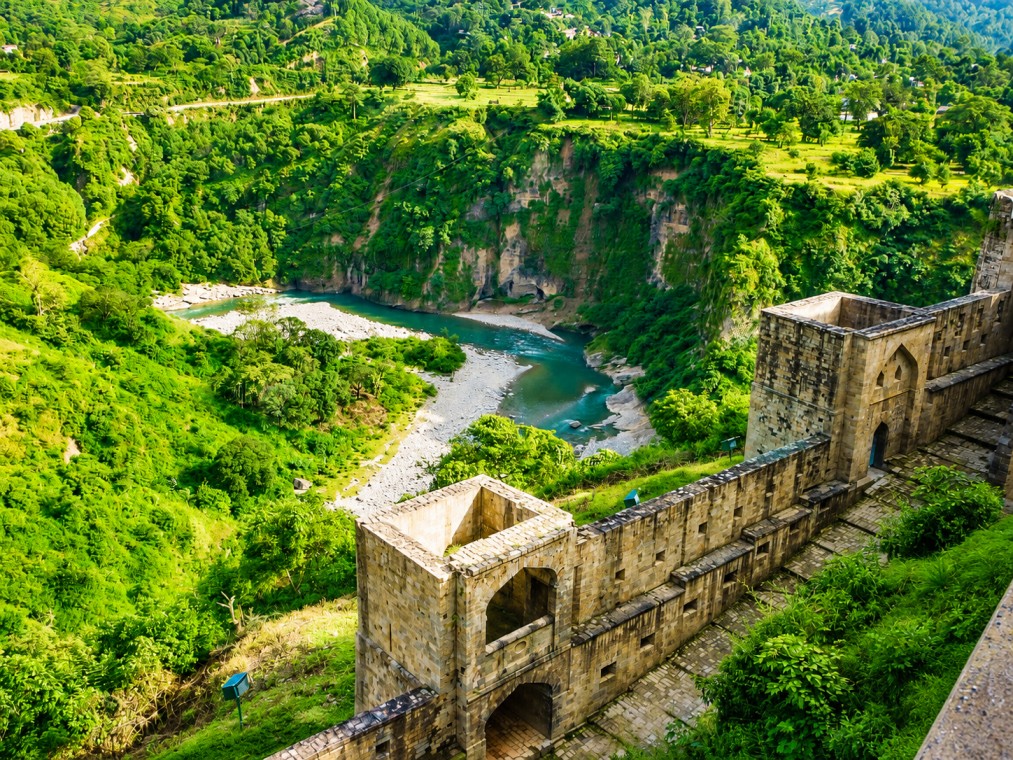
Kangra Fort : A Timeless Himalayan Legacy
Perched on a rocky cliff where the Manjhi and Banganga rivers converge, deep in the folds of the Dhauladhar mountain range, Kangra Fort is not just a monument — it is a living record of over three thousand years of human ambition, conflict, and devotion. Known locally as Nagarkot or Kot Kangra, this formidable fortress in Himachal Pradesh's Kangra district holds the distinction of being the largest fort in the Indian Himalayas and one of the oldest continuously referenced forts in all of India. For anyone who travels with curiosity rather than just a checklist, Kangra Fort is an experience that lingers long after the mountain air has faded.
🏔️ Kangra Fort: The Himalayan Sentinel That Has Outlasted Empires
Perched on a rocky cliff where the Manjhi and Banganga rivers converge, deep in the folds of the Dhauladhar mountain range, Kangra Fort is not just a monument — it is a living record of over three thousand years of human ambition, conflict, and devotion. Known locally as Nagarkot or Kot Kangra, this formidable fortress in Himachal Pradesh's Kangra district holds the distinction of being the largest fort in the Indian Himalayas and one of the oldest continuously referenced forts in all of India. For anyone who travels with curiosity rather than just a checklist, Kangra Fort is an experience that lingers long after the mountain air has faded.
📍 Location and First Impressions
Situated about 20 kilometres from Dharamshala, Kangra Fort rises above the valley with an authority that makes the surrounding modern world feel temporary by comparison. The fort spreads across a staggering 463 acres of rugged terrain, its massive black stone walls hugging the hillside in layers. Below, the rivers glint in the light. Behind, the snow-dusted peaks of the Dhauladhar range stand as an ever-present backdrop.
The moment you approach the outer gates, the scale of the structure stops you. This is not a fort built for ceremony — it was built for survival, and every wall and rampart communicates that intent.
👑 Origins Lost in Legend: The Katoch Dynasty
The history of Kangra Fort is inseparable from the Katoch dynasty, one of the oldest documented royal lineages in the world. According to legend, the clan traces its origin to Bhumi Chand, who was born from a drop of sweat that fell from the goddess Ambika during her battle with the demon Raktbeej. The goddess, pleased with Bhumi Chand's help, gifted him the kingdom of Trigarta — the land of the three rivers — and thus the Katoch story began.
More historically, the fort is attributed to Raja Susharma Chandra, a king who fought alongside the Kauravas in the Mahabharata. After the war's conclusion, he is said to have retreated to the confluence of two rivers and established what would become Kangra Fort.
The fort's ancient name, Nagarkot, appears in early records, and a popular Pahari saying encapsulates its strategic value across centuries: "He who holds Kangra Fort, holds the hills."
The name Kangra itself is believed to derive from Karna Garh — a fort built upon the ear (karna) of the demon Jalandhar, who according to mythology was slain by Lord Shiva on this very ground. Over generations, Karna Garh softened into Kan Garh and finally Kangra.
⚔️ A Fortress That Invited the World's Conquerors
Few forts in India have been attacked as relentlessly — or held as stubbornly — as Kangra.
The earliest recorded invasion dates to 1009 AD, when Mahmud of Ghazni plundered its treasury, which was reportedly so vast it required 1,400 camels to carry the loot. The Tughlaq kings of Delhi tried and failed to hold it. Even Emperor Akbar, at the height of Mughal power, found the fort unyielding — though his successor Jahangir finally captured it in 1620, killed the Katoch king Raja Hari Chand, and annexed the kingdom into the Mughal Empire.
The Mughals held the fort until the late 18th century, when Raja Sansar Chand II — arguably the most celebrated Katoch ruler — reclaimed it in 1786 with Sikh support. Under Sansar Chand's reign, Kangra blossomed into a celebrated centre of Pahari painting, a miniature art school that attracted artists from across northern India and is now recognised as one of the great traditions of Indian visual culture.
His later years brought conflict with the Gurkhas, who besieged the fort for years. Sansar Chand allied with Maharaja Ranjit Singh, who repelled the Gurkhas but claimed the fort as his price in 1809. After Ranjit Singh's death, the British took control following the First Anglo-Sikh War in 1846.
Then, on 4 April 1905, a catastrophic earthquake measuring 7.8 on the Richter scale struck the Kangra Valley, destroying much of what centuries of warfare had failed to bring down. The British subsequently vacated the fort, and what remains today are magnificently haunting ruins.
🏛️ Architecture: Layers Written in Stone
Kangra Fort is a remarkable study in layered architecture, where each conquering power left its own mark without fully erasing what came before. The result is a complex that blends ancient Hindu engineering, Mughal additions, Sikh gateways, and the raw geology of the Himalayan foothills.
🚪 The Gates
The fort is approached through a series of eleven gates, each named for the ruler or era that built it. The outermost entry — the Ranjit Singh Darwaza — was constructed during the Sikh period. Moving inward, visitors pass through the Ahani and Amiri Darwazas, named for Nawab Saif Ali Khan, the first Mughal governor of Kangra. Further along the steep, narrow passage is the imposing Jehangiri Darwaza, built to commemorate Jahangir's conquest, and the inner Darsani Darwaza, whose flanking figures of the river goddesses Ganga and Yamuna — now worn by time — once welcomed pilgrims into the sacred courtyard.
🛕 The Temples
Within the fortified walls stand several ancient temples that remind visitors that Kangra was as much a spiritual centre as a military one. The shrines of Laxmi Narayan and Ambika Devi are notable examples of Nagara-style temple architecture, while a Svetambara Jain temple housing a large idol of Rishabhanatha speaks to Kangra's former significance as a centre of Jainism. The Ambika Devi temple holds special importance — the goddess has been worshipped here for centuries as the clan deity of the Katoch kings.
🛡️ The Bastions and Defences
The fort boasts 23 bastions and a rock-cut moat that connects the Banganga and Manjhi rivers, making natural water barriers part of its defensive design. Inside, 21 treasure wells — each about four metres deep — were once used to store gold and valuables. The battlements are built in descending layers along the hillside, creating overlapping fields of defence that made frontal assault nearly impossible.
🌎 The 1905 Earthquake and What Remains
The earthquake of 1905 was the fort's most devastating blow — more destructive than any of the fifty-plus military sieges it had weathered. Entire sections of wall collapsed, temples cracked, and the towns of Kangra, Dharamshala, and McLeod Ganj were severely damaged. The British, who had used the fort as a garrison, abandoned it shortly after.
What survives today — managed by the Archaeological Survey of India — is both ruined and beautiful. Broken arches frame mountain views. Cracked temple walls still hold carved reliefs. The earthquake did not erase Kangra Fort; it transformed it into something more honest — a monument to impermanence that refuses to disappear entirely.
🥾 Visitor Experience: Time, Terrain, and Views
Visiting Kangra Fort is a physically engaging experience. The path from the entrance to the upper courtyard involves a long, steep climb through narrow passages and sharp turns — comfortable footwear is not optional. But every switchback rewards you with a new perspective: a gate framing a mountain, a temple emerging from foliage, or a sudden panoramic view of the valley that seems almost theatrical in its beauty.
The fort museum near the entrance provides archaeological context, with artefacts and inscriptions that help visitors understand the site's long chronology. An audio guide app is available at the entrance in both English and Hindi.
📅 Best Time to Visit
The best time to visit Kangra Fort is from October to March, when the weather is cool and the Dhauladhar range is often blanketed in snow, making the views particularly dramatic. Early morning visits reward photographers with soft golden light and fewer crowds.
⏰ Timings & Access
Timings: 9:00 AM to 6:00 PM, open all days of the week. Getting there: Approximately 20 km from Dharamshala by road. The nearest airport is Gaggal (about 13 km away) and the nearest major railway station is Pathankot (about 87 km away).
✨ Why Kangra Fort Deserves a Place on Every Traveller's List
In a country overflowing with historic monuments, Kangra Fort stands apart for the sheer breadth of its story. It connects Vedic legend and Mahabharata myth to Mughal politics, Sikh empire-building, British colonialism, and the slow reclamation of ruins by the natural world.
It is a site where a Jain temple, a Hindu shrine, and a Mughal-era mosque coexist within the same walled space — a quiet testament to the layered religious history of northern India.
For heritage tourists seeking something beyond the polished grandeur of Rajasthan's forts, Kangra offers raw, unvarnished history set against one of India's most spectacular mountain landscapes. For trekkers passing through Dharamshala or McLeod Ganj, it makes a deeply worthwhile half-day excursion. And for anyone with an interest in Indian painting, Pahari miniatures — born in this valley during Sansar Chand's reign — provide another reason to make the journey.
Kangra Fort does not dazzle in the way that restored, well-lit monuments can. Instead, it earns its wonder honestly — through scale, age, landscape, and the weight of everything it has survived.