Kanheri Caves : A Journey Through 2,000 Years of History
Right in the middle of one of the world's most populated cities, time has somehow stood still. Buried within the green expanse of Sanjay Gandhi National Park in Borivali, Mumbai, the Kanheri Caves are a staggering reminder that long before Mumbai was a megacity, this forested hill was home to one of ancient India's most significant centres of Buddhist learning, art, and monastic life. Dating back to the 1st century BCE, these caves served as an important centre for Buddhist learning, meditation, and worship, comprising over 100 caves carved out of basalt rock and showcasing remarkable architectural and artistic achievements of ancient India . Few heritage sites in the country offer this particular contrast — the hum of a modern metropolis at your back, and ahead, the cool silence of rock-cut chambers that have endured for over two thousand years.
🏞️ Kanheri Caves, Mumbai: India's Ancient Buddhist University in the Heart of a Forest
Right in the middle of one of the world's most populated cities, time has somehow stood still. Buried within the green expanse of Sanjay Gandhi National Park in Borivali, Mumbai, the Kanheri Caves are a staggering reminder that long before Mumbai was a megacity, this forested hill was home to one of ancient India's most significant centres of Buddhist learning, art, and monastic life.
Dating back to the 1st century BCE, these caves served as an important centre for Buddhist learning, meditation, and worship, comprising over 100 caves carved out of basalt rock and showcasing remarkable architectural and artistic achievements of ancient India.
Few heritage sites in the country offer this particular contrast — the hum of a modern metropolis at your back, and ahead, the cool silence of rock-cut chambers that have endured for over two thousand years.
📜 The Name and Its Origins
The Kanheri Caves derive the origin of their name from the Sanskrit word Krishnagiri, which means "black mountain." The name is a direct reference to the dark basaltic rock from which every single cave in the complex was carved. The site has been known by a number of names through the ages, including Krishnagiri, Kanhagiri, and Kanhasela. Over centuries, the Sanskrit "Krishnagiri" softened into the Marathi "Kanheri" — and the name stuck.
⏳ A History That Spans a Millennium
The Kanheri Caves were carved into the basalt rock between the 1st century BCE and the 10th century CE, and were originally known as Krishnagiri — an important Buddhist centre for millennia. What makes this site exceptional is precisely that thousand-year span of continuous use.
These were not caves built in one era and then abandoned; they grew, expanded, and evolved as successive generations of monks and dynasties added to them.
The earliest records of the Kanheri Caves can be traced back to the reign of Emperor Ashoka, the Mauryan ruler who embraced Buddhism and propagated its teachings. It is believed that the caves were initially excavated during this period as a retreat for Buddhist monks.
🏛️ Architecture: Function, Faith, and Ingenuity
🪨 Engineering Achievement
A total of 109 caves were carved from the dense basalt stone of the hillside, making the Kanheri site feature the largest number of caves carved into a single hill.
Since the 109 caves were constructed across a period spanning a thousand years, the caves are vastly different in shape, size, and level of sophistication.
Most of the caves were Buddhist viharas, meant for living, studying, and meditating.
Cave 3 is the undisputed centrepiece. It features a beautiful chaitya-griha, a stupa, and a courtyard coupled with a statue of the Buddha at the entrance.
🎨 Art, Sculpture, and Inscriptions
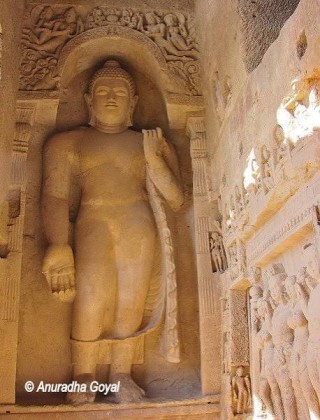
The walls of Kanheri speak. The walls of many of the Kanheri Caves are sculpted with huge images and statues, including one of a standing Buddha and another image of a Bodhisattva, carved somewhere around the 5th to 6th centuries CE.
Nearly 51 legible inscriptions and 26 epigraphs are found at Kanheri, which include inscriptions in Brahmi, Devanagari, and 3 Pahlavi epigraphs found in Cave 90.
📚 Kanheri as a Centre of Learning
It would be a mistake to think of Kanheri only as a place of worship. During the reign of the Kushana and Maurya dynasties, the Kanheri Caves were also a functioning university.
Monks travelled from distant parts of Asia to study here, drawn by the reputation of Krishnagiri as a place of serious scholarship.
🚶 The Visitor Experience
🌳 Forest Setting
Sanjay Gandhi National Park
🥾 Exploration
Trekking & Cave Discovery
⏰ Duration
2–3 Hours Minimum
🌦️ Best Season
November to February
Reaching the Kanheri Caves is part of the experience. The route passes through the dense, leopard-inhabited forests of Sanjay Gandhi National Park.
The best time to visit Kanheri Caves is during the winter months, from November to February, when the weather is cool and pleasant, making exploration comfortable.
🌏 Why Kanheri Matters for Heritage Tourism
The Kanheri Caves hold a unique position in India's tourism landscape. Unlike Ajanta or Ellora, which require dedicated travel, Kanheri sits within a major city — making it accessible to millions of visitors without the need for extended planning.
In 2019, the Kanheri Caves, along with the surrounding Sanjay Gandhi National Park, received the prestigious designation of a UNESCO World Heritage Site, highlighting their global significance and the need for their conservation.
📍 Getting There
The caves are located inside Sanjay Gandhi National Park in Borivali East, about 20 km north of central Mumbai.
The nearest railway station is Borivali on the Western Railway line, from where BEST buses and auto-rickshaws connect to the park's main gate.
The nearest international airport is Chhatrapati Shivaji Maharaj International Airport, approximately 15–22 km away.
✨ Final Reflection
🏞️ Kanheri Legacy
Two thousand years of faith, scholarship, and artistry — all carved into a single black mountain in the middle of a modern forest. That is Kanheri. Come with comfortable shoes, a little curiosity, and plenty of time.