Karla Caves: A 2,000-Year-Old Architectural Masterpiece
Tucked into the rugged Sahyadri hills of Maharashtra, roughly 110 kilometres from Mumbai and just 11 kilometres from the busy town of Lonavala, the Karla Caves stand as one of the finest surviving examples of early Buddhist rock-cut architecture in the world. Carved patiently into basalt cliffs over many centuries, these ancient sanctuaries have witnessed the rise and fall of empires, the quiet devotion of monks, and the admiration of countless pilgrims and travellers across two millennia. For anyone drawn to India's deep heritage, Karla — also spelled Karli or Karle — is not merely a tourist site. It is an open window into an ancient civilisation's spiritual imagination and architectural mastery.
🏛️ Karla Caves: A Living Monument to Ancient India's Rock-Cut Genius
⛰️ One of the finest surviving examples of early Buddhist rock-cut architecture in the world.
📍 Location
Tucked into the rugged Sahyadri hills of Maharashtra, roughly 110 kilometres from Mumbai and just 11 kilometres from the busy town of Lonavala.
🏛️ Heritage
One of the finest surviving examples of early Buddhist rock-cut architecture in the world.
⏳ Timeline
The caves date primarily to the period between the 2nd century BCE and the 5th century CE.
Karla Caves: A Living Monument to Ancient India's Rock-Cut Genius
Tucked into the rugged Sahyadri hills of Maharashtra, roughly 110 kilometres from Mumbai and just 11 kilometres from the busy town of Lonavala, the Karla Caves stand as one of the finest surviving examples of early Buddhist rock-cut architecture in the world. Carved patiently into basalt cliffs over many centuries, these ancient sanctuaries have witnessed the rise and fall of empires, the quiet devotion of monks, and the admiration of countless pilgrims and travellers across two millennia. For anyone drawn to India's deep heritage, Karla — also spelled Karli or Karle — is not merely a tourist site. It is an open window into an ancient civilisation's spiritual imagination and architectural mastery.
📜 Historical Background: Centuries in the Making
The caves date primarily to the period between the 2nd century BCE and the 5th century CE, placing them squarely within the golden age of Indian rock-cut cave construction.
The earliest excavations are believed to have begun under the patronage of powerful merchant guilds, local chieftains, and Satavahana rulers — a dynasty that dominated the Deccan plateau for several centuries and were among the most significant early patrons of Buddhist art and architecture in peninsular India.
Inscriptions found at the site, written in the ancient Brahmi script, confirm donations made by traders, government officials, and even ordinary citizens. This is remarkable — it tells us that the construction of Karla's caves was not purely a royal project but a community endeavour supported by people from varied walks of life. The Western Kshatrapas and later Ikshvaku rulers also played roles in the site's patronage during its long period of active use.
Over centuries, the site gradually transitioned from active Buddhist use. By the medieval period, a small Hindu shrine dedicated to the goddess Ekvira was established near the cave entrance, and today the temple remains a living place of worship, drawing enormous crowds during the Navratri festival. This layered coexistence of Buddhist and Hindu traditions in one location is one of the things that makes Karla genuinely unique among India's heritage sites.
🏗️ Architectural Style: The Chaitya Hall That Defied Time
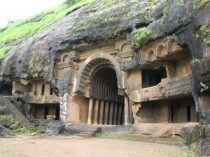
At the heart of the Karla complex is its magnificent chaitya griha — a prayer hall — widely regarded as the largest and best-preserved rock-cut chaitya hall from the ancient period anywhere in India.
The facade stretches over 14 metres in height and is adorned with a large horseshoe-shaped window called the chaitya arch or gavaksha, which was designed not merely for decoration but to channel natural light deep into the interior.
Step inside, and the scale takes you by surprise. The hall stretches approximately 37 metres in length and 14 metres in width, its nave lined with rows of octagonal pillars carved from solid rock.
At the far end of the hall sits the stupa, the domed stone reliquary that served as the focal point of worship and circumambulation for Buddhist monks and lay devotees alike.
Outside, a tall sculpted pillar — an ancient stone column topped with lions — stands at the entrance, echoing the Ashokan pillars found at other major Buddhist sites across the subcontinent.
🎨 Art and Iconography: Stone Brought to Life
The sculptural programme at Karla is not decorative in any superficial sense. Every carved figure, every frieze, every embellishment carries meaning rooted in Buddhist cosmology and social reality.
The mithuna couples — embracing male and female figures carved on the pillar capitals and the outer facade — are thought to represent prosperity, auspiciousness, and the lay life that supported the monastic community.
The facade panels depict rows of elephants, royal figures, and devotees arranged in careful hierarchies.
📖 Legends and Lore: Stories That Live in Stone
Local tradition holds that the goddess Ekvira, whose temple stands beside the caves, is a protector of the fishing communities of the Koli people of Maharashtra.
Devotees walk up the 200-plus stone steps to the hilltop to offer prayers, and during Navratri the entire hillside transforms into a festival, with tens of thousands of worshippers making the climb.
There is also the curious fact that the massive wooden torana beam above the chaitya arch, possibly dating back nearly 2,000 years, is believed to be original teak — making it one of the oldest surviving examples of wood construction in India.
🚶 The Visitor Experience: What to Expect
Arriving at Karla, the first thing that strikes most visitors is the approach.
The hillside path, lined with small stalls selling marigold garlands, coconut offerings, and colourful trinkets, blends seamlessly into the forested landscape.
The interiors are cool even in summer, dimly lit by filtered sunlight from the great chaitya window.
The compound includes a small cluster of viharas — monks' dwelling cells — carved into the hillside beside the main chaitya, offering further insight into how the monastic community organised daily life.
Best Time to Visit: October through March is ideal, when the Sahyadri hills are green from recent monsoon rains and temperatures are comfortable.
🌏 Why Karla Caves Matter for Heritage Tourism
Karla is a UNESCO-listed tentative heritage site and an Archaeological Survey of India (ASI) protected monument.
It forms part of a broader cluster of Buddhist cave sites in Maharashtra that includes Bhaja, Bedse, and the famous Ajanta and Ellora caves further east.
For domestic travellers, Karla offers an accessible weekend getaway from both Pune (about 50 km) and Mumbai, with regular road and rail connections via Lonavala.
The site appeals equally to history scholars, architecture enthusiasts, spiritual seekers, and casual explorers looking for a meaningful break from urban life.
What keeps Karla alive as a heritage destination is not just the age of its stones but the way the site continues to breathe — with festival crowds, morning prayers, and the occasional scholar carefully copying an ancient inscription. It is history that has never entirely become the past.